2018 May

Submitted by Livia Edegger

Strengthening Families Programme, a family-focused prevention programme used in 26 countries around the world, was found to be nine times more effective than individually-targeted programmes and yielded a $10 return for every dollar spent on it. The programme, designed for youth and their families, aims to improve parent-child interactions, parenting skills and strengthen young people’s social and problem-solving skills.

Submitted by Livia Edegger 

As support for decriminalising and legalising marijuana is growing, several new studies highlight the potentially harmful effects of the drug on its user’s brain and heart. The findings are particularly revealing in the field of recreational cannabis use. While studying the brains of a group of twenty occasional cannabis smokers, researchers from Harvard University found that as few as one or two uses a week can change the brain. Smoking marijuana was found to primarily affect the areas involved in decision making, emotions and motivations. Along the same lines, a group of French researchers found that marijuana use ups the risk of developing heart problems (i.e. strokes, heart attacks and circulation problems). More research is needed to better understand the health risks associated with marijuana.

Links:

Source:

http://preventionhub.org/en/prevention-update/even-casual-cannabis-use-can-affect-health

Submitted by Andy Travis 

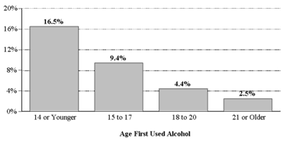
Those who first used alcohol at or before the age of 14 were nearly four times more likely to meet the criteria for past year alcohol abuse or dependence than those who started using alcohol between the ages of 18 and 20 (16.5% vs. 4.4%) and more than six times more likely than those who started using alcohol at or after age 21 (16.5% vs. 2.5%).

These findings illustrate the need for alcohol education and prevention efforts as early as middle school.

Percentage of Adults (Ages 21 or Older) Who Abused or Were Dependent on Alcohol in the Past Year, by Age of First Alcohol Use, 2009.


Similarly, adults who first started using marijuana at or before the age of 14 are most likely to have abused or been dependent on illicit drugs in the past year. Adults who first used marijuana at age 14 or younger were six times more likely to meet the criteria for past year illicit drug abuse or dependence than those who first used marijuana when they were 18 or older (12.6% vs. 2.1%) and almost twice as likely as those who started between the ages of 15 and 17 (12.6% vs. 6.6%).

Percentage of Adults (Ages 21 or Older) Who Abused or Were Dependent on Illicit Drugs in the Past Year, by Age of First Marijuana Use, 2009.


Links:
• Adults Who Initiate Alcohol Use Before Age 21 More Likely to Abuse or Become Dependent on Alcohol(link is external) – CESAR FAX, University of Maryland, USA.
• Early Marijuana Use Related to Later Illicit Drug Abuse and Dependence(link is external) – CESAR FAX, University of Maryland, USA.

Source:

http://preventionhub.org/en/prevention-update/adults-who-initiate-alcohol-and-marijuana-use-age-21-are-much-more-likely-abuse-or-become-d

Submitted by Andy Travis

This forthright editorial in the journal ‘Addiction’ joins over 500 public health leaders and 27 organisations in questioning the role of the global alcohol industry in making alcohol policy. Conflict with the tobacco industry is well documented, where vested interests have fought an aggressive rearguard action against efforts to reduce tobacco harm. Alcohol interests are now seen to be moving intensively into areas of policy making. Addiction’s editorial raises the strong suspicion that these moves are designed mainly to impede effective control and protect commercial interests. The WHO’s Global Strategy on the Harmful Use of Alcohol was endorsed unanimously in 2010, but in 2012 the alcohol producers issued their own strategy and claimed that the adoption of the WHO strategy, ‘…has legitimated industry’s ongoing efforts and has opened the door to the inclusion of producers as equal stakeholders’. Leading health professionals responded with dismay, arguing that the producer’s actions are weak, mostly lacking an appropriate evidence base and unlikely to reduce harm. Dr Chan, Director General of WHO, recently commented on the role of big business.

As the new publication makes clear, it is not just Big Tobacco anymore. Public health must also contend with Big Food, Big Soda, and Big Alcohol. All of these industries fear regulation, and protect themselves by using the same tactics. Research has documented these tactics well. They include front groups, lobbies, promises of self-regulation, lawsuits, and industry-funded research that confuses the evidence and keeps the public in doubt. Tactics also include gifts, grants, and contributions to worthy causes that cast these industries as respectable corporate citizens in the eyes of politicians and the public.

Concern has also been expressed over ‘aggressive marketing strategies’ in areas of the world with minimum alcohol and tobacco policies in place, such as many countries with emerging economies in Asia, Africa and Latin America (see Prevention Hub link below). The ‘Addiction’ editorial highlights the marketing of alcohol to young people and promotion of products such as alcopops.

Links:

Source:

http://preventionhub.org/en/prevention-update/international-outcry-grows-over-alcohol-industry-role-policy-making

Filed under: Alcohol,Economic :

Submitted by Andy Travis

Much research on normative misconceptions among university students has been published in North America, but much less has surfaced in Europe. This cross-sectional study is based on 12 classes of second-year French college students in sociology, medicine, nursing or foreign language. Rather than focus on one substance the students were asked to estimate the proportion of tobacco, cannabis, alcohol use and heavy episodic drinking among their peers and to report their own use.

Researchers found that that substance use patterns and perceptions of the norms differ significantly across academic disciplines and that substance users are more likely to misjudge real peer use prevalence.

They conclude that social norms of substance use are an important factor among students personal use. Overestimating these norms is associated with increased levels of use. In addition to other strategies, the researchers recommend that prevention programs should consider changing use perception when it is overestimated.

“These results show that there are grounds for university level prevention campaigns based on local survey results.”

read more…

Source:

http://preventionhub.org/en/prevention-update/french-students-found-overestimate-their-peers-consumption-cannabis-tobacco-and-alcohol-pre

An effective drug-free workplace policy is one of the best ways for employers to protect their businesses. An effective program does not end with pre-employment screening, since any drug user can count up to three days before the test and then begin to use again after being hired.

Drug-free workplace policies reduce the amount of sick time, absenteeism, workman’s comp claims, insurance premiums, and protects against civil lawsuits because of an employee who inflicts damage on others because of impairment.

Communities that emphasize and encourage drug-free workplace practices can have an impact on overall drug use in the community. When combined with effective education and prevention, and by increasing the incentive of users to seek treatment, we can promote a drug-free culture and a thriving business environment that protects individuals, families and the community.

While some might think they don’t need a drug-free workplace policy, as we discussed last week, that’s really not true. Small businesses, not just large companies, need firm drug testing policies.

One new form of marijuana that’s growing in popularity nationwide underscores the need for workplace drug testing programs. This dangerous drug, wax marijuana, can easily be used in the workplace because it doesn’t look like regular marijuana — and frighteningly, it’s the most powerful form of the drug.

Here’s what employers need to know about wax marijuana, and why it shows the need to participate in Drug Free Work Week.

The 411 on Wax Marijuana – and What it Means for Drug Free Workplace Programs

With aliases like butter and honeycomb because of its waxy texture, wax is the most powerful form of marijuana.

According to wax marijuana users, a single hit can leave a high lasting all day. One dosage is equal to 20 marijuana cigarettes and can produce powerful hallucinations and psychotic effects. This potency is because wax marijuana is more than 80% pure THC.

Manufacturers produce wax by extracting the main psychoactive compound, Tetrahydrocannabinol (THC), from marijuana. They use flammable substances like butane in the process, which makes it quite dangerous, but renders the wax marijuana very strong.

While wax marijuana is legal in states like Colorado and Washington, it’s illegal under federal law and in most states.

Employers should take note – due to its appearance, wax marijuana can be passed off as lip balm.

This means that your employees could bring the most powerful form of marijuana into the workplace and use it right under your nose.

Remember, any on-the-clock substance abuse has lasting effects on your workplace, particularly when it comes to the safety of your employees. Just one hit of wax marijuana can result in an extremely powerful, daylong high — rendering your worker a serious danger to everyone around them.

Your workplace needs a drug testing policy to combat new trends in substance use, like wax marijuana.

Drug Free Work Week is a great opportunity for you to take stock of your existing drug testing policy or create a new workplace drug testing program. If you don’t take the time now to create or revise a policy, you may pay for it down the line as your employees try new drugs, such as wax marijuana, and end up causing injuries or financial damage to your workplace.

Partner With ARCpoint Labs for Workplace Drug Testing Policies.

Located nationwide, ARCpoint Labs provides workplace drug testing assistance. We can work with you to create and implement a drug testing policy that fits your unique needs, considering desired detection windows, new and emerging drugs, and your community’s particular substance abuse issues. Let us work with you to carry out a custom drug testing program.

Source: http://sober-work-place.com/drug-testing-2/with-wax-marijuana-use-on-the-rise-make-sure-you-celebrate-drug-free-work-week/  Introduction from Monte Stiles from DWI

This is a very powerful and heartbreaking story –  let us hope many young people will take notice and never ‘try’ drugs offered by ‘a friend’

Connor Reid Eckhardt added a new video.

“THIS IS SO IMPORTANT TO SHARE….THIS IS NOT A MOVIE!! OUR 19 YEAR OLD SON CONNOR IS NOT WAKING UP FROM THE SINGLE HIT OF “SPICE, K2,” HE TOOK. It has over 600 names. The credits are not going to roll. He is not going surfing this morning. He is GETTING “THAT HAIR CUT” we never wanted to give before he goes into surgery to donate 4 of his organs to SAVE FOUR OTHER LIVES. Connor died. Our son, our only son died from a legal high purchased at the corner market. No drugs or alcohol in his system. Most, not all legal highs are made in CHINA and sold to our youth. Millions are being affected by these legal highs. Please help us get the attention of presidential candidates. We must get this stopped. An entire generation of children and youth are at risk. Please get educated. The Connor Project Foundation is about Education, Awareness, and Prevention. Doit4connor. Do it for your kids and for your communities.

OUR 19 OLD SON CONNOR IS DEAD FROM ONE HIT OF A SYNTHETIC DRUG called spice. WHERE DOES MOST OF THIS POISON COME FROM??? CHINA!!! Who sells this poison to our kids? Go check out these shop owners. WE LET THESE CHEMICALS INTO THE USA?? Why?? Connor made a decision that night that changed our lives forever. He chose to try legal high offered to him “by a friend”. It is sold over the counter in gas stations, mini marts, smoke shops, etc. Targeted at our youth. Stop the madness and share with at least one person. We must take a stand for Connor and all the others who have died or are institutionalized because of these killer legal highs.”

Source:

https://www.facebook.com/270455916494386/videos/436695296537113/

Psychology of Addictive Behaviors journal makes corrections, SAM calls on media to correct stories

FOR IMMEDIATE RELEASE

January 19, 2015

Contact: Jeffrey Zinsmeister

jeff@learnaboutsam.org

+1 (415) 680-3993

[WASHINGTON, DC] – A prominent journal article about marijuana and health which resulted in media outlets reporting on marijuana’s harmlessness has now been corrected. A recheck of the statistics has now found that the incidence of psychotic disorders trended toward a 2.5-fold increase in marijuana users, a difference that went beyond a trend to reach significance in a one-tailed statistical test. This degree of impact matches very well the results of many prior studies involving marijuana use and psychosis though falls short of the five-fold increase in psychosis risk for marijuana users seen with the high strength strains that are more recently available.

Dr. Christine Miller, a former schizophrenia researcher from Johns Hopkins University and now Director of SAM Maryland, first alerted the journal, Psychology of Addictive Behaviors, last December. Some media outlets have already corrected their original story.

“We commend the Washington Post’s Ariana Cha for now updating her story, and hope many more will follow her lead,” remarked Dr. Miller. “The flaw in the original University of Pittsburgh report were certain correction factors applied to the raw data, factors which are strongly affected by psychosis rather than being causes of such a disorder. These inappropriate corrections overpowered the marijuana effect. We’re glad the corrections have been made.”

SAM urges other media outlets to correct their headlines and stories.

The new data comes on the heels of a major report released by the State of Vermont’s Health Department which found that marijuana worsened conditions ranging from mental illness to motor vehicle accidents to negative pregnancy effects – and almost all of them are found to be worsened by marijuana:

For more information about marijuana use and its effects, see http://www.learnaboutsam.org.

###

About SAM

Smart Approaches to Marijuana (SAM) is a nonpartisan, non-profit alliance of physicians, policy makers, prevention workers, treatment and recovery professionals, scientists, and other concerned citizens opposed to marijuana legalization who want health and scientific evidence to guide marijuana policies. SAM has affiliates in 31 states.

www.learnaboutsam.org

Source:

http://psycnet.apa.org/record/2015-58335-001

Submitted by Livia Edegger 

US researchers that analysed over a million lab samples found that prescription drug abuse is twice as likely to decrease in states with drug prevention programmes in place. The states of Florida, Georgia, Kentucky, New York and Tennessee have seen a decline of 10% in prescription drug abuse, a rate 2.5 higher than the average rate for the rest of the country. In addition to the nationwide drug monitoring programme, these states have implemented programmes such as awareness raising initiatives, training and guidance for physicians and additional regulations to curb prescription drug abuse. Overall, prescription drug abuse has fallen from 63% in 2011 to 55% in 2013 with the most significant decline in teen rates from 70% to 57%. Despite these improvements, prescription drug abuse continues to be widespread in the US with more than half the patients endangering their health by misusing prescription drugs.

Links:

Source:

http://preventionhub.org/en/prevention-update/prevention-measures-lower-prescription-drug-abuse-us

23rd July 2014

Submitted by Livia Edegger

Earlier this month Germany celebrated the results of the 2014 drug report which revealed a rapid decline in smoking, drinking and marijuana use among youth over the past ten years. Smoking among German teens aged 12 – 17 has halved in ten years (11.7%). Smoking rates have also dropped among 18 – 25 year olds, not as significantly though. Drinking rates have fallen from 17.9% in 2001 to 13.6% in 2012 among 12 – 17 year olds. In terms of gender differences, teenage boys are twice more likely to consume alcohol than their female counterparts. Little has changed among 18 – 25 year olds, the group that accounts for the highest alcohol consumption rate. Drinking in that age group was reported at 38.4% in 2012 which means it only dropped by a little over 1%. Cannabis ranks first among illicit drugs used with 5.6% of 12 – 17 year old teenagers using it compared to 9.2% in 2001. After years of steady consumption rates, cannabis use among 18 – 25 year olds is on the rise again and at 15.8% resembles figures of 2001.

Source:

http://preventionhub.org/en/prevention-update/germany-releases-drug-report

23rd July 2014

Submitted by Livia Edegger

A study conducted by the US Substance Abuse and Mental Health Services Administration (SAMHSA) found that individuals who had started taking drugs early on in life were more likely to develop mental disorders and become polydrug users. At the time of clinical admission, three quarters of drug users between 18 and 30 years of age had started taking drugs at age 17 or younger. A tenth of drug users had started at an even earlier age. 78.1% of drug users that had started taking drugs at age 11 or younger were taking more than one drug compared to 30.4% of individuals that had initiated drug use after the age of 25. 38.6% of drug users that had begun taking drugs at age 11 or under had developed some form of mental disorder. These results underline the importance of prevention programmes in childhood and early adolescence, phases that are critical for young people’s development.

Links:

Source:

http://preventionhub.org/en/prevention-update/early-onset-drug-use-linked-mental-disorders-and-multi-drug-use

Submitted by Livia Edegger

The findings of a report released by the Health and Social Care Information Centre (HSCIC) reveal a promising downward trend regarding drug use among secondary school students in England. Tobacco, alcohol and drug use among students have been cut in half in the past ten years. Smoking rates have dropped from 9% to 3% and alcohol rates have dropped from 25% to 9%. Illicit drug use has fallen by 50% between 2003 and 2013. The growing concern that e-cigarettes might fuel the uptake of smoking in teenagers was not supported by the report.

Links:

Source: 

http://preventionhub.org/en/prevention-update/drug-use-plunges-50-among-secondary-school-students-england

Filed under: Alcohol,Nicotine,Youth :

A teenage rugby player cut off his own penis and stabbed his mother while high on skunk, his father has revealed, as he called for the drug to be reclassified.

The father, named only as Nick because he wants to remain anonymous as his son is rebuilding his life, is backing Lord Nicholas Monson’s campaign to have skunk reclassified from a class B to a class A drug and for the traditional weaker form of cannabis to be decriminalised.

Lord Monson launched his call following the suicide of his 21-year-old son Rupert, who was addicted to skunk.

Nick, speaking for the first time in an interview with Radio Five Live, said his son, a county rugby player, started smoking “weed” when he was around sixteen and a half before switching to skunk because of “boredom”.

That was the beginning of what Nick said his son would describe as “two and a half years of hell” which culminated in a psychotic episode.

His son went from a “very bright, bubbly lad” to a “waste of space”. The teenager became delusional and paranoid, including sleeping “with a tennis racket in his bed because he thought people were living in the walls”.

Describing the horrific incident when his son attacked his mother and inflicted “incredibly deep self harm”, Nick said it had been a “perfectly normal day” before his son woke in the middle of the night ranting and raving.

“It was absolutely devastating, you can’t imagine anything of that nature happening…the whole episode was just surreal, I remember looking back its almost as if I’m peering in through a window and it’s happening to someone else.”

Nick’s son was in a mental institute for around 6 months, and in total spent almost two years in prison following the incident.

He has undergone surgery, and will have more operations to repair the damage, though Nick said he couldn’t say whether his son would be able to have children. He is clean of drink and drugs, but Nick cautioned that even being around other people smoking skunk could trigger another psychotic episode. His ex-wife has recovered, and has fully reconciled with her son who, Nick said, is “actually in really good form.”

“We recognise that this was an illness… he was totally oblivious, actually has no real memory of anything that happened, even now,” Nick said. “Maybe that’s for the best.”

Source:

https://www.telegraph.co.uk/news/2017/06/02/teenage-rugby-player-cut-penis-high-onskunk-says-father-wants/

A team of researchers from the UF Drug Policy Institute, Harvard University, and other institutions authored a lengthy response to a recent monograph written by the George Soros-funded ICSDP claiming that cannabis health claims have been overblown.

The team, led by former American Society of Addiction Medicine President Stu Gitlow, and other researchers with leadership ties to groups like the American Academy of Pediatrics, Boston Children’s Hospital, the University of Texas, the University of Pennsylvania, and other institutions found that the ICSDP report is an example of deceptive and biased research and that it contains abundant factual errors and logical flaws.

The report’s introduction reads: “The ICSDP conveniently cites evidence that supports its own predetermined narrative, concluding that only the pro-marijuana lobby has any substantive evidence in its favor-and ignores evidence to the contrary. Its main strategy is to attribute overblown “straw man” arguments to established marijuana researchers, misstating their positions and then claiming to “rebut” these positions with research.

“This response/critique reveals the lack of objectivity present in the report and, point-by-point, shows how the interests of the nascent Big Marijuana industry, private equity firms, and lobbyists lining up to capitalize on a new marijuana industry, are served.”

About the UF Drug Policy Institute

The UF Drug Policy Institute (DPI) serves the state of Florida, the Nation, and the global community in delivering evidence-based, policy-relevant, information to policymakers, practitioners, scholars, and the community to make educated decisions about issues of policy significance in the field of substance use, abuse, and addiction.

Read about our Distinguished Fellows Here

Filed under: Cannabis/Marijuana,USA :

Just finished reading the cannabis section of the world drug report mentioned below and here were of the points that stuck out to me:

  • Cannabis herb (they make a distinction between herb and resin) seizures in North America account for 64% of worldwide seizures.
  • US outdoor eradication rates significantly dropped (6,470 in 2012 from 23, 622 in 2011) but it is unclear if the decrease was due to declining law enforcement activity in that area or to increasing legal grows due to new laws in CO and WA.
  • In 2012 , between 125 million and 227 million people who estimated to have used cannabis, that corresponds to 2.7 and 4.9% of the population aged 15-64 years.

We are changing laws to accommodate this small proportion of the population. These laws will have a deleterious knock on effect for the 95% majority of the population.

  • Over the past 5 years (in N. America, the largest cannabis herb market) prevalence rates in the US have increased but declined in Canada between 2008-2011 and increasing again between 2011-2012.

Cannabis use in the UK is down to the lowest levels since measurements began in 1996….. but the UK Government has not so far relaxed firm drug laws.

  • In the US, between 2006-2010 there was a 59% increase in cannabis-related ER visits and a 14% increase in cannabis-related treatment admissions.

•   Expert analyses predicts that legalization of cannabis will most likely reduce production costs which would in turn be expected decease prices overtime. Since cannabis consumption responds to prices, the lower prices will likely lead to high consumption. It is estimated that for each 10% drop in price there will be an approx. 3% increase in total users and a 3-5%

Source:

World Drug Report 2014

http://www.unodc.org/wdr2014/


Filed under: Cannabis/Marijuana :

Submitted by Livia Edegger

The most popular alcohol brands among US youth are the ones most often featured in advertisements in teenage magazines, according to a new study. Their ads are found to be five to nine times more likely to appear in those magazines. Leading researcher Craig Ross of Virtual Media Resources warns parents of the effects of alcohol ads on young adults, “Parents should take note that scientific evidence is growing that exposure to alcohol advertising promotes drinking initiation, and is likely to increase the frequency of consumption for kids already drinking”. Along with a group of researchers he called for developing standards that would limit alcohol advertising to magazines with less than 15% of young people among its readership.

Links:

Underage drinkers’ favourite alcohol brands are heavily advertised in magazines 

http://www.drugfree.org/join-together/underage-drinkers-favorite-alcohol…

Source:

http://preventionhub.org/en/prevention-update/us-teens-targeted-alcohol-advertising-magazines

16th July 2014

Filed under: Alcohol,Youth :

Submitted by Livia Edegger on – 15:38

A group of researchers has developed a test to predict fourteen year old teenagers’ future drinking behaviour. The test takes a wide variety of factors that might influence young adults’ susceptibility to binge drinking into consideration such as family background, personality traits, availability of alcohol as well as brain-related variables. “There is no one really big thing. It’s a bunch of little things adding up to give you this prediction,” says Dr Robert Whelan from the University College Dublin. As of today, the test is far from practical as it lacks accuracy and relies on expensive brain scans. A more simplified and cost-effective version of the test could help identify at-risk adolescents for interventions in the future. Hugh Perry, chairman of the Medical Research Council Neurosciences and Mental Health Board, said further research could “lead to breakthroughs in this field and provide compelling evidence to inform public health policy and lay the groundwork for the design of interventions”.

Links:

Source:

http://preventionhub.org/en/prevention-update/researchers-create-tool-predict-teens%E2%80%99-drinking-behaviour

9th July 2014

Submitted by joanna

This month the Australian Drug Foundation published the latest issue of their Prevention Research journal which features alcohol and drug prevention programmes in communities across Australia. The issue provides guidelines for organisations, individuals, practitioners and others developing and running prevention programmes and activities in community settings. The issue highlights the importance of comprehensive community programmes involving families, schools and other community entities and offers guidelines to community-based organisations and groups working in the field of drug prevention.

Links:

Source:

http://preventionhub.org/en/prevention-update/guide-implementing-community-drug-prevention-programmes

3rd July 2014

Submitted by Livia Edegger 

A new study carried out by the European Institute of Studies on Prevention (IREFREA) explores the role of parenting styles on drug use among teenagers. A group of researchers interviewed almost 8,000 students between 11 and 19 years of age across six European countries. The study analysed four parenting styles – authoritarian, authoritative, indulgent and neglectful. The first two parenting styles were characterised by strict rules and control. Authoritative parenting was marked by good communication, affection and flexibility from the parents’ side while the authoritarian style lacked those characteristics. The more lenient parenting styles – ‘indulgent’ and ‘neglectful’ – differed to the extent that in the former parents were affectionate and understanding, qualities that were absent in the latter. The ‘authoritative’ and ‘indulgent’ parenting styles, in which parents were affectionate and understanding, were the most effective in keeping children from using drugs.

Links:

Source:

http://preventionhub.org/en/prevention-update/why-parenting-styles-matter-when-it-comes-drug-use-among-teens

17th June 2014

Submitted by Livia Edegger on  – 14:25

One of the most widely used school-based prevention programmes has proven to be effective in reducing drug use among adolescents in yet another country. After a team of researchers translated the programme known as Botvin LifeSkills Training into Italian, it was launched in around 180 schools in Lombardy, a region of Northern Italy. Within those schools the programme reached approximately 30,000 students and involved 1,800 teachers. The programme was found to reduce teenage smoking rates by 40% while boosting students’ self-esteem and equipping them with the relevant skills to deal with stressful situations. Following the success of the programme in Northern Italy, the Regional Observatory on Drug Addiction of Lombardy would like to see the programme implemented in schools across the country.

Links:

Source:

http://preventionhub.org/en/prevention-update/another-success-story-italy-adapts-botvin-lifeskills-training

17th June 2014

Submitted by Livia Edegger 

A recent study examines the extent to which peers and parents can influence an adolescent’s attitude towards drinking by comparing teenage drinkers with non-drinkers. The group of teenagers that viewed drinking as a fun activity were not restricted by their parents in their drinking and found it difficult to handle peer pressure. In contrast, the adolescents that did not drink were given stringent rules regarding drinking by their parents and did not feel the need to drink to fit in.

Links:

Source:

http://preventionhub.org/prevention-update/importance-parents-and-peers-young-people%E2%80%99s-attitude-towards-drinking

12th June 2014

Filed under: Alcohol,Youth :

Submitted by Livia Edegger

While the dangers of frequent binge drinking have been widely studied, the potentially harmful effects of a single alcohol binge have not yet been explored in detail. According to a new study, even a single binge can be harmful. Excessive drinking can lead to the release of toxins in the blood that can cause fever, inflammation or tissue damage. Research into how a single episode of binge drinking can affect the drinker’s health is still in its early stage and needs to develop further to determine its harms.

Links:

Source:

http://preventionhub.org/prevention-update/single-alcohol-binge-may-be-harmful

3rd June 2014

Filed under: Alcohol,Health :

Submitted by Livia Edegger

A new study found that movies that present alcohol in a positive light can encourage drinking among young adults. As characters are often seen as role models their drinking habits can have an impact on teenagers’ views on drinking. Since young viewers tend to be more involved in movies and are mostly unaware of the hidden advertising messages, alcohol marketing in movies might actually be more effective than ads. ‘Participants were more transported into and had a more positive attitude toward movie clips with alcohol portrayals compared to the same movie clips with no alcohol portrayals’, says researcher Renske Koordeman. Research on the effects of alcohol marketing in films is of relevance as most movies include some kind of reference to alcohol brands or drinking and watching movies is among the top pastimes among adolescents.

Links:

Source:

http://preventionhub.org/en/prevention-update/how-movies-may-affect-young-viewers%E2%80%99-attitude-towards-drinking

3rd June 2014

Filed under: Alcohol,Youth :

Submitted by Livia Edegger 

This study, carried out in several Dutch schools, was administered to adolescents and parents simultaneously as well as separately. While simultaneous interventions held off the onset of regular drinking, separate interventions did not have an impact on teenage drinking. Combined prevention, targeting adolescents and their parents, was found to be the most effective among adolescents with low self-control and lenient parents. The study highlights the importance of addressing self-control among adolescents and parenting styles as part of comprehensive prevention programmes.

Links:

Source:

http://preventionhub.org/prevention-update/dutch-prevention-programme-yields-promising-results

28th May 2014

Submitted by Livia Edegger

A new study found that children of smokers are not only more likely to take up smoking themselves, but are also at a higher risk of becoming addicted. The longer children are exposed to their parents’ smoking at home, the more likely they are to become nicotine-dependent themselves. Consistent with previous research, quitting smoking is not only crucial for the parents’ personal health, but also for their children’s well-being. Although the findings seem obvious, they do highlight the critical role parents play in preventing their children’s tobacco use.

Links:

Source:

http://preventionhub.org/prevention-update/parent-child-%E2%80%98vicious-cycle%E2%80%99-family-smoking

20th May 2014

Submitted by Andy Travis

This study found that youth with more substance users in their networks reported greater alcohol, cigarette, and marijuana consumption regardless of whether these network members provided tangible or emotional support. The homeless setting was more significant in consumption than meeting network members in other contexts. Numbers of adults and school attendees in networks reduced consumption.

Read more

Links:
• One in three parents do not talk to their children about the risks associated with drinking alcohol(link is external) Full statement ,with further links.
• Alcohol. It’s no joke. | Why Let Drink Decide(link is external) The video campaign.

Source:

http://preventionhub.org/en/prevention-update/survey-uk-parents-suggests-parents-more-concerned-about-risks-drugs-alcohol-government-anno

11th January 2011

Submitted by Livia Edegger

As a country with a history of heavy smoking and drug use among youth, Ireland embraces the results of a new study indicating a substantial drop in teen smoking. Youth smoking rates fell from 21.1% in 1998 to 11.9% in 2010. Similarly, the percentage of teenagers that take their first puff at age 13 or younger has decreased significantly. While in 2002 more than 60% of Irish teenagers had their first cigarette at age 13 or younger, by 2010 that number had fallen to just under 50%. These positive developments were presented at the Irish Cancer Society’s X-Hale Film Festival in Dublin, which featured 43 short clips produced by youth groups that drew attention to the harms of smoking.

Links:

Source:

http://preventionhub.org/en/prevention-update/teenage-smoking-cut-half-ireland

23rd July 2014

Filed under: Nicotine,Youth :

Back to top of page

Powered by WordPress