2019 February

By Mark Gold, MD

Knowing is not enough; we must apply. Willing is not enough; we must do. —Johann Wolfgang von Goethe

The Harvard Review of Psychiatry has recently chronicled important advances in understanding mental health disorders and, to a lesser extent Substance Use Disorder (SUD). This clinical review highlights the important contributions of Harvard experts over the past 25 years.

Addiction Research: What Have We Learned

Through my nearly 40 years of work in translational research and through the work of my colleagues, I have seen tremendous advances that changed how we understand the etiology and pathophysiology of SUD. Specifically, establishing the neurobiological basis of SUD, and the development of new and novel evidence-based pharmacologic and behavioral treatments including the discovery of the game changing and lifesaving drug, naltrexone, and thus establishing the neurobiological foundations for Medically Assisted Treatment (MAT), which resulted in important changes in the DSM.

As research established risk factors for SUD, we discovered that this disease is largely determined (40-60%) by genetic factors. Certainly, the Human Genome Project has unlocked the door to the field of epigenetics and the recognition that subtle variants in genetic transcription and coding are associated with numerous diseases, including SUD. The neuro-mechanisms and environmental stressors that conspire to “switch on” particular genes that increase the risk for SUD are not well established. Yet, our understanding of how specific neuronal circuitry mediates substance-induced reward, drug craving, compulsions and withdrawal is becoming clear. For example, when hedonically driven dopaminergic and opioidergic systems are disrupted, via the chronic use of intoxicants, neuroadaptation results in drug seeking, craving, anhedonia, depression, and chronic deficits in mood, memory and self-control. In other words, addiction.

Most recently, the discovery of ketamine’s efficacy in acute suicidality and treatment resistant depression represents a new and novel direction for research and the development of new therapeutics via the NDMA system. This discovery may supplant the 50-year-old catecholamine hypothesis for understanding addiction, mood disorders, pain and perhaps more.
But knowing is never enough in medicine—we must do.

So, in spite of all we have learned in the past few decades, the neurobiology and epigenetic risks for addiction remain underestimated and virtually unaddressed in current clinical guidelines for treating SUD. For example, we now know that early childhood trauma produces potentially heritable epigenetic changes that are highly correlated with SUD and other psychopathologies in adolescence and early adulthood. In addition, survey data reveals that approximately 70% of women in SUD treatment have suffered trauma, yet only a few of the top centers are professionally equipped to treat trauma as a comorbid disorder. Unaddressed, trauma almost always results in relapse.

Challenges

The increasing prevalence and severity of SUD and the lack of available treatment is a formidable gap that is widening. By treatment, we do not mean SUD CPR or Naloxone, but rather prevention and when that fails, treatment that is safe and effective for five years. Efforts to close this gap involve many nonclinical variables (cost, access, harm reduction vs. medical model, politics, etc.), over which we have little control–but this is not to say we don’t have influence.

These are exciting times, as there is much to be learned about addictive disease and its numerous comorbidities. But, unless much more of the 23+ million currently addicted people in the US get help, research will remain simply academic.

Source: https://www.rivermendhealth.com/resources/addiction-research/ July 2017

Filed under: Addiction :

Psychology of Addictive Behaviors journal makes corrections, SAM calls on media to correct stories

A prominent journal article about marijuana and health which resulted in media outlets reporting on marijuana’s harmlessness has now been corrected. A recheck of the statistics has now found that the incidence of psychotic disorders trended toward a 2.5-fold increase in marijuana users, a difference that went beyond a trend to reach significance in a one-tailed statistical test. This degree of impact matches very well the results of many prior studies involving marijuana use and psychosis though falls short of the five-fold increase in psychosis risk for marijuana users seen with the high strength strains that are more recently available.

Dr. Christine Miller, a former schizophrenia researcher from Johns Hopkins University and now Director of SAM Maryland, first alerted the journal, Psychology of Addictive Behaviors, last December. Some media outlets have already corrected their original story. 

“We commend the Washington Post’s Ariana Cha for now updating her story, and hope many more will follow her lead,” remarked Dr. Miller. “The flaw in the original University of Pittsburgh report were certain correction factors applied to the raw data, factors which are strongly affected by psychosis rather than being causes of such a disorder. These inappropriate corrections overpowered the marijuana effect. We’re glad the corrections have been made.”

SAM urges other media outlets to correct their headlines and stories.

The new data comes on the heels of a major report released by the State of Vermont’s Health Department which found that marijuana worsened conditions ranging from mental illness to motor vehicle accidents to negative pregnancy effects – and almost all of them are found to be worsened by marijuana:

Source: Email from SAM (Smart Approaches to Marijuana) <info@learnaboutsam.org>, January 2016

Link to clarification:

https://psycnet.apa.org/record/2015-58335-001

Abstract

BACKGROUND

Cannabis is one of the most abused drugs worldwide, with more than 20 million users in the United States (US). As access to cannabis products increases with expanding US legislation and decriminalization of marijuana, emergency physicians must be adept in recognizing unintentional cannabis toxicity in young children, which can range from altered mental status to encephalopathy and coma.

CASE REPORT

     We report the case of a 13-month-old female presenting with self-limiting altered mental status and lethargy, with a subsequent diagnosis of tetrahydrocannabinol exposure on confirmatory urine gas chromatography-mass spectrometry.

Why Should an Emergency Physician Be Aware of This?

         Considering caretakers rarely report possible cannabis exposure, history-taking must review caretakers’ medicinal and recreational drug exposures to prevent inadvertently missing the diagnosis. In the young child with altered mental status, prompt urine screening for cannabinoid detection can prevent further invasive and costly diagnostic investigations, such as brain imaging and lumbar puncture.

CASE REPORT
               A healthy 13-month-old, 12-kg female presented to the ED with injected conjunctiva and inappropriate staring for 2 h, followed by a half-hour period of somnolence. The mother denied any possible ingestions, fevers, vomiting, seizures, or head trauma. Birth and medical history were unremarkable.
        Growth and development were age appropriate. On presentation, patient was somnolent, but arousable with stimulation. Vital signs were: temperature 36.6C, heart rate of 127 beats/min, respiratory rate of 39 breaths/min, blood pressure of 98/66mmHg, and an SpO2 of 100% on room air. Pupils were equal and dilated to 6mm bilaterally.
Physical examination was otherwise unremarkable. Computed tomography of the head, chest x-ray study, electrocardiogram, complete blood count, comprehensive metabolic panel, and serum toxicology were unremarkable.
       The mother appeared intoxicated, with slurred speech and injected conjunctiva. Maternal cannabinoid intoxication was suspected and urine cannabinoids on the child were sent and returned positive. Upon result disclosure, the mother stated that the child recently consumed hemp seed milk. Urine gas chromatography-mass spectrometry (GC-MS) confirmatory test was positive for d-9- tetrahydrocannabinol (THC). Within 8 h, the child returned to baseline without any medical interventions other than observation. Poison control, social work, and child protection services were all notified and involved.

DISCUSSION
           Cannabis is one of the most abused drugs worldwide. Cannabis formulations, such as marijuana (dried, leaves), hashish (resin), and hashish oil (concentrated resin extract) can be inhaled or ingested. THC is the main psychoactive ingredient that binds to brain cannabinoid receptors, producing dose- and time-dependent stimulant, hallucinogenic, or sedative effects. Effects of inhaled cannabis occur within minutes after ingestion, peak within 15–30 min, and last up to 4 h post ingestion.

INTRODUCTION
          Cannabis is a psychoactive plant composed of more than 500 chemical components called cannabinoids, which exert their psychoactive effect by activating specific receptors in the central nervous system and immune system. Cannabinoids are among the most abused drugs worldwide, with an estimated 22.2 million users in the United States. Since 2017, medical marijuana has been legalized in 31 states, and 9 states have decriminalized recreational marijuana. In such states, emergency department (ED) visits and poison center calls for accidental cannabis intoxication have increased. With these changes, emergency physicians must be adept in recognizing unintentional cannabis toxicity in young children, as intoxication can result in encephalopathy and coma.

     Orally consumed cannabis has delayed effects, with onset ranging from 30 min to 3 h, lasting up to 12 h post ingestion. With the increased bioavailability of cannabis concentrates and the smaller body mass in children, toddler cannabis ingestion results in high serum THC levels, despite a small amount ingested.

     Pediatric cannabis intoxication has variable presentations, ranging from mentation changes to encephalopathy and coma. The most common symptoms are central nervous system depression (i.e., lethargy, coma), confusion, agitation, hypotonia, bilateral reactive mydriasis, and ataxia. Nausea and vomiting have been reported, along with bradycardia, bradypnea, hypotension, and respiratory depression necessitating mechanical ventilation. Other symptoms include tremor, hallucinations, nystagmus, slurred speech, and muscle weakness. With such nonspecific symptomatology, cannabis toxicity can mimic postictal states, encephalitis,or sepsis, which lead to unnecessary diagnostic evaluations.
    Prompt urine screening can prevent further invasive and costly workups, such as brain imaging and lumbar puncture, and may thwart the need for mechanical ventilation or i.v. antibiotics/antivirals for presumed meningoencephalitis. Initial urine screening is typically performed with the highly sensitive enzyme multiplied immunoassay technique, but can have false-positive results, as many drug metabolites can influence the test, including hemp seed products. The confirmatory test, GC-MS, will only test positive for THC, making it highly specific for cannabis ingestion.

       Hemp is derived from a strain of the cannabis sativa plant species that contains a much lower concentration of the psychoactive component, THC, and higher concentrations of cannabidiol. Due to the increased availability in natural grocery stores, hemp products have become increasingly popular as health supplements in children. In order for hemp products to be commercially sold in the United States, strict regulations enforce the THC component to be < 0.3% of the total product weight. Despite these strict regulations on THC content, a recent study byYang et al. demonstrated that hemp products, in fact, have a variable THC component and may contain up to 12 times the legal THC limit. Therefore, prolonged use of hemp seed oil may induce neurologic symptoms of THC.

       A recent case by Chinello et al. described a case of a 2-year-old child who developed neurologic symptoms after taking 2 teaspoons of hemp seed oil per day for 3 weeks. No antidote exists for cannabis toxicity and activated charcoal is not effective. Management is largely supportive and most pediatric patients are observed and return to baseline within 8–12 h. Pediatric cannabis intoxication should be reported to child protection services to identify neglect and at-risk families and enhance child safety.

       Pediatric cannabis ingestions are more frequent due to rising marijuana use in the United States (US). In a comparison of state trends in unintentional pediatric marijuana exposures, as measured by call volume to US poison centers, call rates in states that had passed legislation prior to 2005 were increased by 30%, juxtaposed to non-legal states, where call volume remained unchanged. Despite its increasing availability, reports of unintentional pediatric cannabis ingestion leading to toxicity are uncommon. History taking must review both medicinal and recreational drug exposures to prevent missing the diagnosis. Knowledge of substances that can lead to false positives is imperative. Pertinent to our case, hemp product consumption will not result in a positive cannabinoid urine confirmatory test, as hemp does not contain enough THC to induce toxicity. However, recent data show hemp seed oil products may have substantially more THC than the level acceptable for commercial hemp use, and with prolonged exposure may induce toxicity. Our case involved an acute exposure and is therefore unlikely to cause any related toxicities.

      Lastly, with the growing popularity of edible marijuana products, which typically resemble candy and may be alluring to the exploratory toddler, emergency physicians must be vigilant when considering potential cannabis toxicity.

WHY SHOULD AN EMERGENCY PHYSICIAN BE AWARE OF THIS?
As access to cannabis increases, emergency physicians must recognize pediatric unintentional cannabis toxicity. Prompt cannabinoid urine screening can prevent further invasive diagnostic investigations.

Source: https://www.ncbi.nlm.nih.gov/pubmed/30340924 January 2019


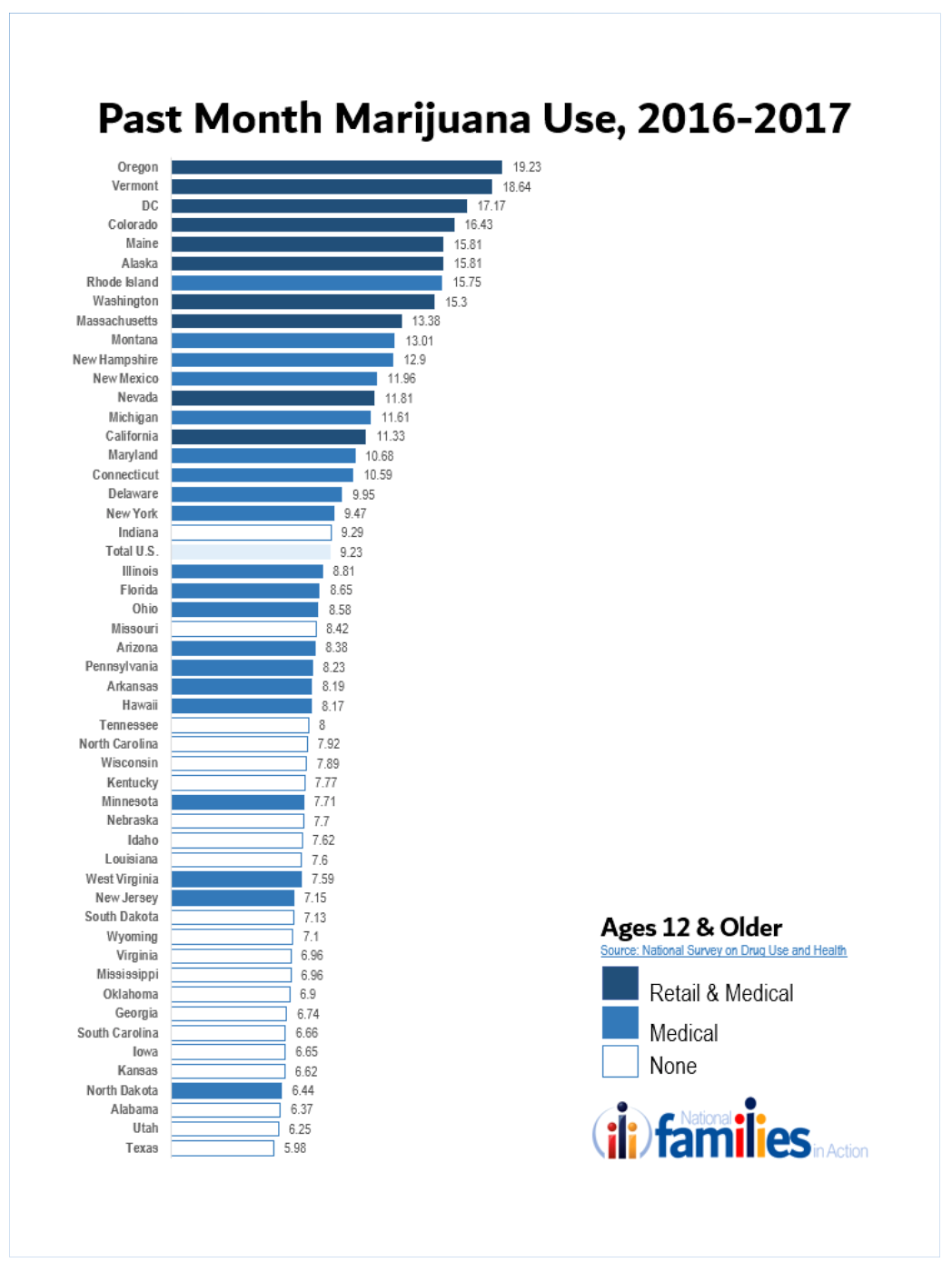
The new 2016-2017 National Survey on Drug Use and Health State Estimates is out this week. The graphs above illustrate a few of the findings from this annual survey conducted by the Substance Abuse and Mental Health Services Administration. Numbers in graphs are percentages. The graphs can be downloaded starting Thursday, December 6 here. National Families in Action grants permission to reproduce them for educational purposes.

Source: Email from National Families in Action’s The Marijuana Report <nfia@nationalfamilies.org>  December 2018

Researchers at the Centre for Addiction and Mental Health (CAMH) have identified 428 distinct disease conditions that co-occur in people with Fetal Alcohol Spectrum Disorders (FASD), in the most comprehensive review of its kind.

The results were published today in The Lancet.

“We’ve systematically identified numerous disease conditions co-occurring with FASD, which underscores the fact that it isn’t safe to drink any amount or type of  at any stage of pregnancy, despite the conflicting messages the public may hear,” says Dr. Lana Popova, Senior Scientist in Social and Epidemiological Research at CAMH, and lead author on the paper. “Alcohol can affect any organ or system in the developing fetus.”

FASD is a broad term describing the range of disabilities that can occur in individuals as a result of alcohol exposure before birth. The severity and symptoms vary, based on how much and when alcohol was consumed, as well as other factors in the mother’s life such as stress levels, nutrition and environmental influences. The effects are also influenced by genetic factors and the body’s ability to break down alcohol, in both the mother and fetus.

Different Canadian surveys suggest that between six and 14 per cent of women drink during pregnancy.

The 428 co-occurring conditions were identified from 127 studies included in The Lancet review. These disease conditions, coded in the International Classification of Disease (ICD-10), affected nearly every system of the body, including the central nervous system (brain), vision, hearing, cardiac, circulation, digestion, and musculoskeletal and respiratory systems, among others.

While some of these disorders are known to be caused by alcohol exposure – such as developmental and cognitive problems, and certain facial anomalies – for others, the association with FASD does not necessarily represent a cause-and-effect link.

Problems range from communications disorders to hearing loss

However, many disorders occurred more often among those with FASD than the general population. Based on 33 studies representing 1,728 individuals with Fetal Alcohol Syndrome (FAS), the most severe form of FASD, the researchers were able to conduct a series of meta-analyses to establish the frequency with which 183 disease conditions occurred.

More than 90 per cent of those with FAS had co-occurring problems with conduct. About eight in 10 had communications disorders, related to either understanding or expressing language. Seven in 10 had developmental/cognitive disorders, and more than half had problems with attention and hyperactivity.

Because most studies were from the U.S., the frequency of certain co-occurring conditions was compared with the general U.S. population. Among people with FAS, the frequency of hearing loss was estimated to be up to 129 times higher than the general U.S. population, and blindness and low vision were 31 and 71 times higher, respectively.

“Some of these other co-occurring problems may lead people to seek professional help,” says Dr. Popova. “The issue is that the underlying cause of the problem, alcohol exposure before birth, may be overlooked by the clinician and not addressed.”

The benefits of screening and diagnosis

Improving the screening and diagnosis of FASD has numerous benefits. Earlier access to programs or resources may prevent or reduce secondary outcomes that can occur among those with FASD, such as problems with relationships, schooling, employment, mental health and addictions, or with the law.

“We can prevent these issues at many stages,” says Dr. Popova. “Eliminating alcohol consumption during pregnancy or reducing it among alcohol-dependent women is extremely important. Newborns should be screened for , especially among populations at high risk. And alerting clinicians to these co-occurring conditions should trigger questions about prenatal .”

“It is important that the public receive a consistent and clear message – if you want to have a healthy child, stay away from alcohol when you’re planning a pregnancy and throughout your whole pregnancy,” she says.

It’s estimated that FASD costs $1.8 billion annually in Canada, due largely to productivity losses, corrections and health care costs, among others.

In addition to this review, Dr. Popova has been part of an expert group of leading FASD researchers and clinicians working with the Ontario Ministry of Children and Youth Services on its new FASD strategy. Her team is also undertaking a study to determine how common FASD is in Canada, as well as in other countries in Eastern and Central Europe and Africa.

Provided by: Centre for Addiction and Mental Health

Source: https://m.medicalxpress.com/news/2016-01-conditions-co-occur-fetal-alcohol-spectrum.html January 2016

  • Cannabis interferes with a user’s ability to recognize, process and empathize with human emotions including happiness, sadness and anger
  • Pot smokers were shown faces depicting different emotions in tests
  • They were hooked up to brain monitoring device, looking at activity levels 
  • Cannabis users showed greater response to negative emotions 
  • And those smoking marijuana showed lower response to happy emotions 

Smoking cannabis alters a person’s ability to perceive and judge emotions, a study has found.

The drug interferes with user’s capacity to recognize, process and empathize with human emotions, including happiness, sadness and anger.

But the results also suggest that the brain may be able to counteract these effects depending on whether the emotions are directly, or indirectly detected.

The complex biochemistry of marijuana and how it affects the brain is only beginning to be understood.

Dr Lucy Troup, assistant professor of psychology at Colorado State University, has set out to answer specifically how, if at all, cannabis use affects a person’s ability to process emotions.

She has long been fascinated by the psychology of drugs and addiction.

‘We’re not taking a pro or anti stance, but we just want to know, what does it do? It’s really about making sense of it,’ she said. 

For almost 20 years Dr Troup and her graduate students have been conducting experiments to measure the brain activity of about 70 volunteers.

They all identified themselves as chronic, moderate or non-users of cannabis.

They were all vetted as legal users of cannabis, and were either medical marijuana users aged 18 or older, or recreational users aged 21 or older.

The experiments involved the participants looking at faces depicting four separate expressions: neutral, happy, fearful and angry, while they were hooked up to an electroencephalogram (EEG), which shows the electrical activity of the brain.

Cannabis users showed a greater response to faces showing negative expressions, especially angry faces, when compared with a control group of non-cannabis users. In contrast, those who used the drug showed a smaller response to positive expressions – happy faces – compared with the control group

Cannabis users showed a greater response to faces showing negative expressions, especially angry faces, when compared with a control group of non-cannabis users.

In contrast, those who used the drug showed a smaller response to positive expressions – happy faces – compared with the control group.

Those taking part in the study were also asked to pay attention to the emotion and identify it.

Researchers noted in those cases, users and non-users of cannabis could not be told apart.

But, when they were asked to focus on the sex of the face, and then identify the emotion, cannabis users scored much lower than non-users.

This signified a depressed ability to ‘implicitly’ identify emotions.

Cannabis users were also less able to empathize with the emotions, the scientists found.

They said their findings seem to suggest the brain’s ability to process emotion is affected by cannabis, but there may be some compensation that counteracts those differences.

The study is published in the journal PLOS ONE.

Source: https://www.dailymail.co.uk/health/article-3472039/Cannabis-DOES-alter-brain-s-ability-process-emotions-experts-warn.html  March 2016

By Dean A. Dabney

The United States has been waging a war on drugs for nearly 50 years . Hundreds of billions of dollars have been spent on this long campaign to thwart the production, distribution, sale and use of illegal drugs.

This sustained investment has resulted in millions of drug offenders being processed through the American criminal justice system. It has also influenced crime control strategies used by American police.

Under President Barack Obama, there was a period of reform and moderating of tactics.

But President Donald Trump’s attorney general, Jeff Sessions, is announcing plans to return to “law and order” approaches, such as aggressive intervention by law enforcement and use of mandatory minimum sentences by prosecutors.

I recently co-authored a book with University of Louisville criminal justice professor Richard Tewksbury on the role of confidential informants . In my view, a return to a “law and order” approach would undo recent gains in reducing crime rates as well as prison populations and would further strain tense police-community relations .

Drugs are different

Unlike violent or property crimes – which usually yield cooperative victims and witnesses – police and prosecutors are at a disdvantage when fighting drugs. Drug users don’t see themselves as crime victims or their dealers as criminals. Police thus have limited options for identifying offenders.

Alternatives include the use of undercover operations or conducting aggressive crackdown operations to disrupt the market in real time.

But sneaking up on or infiltrating secretive and multilayered drug organizations is not easy to do, and usually produces only low-level offenders . Poor police-community relations don’t help. Heightened enforcement and punishments have made matters worse by increasing the secrecy and sophistication of the illegal drug market and forcing police to develop criminal intelligence on offenders.

So how do police gather criminal intelligence on drug crimes?

The most honorable way is to rely on law-abiding sources who see the criminal activity and feel compelled to report it to the police in order to stop the problem.

The second option is for police to turn to a paid informant who is familiar with the drug operations to set up a buy or inform on the criminal activities of others in exchange for money.

A third option is to apprehend known drug offenders and coerce them into divulging information on higher-ups in exchange for a lighter sentence. We call these folks “indentured informants” because they “owe” the police information. If they don’t follow through on their end of the deal, they face the weight of criminal prosecution, often through heavy mandatory minimum sentences.

As police-community relations have eroded over time, police have slowly but surely increased their reliance on criminal informants – especially to develop cases on higher-level criminals.

The consequences of coercive tactics

Mandatory minimum sentences serve as a strong motivator to snitch. It has become the “go-to move” for authorities.

Not surprisingly, drug dealers fight back against this coercive method of getting evidence with a “stop snitchin'” campaign. Retaliatory violence often erupts , and it becomes harder for police to get evidence from both criminal and civic-mindedinformants who fear reprisals from drug dealers. Anger grows against police who are perceived as not following through on promises to protect witnesses or clean up neighborhoods.

There exists yet another wrinkle in the equation. Reliance on harsh drug sentences and confidential informants has become part and parcel to how other types of criminal cases are solved.

Witnesses or persons privy to information in homicide or robbery cases are routinely prodded into cooperating only after they find themselves facing a stiff penalty due to their involvement in an unrelated drug case.

Here again, this produces short-term gains but long-term complications for criminal justice authorities as states move to decriminalize or legalize drugs. What happens when prosecutors working violent or property crime cases can no longer rely on the threat of mandatory minimum sentences to compel individuals to provide information?

By exploiting intelligence sources and putting them at risk, the war on drugs has pitted the police against residents in drug-ridden communities. This runs contrary to the ideals of community policing, in which trust and legitimacy are essential to members of the community and law enforcement collaborating to prevent and combat crime.

The past decade has witnessed significant reforms within the criminal justice system, particularly as it relates to drug enforcement. Authorities have sought to integrate apublic health approachinto the long-standing criminal justice model and adopt a more patient and long-term view on the drug problem.

In the end, the reliance on informants and mandatory minimum sentences creates numerous unanticipated negative consequences which will continue to grow if we revert back to them.

Dean A. Dabney is an associate professor of justice and criminology at Georgia State University. He wrote this piece for The Conversation where it first appeared.

Source: https://articles.pennlive.com/opinion/2017/08/reviving_the_war_on_drugs_isnt.amp August 2017

By Robert DuPont

Abstract

The current narrative describing the national opioid epidemic as the result of overprescribing opioid pain medicines fails to capture the full dimensions of the problem and leads to inadequate and even confounding solutions. Overlooked is the fact that polysubstance use is nearly ubiquitous among overdose deaths, demonstrating that the opioid overdose death problem is bigger than opioids. The foundation of the nation’s opioid overdose crisis – and the totality of the nation’s drug epidemic – is widespread recreational pharmacology, the use of drugs for fun or “self-medication.” The national focus on opioid overdose deaths provides important new opportunities in both prevention and treatment to make fundamental changes to the way that substance use disorders and related problems are understood and managed.

The first-ever US Surgeon General’s report on addiction provides a starting point for systemic changes in the nation’s approach to preventing, treating and managing substance use disorders as serious, chronic diseases. New prevention efforts need to encourage youth to grow to adulthood not using alcohol, nicotine, marijuana or other drugs for reasons of health. New addiction treatment efforts need to focus on achieving long-term recovery including no use of alcohol, marijuana and other drugs.

Source: http://www.sciencedirect.com/science/article/pii/S0361923017302927  June 2017

Narcotics experts are warning against dangerous drugs being mis-sold as MDMA.

According to reports from the UK, this substance can lead to psychosis and some users claim it has the ability to keep them awake for up to three days. These undesired side effects are not typical of MDMA or “Molly.”

Instead, this “fake MDMA” — drug N-Ethyl-Pentylone — is made three times as strong. It was first discovered in the US in 2016, which spread to Australia in 2017 and most recently has been found at the Manchester music festival, Parklife.

This drug has been linked to mass casualties around the world. Dr. David Caldicott, an expert in emergency medicine, explained the dangers of N-Ethyl-Pentylone as follows:

“It has been clearly responsible for the deaths of people overseas, and a rather unfortunate phenomenon known as ‘mass casualty overdoses’, where 10-20 people drop simultaneously. So, it’s of great concern to the music festival environment.”

While this was discovered in the UK, it’s possible for partakers to happen upon this in North America too, so please exercise every caution if you do take the risk of doing drugs at a show or festival this summer.

Source:  https://www.youredm.com/2018/06/10/mdma-lookalike-drug-makes-its-way-into-festivals/   June 2018

Back to top of page

Powered by WordPress