2019 September

  • Polly Ross, 32, suffered with Hyperemesis Gravidarum during second pregnancy
  • Mother smoked cannabis and magic mushrooms to ease pain, an inquest heard
  • ‘Talented and clever’ translator took her life in 2015 after battling with psychosis

A mother-to-be who took cannabis after developing the same morning sickness condition as the Duchess of Cambridge killed herself after developing a drug-induced psychosis, an inquest heard.  

Talented translator Polly Ross, 32, suffered Hyperemesis Gravidarum (HG), the condition which saw Kate Middleton rushed to hospital in August while visiting the queen in Aberdeen.

Hull Coroner’s Court in East Yorkshire was told today how a desperate Mrs Ross took cannabis and magic mushrooms in a bid to tackle the severe bouts of sickness.

However in July 2015, just a year after the birth of her second daughter, she died after stepping out in front of a train.  

A coroner heard Mrs Ross had developed ‘drug induced psychosis’ after taking cannabis to stop symptoms of HG.

Mrs Ross told her GP, Dr Daniella Malesknasr, she had taken cannabis during her pregnancy after visiting the doctors suffering from post natal depression.

Dr Malesknasr told the hearing: ‘She had told me when she was pregnant with her second child that she was taking cannabis and magic mushrooms to help combat HG during her pregnancy – but she was no longer taking it.’

Talented Polly Ross, 32, suffered the same condition but tried to soothe symptoms herself by taking cannabis and magic mushrooms

Professor Paul Marks, the senior coroner, questioned: ‘And does taking cannabis actual benefit those suffering from HG?.’

The doctor replied: ‘I can’t possibly comment on that.’

Dr Malesknasr said ‘alarm bells were ringing’ after Polly had told her she wanted to commit suicide on February 13, 2015.

Mrs Ross tried to take her life three times with self harm and taking an overdose twice in a three month period

The inquest heard the GP had called in at her home to find her in a psychotic episode and Mrs Ross was sectioned the following month.

By March 18, Dr Malesknasr said Mrs Ross was diagnosed with drug induced psychosis following the amounts of magic mushrooms and cannabis she had been taking.

The GP said she was then given Respiradon to help battle the psychosis.

Mrs Ross tried to take her life three times with self harm and taking an overdose twice in a three month period.

However, the court heard she was remarkably allowed to discharge herself voluntarily following the last attempt to take her own life.

Professor Marks said: ‘So after taking an overdose of paracetamol tablets, Polly was allowed to just leave voluntarily?’

Dr Malesknasr said: ‘I can’t comment on that because it is a hospital matter.’

However, in May 2015 a psychiatrist in the community said that psychosis was no longer a problem and she should come off the anti-psychosis drug Respiradon.

The translator was given help by a crisis team to give her a ‘higher and intense level of support’, but Mrs Ross had refused them entry to her house in Driffield, East Yorkshire.

Mrs Ross died on July 12, 2015, by stepping in front of a train in Hull, East Yorkshire, and ‘death was instant’, Hull Royal Infirmary Consultant Histopathologist Dr Ian Richmond told the hearing.

She had told mental health workers at the women-only care centre at Westlands voluntary care unit in Hull, East Yorkshire, that she was going to the shop.

Mrs Ross died on July 12, 2015, by stepping in front of a train in Hull, East Yorkshire

A statement from Mrs Ross’s aunt Emma May, who cared for her during her final months, read: ‘With the right guidance, medication and support, Mrs Ross could have made a full recovery.

‘There should be systems in place to protect that life especially because there are so many suicides attempts of post natal women.

‘I cannot understand why she was allowed to leave the hospital unit before she died.

‘Polly clearly said many times that she would kill herself, many months before she did.

‘I feel that she posed a significant risk to herself, did not have sufficient capacity to make decision and more should have been done to protect and care for her.’

Mrs Ross, who ran her own ‘very good’ translation business in Paris, was described as ‘an extremely intelligent lady and very driven in her own ambition’, by Mrs May.

She was also described as ‘frighteningly clever’.

She met her English husband Samuel Ross in 2011 in the French capital and the pair quickly married and had two daughters born in June 2012 and June 2014 respectively.

Mrs Ross suffered HG during pregnancy with both children and had post natal depression following the birth of both children.

The inquest, expected to last three days, continues.

WHAT IS HG?

Excessive nausea and vomiting during pregnancy is known as hyperemesis gravidarum (HG), and often needs hospital treatment.
Unlike regular morning sickness, HG may not get better by 14 weeks.
It may not clear up completely until the baby is born, although some symptoms may improve at around 20 weeks.
Some pregnant women be sick many times a day and be unable to keep food or drink down, which can have a negative effect on their daily life.
Exactly how many pregnant women get HG is not known as some cases may go unreported, but it’s thought to be around 1 in every 100.
Signs and symptoms of HG include prolonged and severe nausea and vomiting, dehydration and low blood pressure. Source: NHS Choices  

Source: https://www.dailymail.co.uk/news/article-5063227/Pregnant-mum-killed-developing-drug-habit.html November 2017

Abstract

Synthetic cannabinoids (SCs) are marketed worldwide as legal surrogates for marihuana. In order to predict potential health effects in consumers and to elucidate the underlying mechanisms of action, we investigated the impact of a representative of the cyclohexylphenols, CP47,497-C8, which binds to both cannabinoid receptors, on protein expression patterns, genomic stability and on induction of inflammatory cytokines in human lymphocytes. After treatment of the cells with the drug, we found pronounced up-regulation of a variety of enzymes in nuclear extracts which are involved in lipid metabolism and inflammatory signaling; some of the identified proteins are also involved in the endogenous synthesis of endocannabinoids. The assumption that the drug causes inflammation is further supported by results obtained in additional experiments with cytosols of LPS-stimulated lymphocytes which showed that the SC induces pro-inflammatory cytokines (IL12p40 and IL-6) as well as TNF-α. Furthermore, the proteome analyses revealed that the drug causes down-regulation of proteins which are involved in DNA repair. This observation provides an explanation for the formation of comets which was seen in single-cell gel electrophoresis assays and for the induction of micronuclei (which reflect structural and numerical chromosomal aberrations) by the drug. These effects were seen in experiments with human lymphocytes which were conducted under identical conditions as the proteome analysis. Taken together, the present findings indicate that the drug (and possibly other structurally related SCs) may cause DNA damage and inflammation in directly exposed cells of consumers.

Source: https://www.ncbi.nlm.nih.gov/pubmed/26194647 June 2016

University of Alberta led guideline warns health risks may outweigh benefits, provides guidance on when (and when not to) prescribe.

A new medical guideline published today suggests Canada’s family physicians should take a sober second thought before prescribing medical cannabis to most patients.

Published in Canadian Family Physician, “Simplified Guideline for Prescribing Medical Cannabinoids in Primary Care” states there is limited evidence to support the reputed benefits of medical marijuana for many conditions, and what benefits do exist may be balanced out or even outweighed by the harms.

“While enthusiasm for medical marijuana is very strong among some people, good-quality research has not caught up,” said Mike Allan, director of evidence-based medicine at the University of Alberta and project lead for the guideline.

The guideline was created after an in-depth review of clinical trials involving medical cannabis and will be distributed to roughly 30,000 clinicians across Canada. It was overseen by a committee of 10 individuals, supported by 10 other contributors, and peer reviewed by 40 others, each a mixture of doctors, pharmacists, nurse practitioners, nurses and patients. The review examined cannabinoids for the treatment of pain, spasticity, nausea and vomiting, as well as their side-effects and harms.

Researchers found that in most cases the number of randomized studies involving medical cannabis is extremely limited or entirely absent. The size and duration of the studies that do exist are also very narrow in scope.

“In general we’re talking about one study, and often very poorly done,” said Allan. “For example, there are no studies for the treatment of depression. For anxiety, there is one study of 24 patients with social anxiety in which half received a single dose of cannabis derivative and scored their anxiety doing a simulated presentation. This is hardly adequate to determine if lifelong treatment of conditions like general anxiety disorders is reasonable.”

According to the guideline, there is acceptable research for the use of medical cannabinoids to treat a handful of very specific medical conditions. They include chronic neuropathic (nerve) pain, palliative cancer pain, spasticity associated with multiple sclerosis or spinal cord injury, and nausea and vomiting from chemotherapy. Even in those specific cases, the benefits were found to be generally minor.

For nerve pain, 30 per cent of patients given a placebo saw a moderate improvement in their pain while 39 per cent experienced the same effect while on medical cannabinoids. In patients with muscle spasticity, 25 per cent of those taking a placebo saw a moderate improvement compared to 35 per cent on medical cannabis. The use of medical cannabis was best supported in its use for chemotherapy patients experiencing nausea and vomiting. Just under half of patients using cannabinoids for their symptoms had an absence of nausea and vomiting compared to 13 per cent on placebo.

“Medical cannabinoids should normally only be considered in the small handful of conditions with adequate evidence and only after a patient has tried of number of standard therapies,” said Allan. “Given the inconsistent nature of medical marijuana dosing and possible risks of smoking, we also recommend that pharmaceutical cannabinoids be tried first before smoked medical marijuana.”

While the researchers found evidence supporting the use of medical cannabinoids to be limited, side-effects were both common and consistent. About 11 per cent of patients were not able to tolerate medical cannabinoids, versus three per cent of those taking placebo. Common effects included sedation (50 per cent versus 30 per cent), dizziness (32 per cent versus 11 per cent) and confusion (nine per cent versus two per cent).

“This guideline may be unsatisfactory for some, particularly those with polarized views regarding medical cannabinoids,” said Allan.

He added that those who oppose the use of cannabinoids for medical therapy may be disappointed that the guideline considers medical cannabinoids in specific cases. Others, who feel cannabinoids are highly effective and don’t pose any risk, may be frustrated that the guideline doesn’t advocate their use sooner or for a broader range of conditions.

“Better research is definitely needed — randomized control trials that follow a large number of patients for longer periods of time. If we had that, it could change how we approach this issue and help guide our recommendations.”

Source: https://www.sciencedaily.com/releases/2018/02/180215153923.htm February 2018

Filed under: Marijuana and Medicine :

The Centers for Disease Control (CDC) recently issued a warning about vaping following a multistate outbreak of severe lung problems linked to the use of electronic cigarettes. According to the CDC, there are, as of September 6, 450 reported cases of possible vaping-linked lung problems across 33 states and 1 territory, resulting in 6 deaths. Officials have not identified a specific e-cigarette product as a cause of the illnesses, meaning that various devices on the market could be contributing to this alarming pattern. Patients admitted for lung problems report difficulty breathing, fatigue, fever, nausea, and vomiting. Somehow, to proponents and purveyors of e-cigarettes, the very idea that vaping could be dangerous seems to have come as a surprise. 

The CDC updated its warning to suggest that e-cigarette and vaping device users refrain from using the products at all during the course of its investigation. It has also warned against buying counterfeit or street vaping products, including those with THC or other cannabinoids, and against modifying e-cigarette products. Moreover, the CDC urges youth, pregnant women, and adults who do not currently use tobacco products to refrain from using e-cigarette products, and encourages individuals who smoke and want to quit to use FDA-approved medications instead of e-cigarettes. Some health officials and experts believe that street vaping products with illicit or tainted substances may be behind the outbreak of lung problems, but no one can be certain at this point. Some patients have reported using vaping cartridges with THC or cannabinoids, but others have reported using different vaping cartridges without such substances. Most contain ingredients not generally tested for chronic inhalation in humans, and, to make matters worse, they can become contaminated in ways detrimental to respiratory and heart health. It is unlikely that any substance you inhale has been tested for safety for weeks, months, or over the long haul. But inhalation from vaping has effects on the lungs that are dramatic, can be easily seen on imaging, and do not seem easy to reverse.

Tobacco smoking in the English colonies of North America started early and peaked in the U.S. in the 1960s and 1970s, credible evidence proving its causal links to cancer, emphysema, and bronchitis emerging only over a century after its explosive growth and wild popularity. Why would boosters and defenders of today’s e-cigarettes, looking back at this history, believe that research would come to indicate the product’s benefits for the lungs, or for the respiratory health of those they may expose to vaping?

While experts and officials will continue to study this outbreak and may identify particular illicit substances as the culprit, the headlines have naturally raised questions for individuals who vape about long term consequences. What we know about cigarette smoking is bad enough, but there are few surprises. Here, we’re in uncharted territory. Yes, the FDA and other agencies will look at the broader health and safety of e-cigarette products and devices, but in the meantime, users will need to be evaluated and hope that their own lungs are not compromised in ways that only become clearly understood after they stop, or years down the line. While receiving considerably less media coverage, journalists recently found that the FDA began investigating vaping-associated seizures after some users of JUUL, the top-selling vaping product in the U.S., submitted claims of seizures to the administration’s safety portal.

It is important to note that Research You Can Use previously observed that there is not yet enough evidence to conclude whether e-cigarettes are suitable for smoking cessation. Some researchers now suggest that vaping nicotine may not be safer than smoking tobacco cigarettes. More recently, the FDA has agreed that JUUL’s claims of comparative safety are unproven. Other new studies have looked at the relative health of ingredients in some e-cigarette products, and the effects of vaping on the vascular system. The truth is that it’s risky and scientifically invalid to start from the premise that drugs are safe until proven dangerous. It reminds me of cocaine being touted as safe, or non-addicting, or even as “the champagne of drugs” until the aftermath of widespread use in the 1970s and 80s demonstrated that it was highly addictive and led to heart problems, brain damage, and other diseases.

What did these studies find?

One study, led by Yale’s Julie Zimmerman, found that chemical interactions in some of JUUL’s inhaled liquid nicotine mixtures yield unanticipated new chemicals that can cause breathing problems. In this study, researchers created a machine to trap JUUL aerosol and investigate its chemical composition. They found that the alcohols hosting flavors and nicotine in JUUL’s e-liquid react with vanillin, a flavor prohibited in tobacco cigarettes, to produce acetals. The effects of inhaling acetal chemicals are unknown, but the study notes that they can cause inflammation and lung irritation. The study found acetals in JUUL’s ‘Crème Brulée’ flavor. One researcher told Yale in an interview that the team was surprised to find such high vanillin chemical levels, pointing out that the detected levels reached those established for health limits on vanillin in bakeries and flavoring businesses.

This study also found menthol in 4 of the 8 JUUL flavors it tested. Menthol, the researchers note, can expand nicotine intake. This could be concerning in part because JUUL pods already have high nicotine content relative to other nicotine products—individuals absorb from one JUUL pod as much nicotine as an entire pack of cigarettes. The researchers also observe that the findings are notable because users of the product often believe that the ingredients and chemical makeup of e-liquids are stable, without realizing that the included chemicals can combine, alter each other, or produce potentially harmful new compounds. The study calls for vaping regulations that tackle the creation of new and possibly toxic chemical elements in e-liquids, exposure to flavorings, and menthol levels.

Another new study, this time from the University of Pennsylvania, examined the effects of vaping on the vascular system and found that e-cigarette use, even without nicotine, can damage blood flow. Researchers studied 31 nonsmokers between the ages of 18 and 35, with no prior history of cardiovascular problems, hypertension, asthma, respiratory tract infections, or cancer. Participants in the study inhaled from e-cigarette devices 16 times each, at three seconds per inhalation. The researchers then used MRIs to measure the participants’ blood vessel health, having evaluated it before and after the vaping exercises. In the participants’ post-vaping leg veins, oxygen levels fell 20 percent, and their peak blood flow velocity fell 17 percent. Their femoral arteries also dilated 34 percent less. The researchers call for additional research on the topic to corroborate their findings in larger groups, and their results focus only on the ECO e-cigarette device, but they nonetheless point to serious concerns about chronic use of vaping products, which may not give time for users’ blood vessel health to normalize or reset.

Why is this important?

Individuals who use vaping products can assume, on the basis consumer-focused “evidence,” that because e-cigarette makers claim that their products are a healthier alternative to tobacco products, they must be “healthy” overall. Some evidence does support the idea that vaping is preferable to smoking tobacco, which is why the United Kingdom’s government asserts that vaping is 95 percent less harmful than e-cigarette use and encourages e-cigarette users to switch to vaping. The dispute over this assertion may come down to the exact meaning of “less harmful,” but those with vaping-related lung disease would certainly argue that vaping is not safer than smoking tobacco. It’s also true that news reports on vaping can often overstate claims in the other direction, alleging or implying that e-cigarettes alone are responsible for severe lung distress. On this point, it may be useful to consider a similar research problem: attempting to determine whether smoking cannabis causes lung cancer when most cannabis smokers also smoke other drugs, and when many also smoke tobacco. By the time health officials and experts reach a definitive conclusion, it may be too late for those vaping. While exaggerations or misleading reports exist, they should not be used to support denial of mounting evidence, or instill confidence in vapers when new research shows obvious reasons to worry—and to worry about health more seriously than the “long-term effects are unknown” talking point.

The CDC’s overall position on vaping in recent years, subject to change,  is that e-cigarettes “have the potential” to help adult smokers quit if they are not pregnant and can entirely substitute vaping for smoking tobacco products. Again, the CDC is now suggesting that individuals avoid vaping while investigations into the associated outbreak continue. It also says that scientists still have much to learn about e-cigarettes and warns that they are not safe for youth. The CDC, FDA, NIDA, and other authorities have recognized youth vaping as a growing epidemic, and have begun taking measures to confront it. Federal officials are now reportedly creating a plan to ban flavored e-cigarette products, which have a particular appeal to youth. Given the recent outbreak of severe lung problems and continued youth interest in e-cigarettes, additional action on this front will likely be required. Another recent study, for example, found 25 distinct “vape tricks” in 59 sample videos on YouTube with a median count of over 32,000 views. “Vape tricks” are stylized and playfully affected techniques for vaping, such as exhaling clouds in unique shapes, that attract the young. 48 percent of the videos were linked to industry posting accounts. This study recommended restrictions on e-cigarette social media marketing to help curb youth vaping, which sounds like a promising avenue for public health. Officials may also find it beneficial to take account of new studies about vaping’s effects on lung and blood vessel health as they deal with the increasingly apparent reality that e-cigarette use is not merely problematic in associated outbreaks, but in legal use, too.

Source: https://www.addictionpolicy.org/blog/tag/research-you-can-use/vaping-and-lungs September 2019

The United States is confronting a public health crisis of rising adult drug addiction, most visibly documented by an unprecedented number of opioid overdose deaths. Most of these overdose deaths are not from the use of a single substance – opioids – but rather are underreported polysubstance deaths. This is happening in the context of a swelling national interest in legalizing marijuana use for recreational and/or medical use. As these two epic drug policy developments roil the nation, there is an opportunity to embrace a powerful initiative. Ninety percent of all adult substance use disorders trace back to origins in adolescence. New prevention efforts are needed that inform young people, the age group most at-risk for the onset of substance use problems, of the dangerous minefield of substance use that could have a profound negative impact on their future plans and dreams.

MOVING BEYOND A SUBSTANCE-SPECIFIC APPROACH TO YOUTH PREVENTION

The adolescent brain is uniquely vulnerable to developing substance use disorders because it is actively and rapidly developing until about age 25. This biological fact means that the earlier substance use is initiated the more likely an individual is to develop addiction. Preventing or delaying all adolescent substance use reduces the risk of developing later addiction.

Nationally representative data from the National Survey on Drug Use and Health shows that alcohol, tobacco and marijuana are by far the most widely used drugs among teens. This is no surprise because of the legal status of these entry level, or gateway, drugs for adults and because of their wide availability. Importantly, among American teens age 12 to 17, the use of any one of these three substances is highly correlated with the use of the other two and with the use of other illegal drugs. Similarly for youth, not using any one substance is highly correlated with not using the other two or other illegal drugs.

For example, as shown in Figure 1, teen marijuana users compared to their non-marijuana using peers, are 8.9 times more likely to report smoking cigarettes, 5.6, 7.9 and 15.8 times more likely to report using alcohol, binge drink, and drink heavily, respectively, and 9.9 times more likely to report using other illicit drugs, including opioids. There are similar data for youth who use any alcohol or any cigarettes showing that youth who do not use those drugs are unlikely to use the other two drugs. Together, these data show how closely linked is the use by youth of all three of these commonly used drugs.


Among Americans age 12 and older who meet criteria for substance use disorders specified in the Diagnostic and Statistical Manual of Mental Disorders, 4th edition (DSM-IV). Marijuana remains illegal under federal law but is legal in some states for recreational use the legal age is 21, and in some states for medical use, the legal age is 18. Nationally the legal age for tobacco products is 18 and for alcohol it is 21.

These findings show that prevention messaging targeting youth must address all of these three substances specifically. Most current prevention efforts are specific to individual substances or kinds and amounts of use of individual drugs (e.g., cigarette smoking, binge drinking, drunk driving, etc.), all of which have value, but miss a vital broader prevention message. What is needed, based on these new data showing the linkage of all drug use by youth, is a comprehensive drug prevention message: One Choice: no use of any alcohol, nicotine, marijuana or other drugs for youth under age 21 for reasons of health. This no use prevention message provides clarity for young people, parents, physicians, educators, communities and for policymakers. It is not intended to replace public health prevention messages on specific substances, but enhances them with a clear focus on youth.

Some claim adolescent use of alcohol, cigarettes and marijuana is inevitable, a goal of no use of any drug as unrealistic and that the appropriate goal of youth prevention is to prevent the progression of experimentation to later heavy use or problem-generating use. These opinions are misleading and reflect a poor understanding of neurodevelopment that underpins drug use. Teens are driven to seek new and exciting behaviors which can include substance use if the culture makes them available and promotes them. This need not be the case. New data in Figure 2 (below) show over the last four decades, the percentage of American high school seniors who do not use any alcohol, cigarettes, marijuana or other drugs has increased steadily. In 2014, 52% of high school seniors had not used any alcohol, cigarettes, marijuana or other drugs in the past month and 26% had not used any alcohol, cigarettes, marijuana or other drugs in their lifetimes. Clearly making the choice of no use of any substances is indeed possible – and growing.


Key lessons for the future of youth prevention can be learned from the past. Substance use peaked among high school seniors in 1978 when 72% used alcohol, 37% used cigarettes, and 37% used marijuana in the past month. These figures have since dropped significantly (see Figure 3 below). In 2016, 33% of high school seniors used alcohol, 10% used cigarettes and 22% used marijuana in the past month. This impressive public health achievement is largely unrecognized.

Although the use of all substances has declined over the last four decades, their use has not fallen uniformly. The prevalence of alcohol use, illicit drug use and marijuana use took similar trajectories, declining from 1978 to 1992. During this time a grassroots effort known as the Parents’ Movement changed the nation’s thinking about youth marijuana use with the result that youth drug use declined a remarkable 63%. Rates of adolescent alcohol use have continued to decline dramatically as have rates of adolescent cigarette use. Campaigns and corresponding policies focused on reducing alcohol use by teens seem to have made an impact on adolescent drinking behavior. The impressive decline in youth tobacco use has largely been influenced by the Tobacco Master Settlement Agreement which provided funding to anti-smoking advocacy groups and the highly-respected Truth media campaign. The good news from these long-term trends is that alcohol and tobacco use by adolescents now are at historic lows.

It is regrettable but understandable that youth marijuana use, as well as use of the other drugs, has risen since 1991 and now has plateaued. The divergence of marijuana trends from those for alcohol and cigarettes began around the time of the collapse of the Parents’ Movement and the birth of a massive, increasingly well-funded marijuana industry promoting marijuana use. Shifting national attitudes to favor legalizing marijuana sale and use for adults both for medical and for recreational use now are at their highest level and contribute to the use by adolescents. Although overall the national rate of marijuana use for Americans age 12 and older has declined since the late seventies, a greater segment of marijuana users are heavy users (see Figure 4). Notably, from 1992 to 2014, the number of daily or near-daily marijuana uses increased 772%. This trend is particularly ominous considering the breathtaking increase in the potency of today’s marijuana compared to the product consumed in earlier decades. These two factors – higher potency products and more daily use – plus the greater social tolerance of marijuana use make the current marijuana scene far more threatening than was the case four decades ago.

Through the Parents’ Movement, the nation united in its opposition to adolescent marijuana use, driving down the use of all youth drug use. Now is the time for a new movement backed by all concerned citizens to call for One Choice: no use of any alcohol, nicotine, marijuana or other drugs for youth under age 21 for reasons of health. This campaign would not be a second iteration of the earlier “Just Say No” campaign. This new no-use message focuses on all of the big three drugs together, not singly and only in certain circumstances such as driving.

We are at a bitterly contentious time in US drug policy, with front page headlines and back page articles about the impact of the rising death rate from opioids, the human impact of these deaths and the addiction itself. At the same time there are frequent heated debates about legalizing adult marijuana and other drug use. Opposing youth substance use as a separate issue is supported by new scientific evidence about the vulnerability of the adolescent brain and is noncontroversial. Even the Drug Policy Alliance, a leading pro-marijuana legalization organization, states “the safest path for teens is to avoid drugs, including alcohol, cigarettes, and prescription drugs outside of a doctor’s recommendations.”

This rare commonality of opinion in an otherwise perfect storm of disagreement provides an opportunity to protect adolescent health and thereby reduce future adult addiction. Young people who do not use substances in their teens are much less likely to use them or other drugs in later decades. The nation is searching for policies to reduce the burden of addiction on our nation’s families, communities and health systems, as well as how to save lives from opioid and other drug overdoses. Now is precisely the time to unite in developing strong, clear public health prevention efforts based on the steady, sound message of no use of any alcohol, nicotine, marijuana or other drugs for youth under age 21 for reasons of health.

Robert L. DuPont, MD, President, Institute for Behavior and Health, Inc.

Source: https://www.ibhinc.org/blog/reducing-adult-addiction-youth-prevention  February 2018

Ontario’s proposal to allow people to consume marijuana in hotel rooms opens the door to a boom in cannabis tourism, says lawyer Matt Maurer.

Maurer heads the cannabis law group at Minden Gross in Toronto, and says he knows businesspeople who are interested in opening cannabis-friendly hotels and resorts.

Maurer says he was surprised by the province’s proposal to loosen up the ban on consuming cannabis anywhere other than private homes. The government has also asked for public comments on whether to allow cannabis lounges.

Maurer said he assumed the provincial government would eventually consider exemptions to the cannabis act passed in December, which bans consumption in public places.

 “I was surprised that it happened so quickly.”

Maurer calls consumption in hotels “step No. 1” in the development of a cannabis tourism industry.

“You could come to Ontario, go to the government-owned retail store, pick up your cannabis, head out to the hotel room, consume it there and head out to where ever you are going that evening, to a show or an event.”

The provincial regulations unveiled last month propose that cannabis could be consumed by residents and their guests at rooms in hotels, motels and inns, as long as the drug is not smoked or vaped. Smoking and vaping marijuana would be allowed in designated smoking rooms.

The regulations have been posted for public comment. The government plans to put them into effect when recreational marijuana is legalized across the country, expected in July.

Ontario has also opened the door to cannabis consumption lounges, asking for public comments on the idea. There’s no time frame for the lounges, but rules won’t be in place be by July. The province says the comments it receives will “inform future policy development and consultations.”

Abi Roach, who runs a cannabis vaping lounge in Toronto called Hotbox Cafe, says she’s interested in opening more if they become legal. She dreams of the day when lounges will be allowed to sell single servings of cannabis, just like drinks are served in a bar or restaurant. 

At the Hotbox (slogan: “serving potheads since … ahh I forget”), guests pay a $5 entry fee and bring their own pot.

If Ontario allows lounges, they probably won’t feature smoking inside because of concerns over the health dangers of second-hand smoke to both customers and employees, said Roach. “I don’t like to be in a big smoky room, either.”

At the Hotbox, only vaping is allowed inside. Pot smokers puff at an outdoor patio.

Roach also sees a demand for pot-friendly hotels. She’s helping design a cannabis-themed room at a hotel to be built in downtown Toronto. Each room in the hotel is owned by a private investor and offers a themed experience. If cannabis consumption is made legal in hotel rooms, they’ll go ahead with that project.

However, Roach said she doubts if Canada will see a big influx of cannabis tourists from the U.S. because we’ll be competing with a growing number of American states that are legalizing pot, some of which have taken a more creative, freewheeling approach. Ontario plans to sell cannabis from behind the counter at a restricted number of government-run stores. That won’t appeal to people who want convenience and innovative products from craft producers, said Roach.

“Canada really has to be careful in terms of blocking innovation in this industry.”

Roach said she recently drove from Vancouver to Washington State, where she stopped at a gas station and bought a joint. “To me as a tourist, it was like, ‘Wow, this is great!’ ”

In the lvillage of Embrun 40 kilometres southeast of Ottawa, Frank Medewar says he plans to open a lounge if they are made legal. He already runs InfoCannabis, a service that advises people about medical marijuana, and Seed 2 Weed, a store that sells growing equipment.

Medewar says his lounge will be modern and upscale, similar to an old-fashioned cigar lounge.

At the headquarters of the world’s largest medical marijuana company, Canopy Growth Corp. in Smiths Falls, spokesman Jordan Sinclair said the company would love to make the huge grow-op a tourist destination.

Canopy is in a former Hershey chocolate factory that was famous for tours taken by thousands of schoolchildren and tourists.

Canopy plans to have the plant open for public tours this summer, said Sinclair.

The company would also like to run a retail store on site, so the experience would be similar to a winery tour. However, the province has nixed that idea.

At Ottawa Tourism, spokesperson Jantine Van Kregten said the legalization of cannabis is on the radar. However, she hasn’t heard of any specific plans for hotels or other tourist ventures. “I think everybody is kind of taking a wait-and-see approach. I haven’t heard a lot of talk, a lot of scuttlebutt, in the industry of what their plans are. I think a lot of questions are unanswered about exactly how the legislation will roll out.”

Source: https://ottawacitizen.com/news/local-news/ontario-proposal-to-allow-cannabis-consumption-in-hotel-rooms-could-jump-start-pot-tourism February 2018

Study drawing on data from the Netherlands is the first to show how admissions to treatment centres rise and fall in line with cannabis strength

Many countries have seen far stronger cannabis come on to the market in the past few decades

Researchers have found fresh evidence to suggest that more potent strains of cannabis are at least partly to blame for the number of people seeking help from drug treatment programmes.

Scientists at King’s College London drew on data from the Netherlands to show that admissions to specialist treatment centres rose when coffee shops sold increasingly more potent cannabis, but fell again when the cannabis weakened.

The work is the first to investigate how admissions to drug treatment programmes rise and fall in line with the strength of cannabis available to users. It found that changes in demand for treatment typically lagged five to seven years behind changes to cannabis strength.

“This is the first study to provide evidence for an association between changes in potency and health-related outcomes,” said Tom Freeman, an addiction scientist at King’s.

The demand for specialist treatment among cannabis users has risen steadily in recent years, with more people now citing the drug on admission than any other illicit substance. In Europe, the number of first-time referrals for cannabis rose 53% from 2006 to 2014.

Cannabis plants produce more than 100 active compounds called cannabinoids but THC, or delta-9 tetrahydrocannabinol, is largely responsible for the drug-related high. A second compound called CBD, or cannabidiol, appears to reduce some of the mental health risks linked to heavy cannabis use by counterbalancing the effects of THC.

In work funded by the Society for the Study of Addiction, Freeman and others studied data gathered by the Trimbos Institute, a non-profit mental health and addiction organisation in the Netherlands. Each year, the institute conducts anonymous tests on cannabis for sale at a random selection of coffee shops in the country.

Writing in the journal, Psychological Medicine, the researchers show that THC levels in cannabis soared from an average of 8.6% to 20.4% from 2000 to 2004, then slowly fell to 15.3% by 2015. When the researchers looked at the impact on drug treatment programmes, they found that first-time cannabis admissions nearly quadrupled from seven to 26 per 100,000 inhabitants from 2000 to 2010, and then dropped to less than 20 per 100,000 inhabitants in 2015. It means that for every 1% increase in THC, about 60 more people entered treatment.

“We see a rapid increase in THC between 2000 and 2004 followed by a slower decline, and then you see a very similar profile in drug treatment admissions,” Freeman said. The rise in cannabis potency was one of a number of factors driving admissions to specialist drug services.

Val Curran, professor of psychopharmacology at UCL, said: “This adds to a growing number of scientific studies which suggest rising THC potency of cannabis is associated with greater incidence of mental health problems including addiction and possibly psychosis.”

But she added that stronger cannabis was not solely responsible for increasing demand for drug treatment. “Other factors include the marked decrease in levels of cannabidiol (CBD) in cannabis. There is evidence that CBD can protect against some mental health harms of THC,” she said.

Ian Hamilton, a mental health lecturer at the University of York, agreed that other factors beyond the potency of the drug were important. “It is possible that seeking help for problems with cannabis has become more acceptable by users and treatment providers. Over the same period that cannabis referrals to treatment have been increasing, referrals for problems with opiates such as heroin have been in decline. So although cannabis has traditionally been viewed as relatively benign by treatment workers they may now be more inclined to offer support,” he said.

Source: https://www.theguardian.com/science/2018/jan/31/stronger-cannabis-linked-to-rise-in-demand-for-drug-treatment-programmes January 2018

After Lynley Graham’s custody photo was posted to a police force’s Facebook page, horrified users were quick to discuss the harmful effects of hard drugs

Deep lines etched across a woman’s face and cheeks sunken to the bone – this one shocking image illustrates the effects of substance abuse.

Lynley Graham’s custody picture has been released by Humberside Police after she was jailed for 18 months for drug offences.
Graham was found in possession of class A drugs, including heroin and cocaine, and was subsequently charged with possessing a class A drug with intent to supply, Grimsby Live reports.

After the photo was posted to Humberside Police’s Facebook page on Wednesday, users were quick to discuss the 53-year-old’s weathered appearance.

Before and after pictures show a striking physical transformation.

One said: “I’m 64, I look young compared to her. Is she a lesson, perhaps, in what substance abuse can do to your skin?”

Another added: “Let’s hope some young people look at her and see what a life of drugs does apart from ruining entire families.”

Drug addiction and misuse contributed to more than 2,500 UK deaths in 2017.

Inhalants can cause damage to the kidneys, liver and bone marrow, and persistent drug consumption can result in abscesses, tooth decay – known as ‘meth mouth’ in the United States.

Other symptoms include premature ageing of the skin, often adding decades to someone’s appearance.

Rehabs.com, a US-based charity, has also published startling images of drug users to demonstrate the long-term toll narcotics have on one’s appearance.

Drugs can damage almost every system in the body; bloodshot eyes, dilated pupils, puffy faces and discoloured skin are all noticeable signs.

Some users suffer a rapid physical deterioration – with facial appearances sometimes ruined in just a matter of years.

Self-inflicted wounds, common among consumers of methamphetamine, can be caused by users picking at their skin to relieve the sensation of irritation – sometimes described as like crawling insects.

And a skeletal appearance can be the result of appetite-suppression.

Cocaine can commonly lead to chronic skin ulcers, pus-filled skin and the development of Buerger’s disease – an inflammation in small and medium-sized blood vessels.

Heroin has been known to dry the skin, leaving addicts with itchy and aged skin.

In May, Sir Angus Deaton, a world-leading economist, warned that drug abuse and alcoholism claim more lives of those in middle-age than heart disease.

‘Economic isolation’ is cited as one of the biggest contributors.

In 2017, a poll of 1,600 adults found that almost nine in ten said that seeing the physical effects of hard drugs made them less likely to take them.

The publication of such images is a common tactic among anti-addiction campaigners.

Scotland is experiencing its own drug crisis, with a 27 per cent rise in drug-related deaths, according to official statistics.

It puts Scotland’s drug mortality rate three times higher than the UK as a whole, and higher than any other country in the European Union.

The NHS offer services for drug and alcohol recovery, as do outside agencies, such as Addaction

Source: https://www.mirror.co.uk/news/uk-news/shocking-image-illustrates-how-drugs-18790997 July 2019

As more cases turn up, doctors are concerned about the extent to which memory loss may be undetected.

Just over five years ago, a man suffering from amnesia following a suspected drug overdose appeared at Lahey Hospital and Medical Center in Burlington, Massachusetts, a Boston suburb. He was 22, and had injected what he believed to be heroin. When he woke up the next morning, he was extremely confused, repeatedly asking the same questions and telling the same stories. Doctors at Lahey quickly diagnosed the man with anterograde amnesia—the inability to form new memories.

His brain scan revealed why. “I thought it was an extremely strange scan—it was almost hard to believe,” says Jed Barash, a neurologist working at Lahey at the time. In the scan, the twin, seahorse-shaped structures of the man’s hippocampi were lit up against the dark background of the rest of the brain—a clear sign of severe injury to just that one region.

“It was strange because that was all there was,” Barash says.

Memory researchers have known since the late 1950s that the hippocampi are responsible for turning short-term memories into lasting ones, so the amnesia was not surprising. Just how the damage occurred, however, remained a mystery. Lack of oxygen to the brain that would have occurred during the overdose could not be the only explanation. The number of survivors in the state that year could easily have numbered in the thousands, so why was there only one patient with this seemingly unique brain damage?

Along with his colleagues, Barash—now the medical director at the Soldiers’ Home health-care facility in Chelsea, Massachusetts—figured that the opioids must have played a role, and that hunch became only more acute as three more patients—each fitting the same pattern—appeared at Lahey over the next three years. All had the same unique destruction of the hippocampi, all had amnesia, and all were suspected to have overdosed. By that point, the doctors at Lahey faced two fundamental questions: What was causing the strange new syndrome? And precisely how rare was it?

Both questions remain unanswered, but a case report published Tuesday in the Annals of Internal Medicine adds to a growing body of evidence suggesting that the problem is far from isolated, and that a potent opioid variation could be involved. A total of 14 patients have now been identified in Massachusetts, one of whom was first admitted to a hospital in his home state of New Hampshire. The new case study reveals two more patients—one from Virginia, and one from Maryland. Both turned up at a medical facility in West Virginia.

Although many of the patients had taken a variety of drugs, all but one either have a history of opioid use or tested positive for opioids. The most recent case, a 30-year-old man examined last year in West Virginia, is the first patient proven to have taken fentanyl, an extremely potent and dangerous opioid that is rarely tested for in toxicology screens.

There are many barriers to determining the true scope of the problem, from lack of proper testing to the fact that many patients never come to attention in the first place. And amid a larger opioid crisis that some experts say could claim as many as 500,000 lives over the next decade, pinning down the cause of a dozen or so amnesia cases can seem trifling. “It’s sort of like the Titanic going down and you’re worried about some details,” says Alfred DeMaria, the state epidemiologist for Massachusetts.

At the same time, DeMaria suggests that, at the very least, these patients may offer a different route for understanding a disorder, as was the case with a small cluster of patients in the early 1980s who developed Parkinson’s disease after taking contaminated drugs—a misfortune that turned out to be limited to a few people, but which nonetheless gave Parkinson’s researchers a new tool for studying the disease. More worryingly, he also points to several examples of medical investigations that began with a small number of mysterious cases and turned out to have significant public health-implications, such as the appearance of West Nile Virus, or the AIDS epidemic.

Bertha Madras, a psychobiologist at McLean Hospital in Belmont, Massachusetts, and a member of President Donald Trump’s Commission on Combating Drug Addiction and the Opioid Crisis, agreed that getting to the bottom of these amnesia cases is crucial—particularly given that many cases may be going undetected since the type of cognitive testing needed to diagnose amnesia may not be routinely done in overdose survivors. She also suspects that with overdose-antidote drugs like naloxone becoming more widely available, it is possible that more patients, rather than turning up dead, will show up at hospitals.

And with more survivors, Madras said in an email message, “there conceivably will be more cases of brain damage, especially in the very oxygen-sensitive hippocampus, the ‘epicenter’ of initial learning and memory.”

* * *

After encountering more patients following that first one in 2012, Barash contacted the Massachusetts Department of Public Health in 2015, which put out a request to emergency-room physicians, neurologists, and radiologists statewide for information that might identify additional cases. By the end of 2016, a total of 14 people who matched the pattern had been identified. Then, in May of 2017, the DPH made what they called “an unusual amnestic syndrome” with “acute, bilateral hippocampal” damage a reportable disease syndrome—a status that requires any doctor who sees such a case to forward patients’ medical records for review.

As of today, however, DeMaria believes there is no such mechanism in place in other states, and that’s one of the barriers to getting a handle on the prevalence of the amnestic syndrome. Marc Haut, the neuropsychologist who examined the man from Virginia in 2015, and one of the authors on the new Annals paper, had no way of knowing about the investigation in Massachusetts and initially chalked up the damage to cocaine use. At the time, he saw no reason to consider opioids, in part because of the information the patient shared with him. “Patient reports about substance use [are] not always accurate for a couple of reasons, one being the patients themselves,” he says. “And the other being that patients often don’t know what they’re buying and using.”

So it was not until he received an email from Barash that Haut, the chair of the behavioral medicine and psychiatry department at West Virginia University, reconsidered whether opioids could have played a role. To date, only eight of the 16 patients reported in the cluster had cocaine in their system, making opioids a more consistent link than any other drug. Barash, who is also an author on the Annals paper, wonders if fentanyl—considered to be 50 times more potent than heroin—is a key component, in part because the timing and location of the appearance of these amnestic cases parallels the rise of fentanyl overdoses in two of the hardest hit regions in the country. Teasing this out is complicated with the ever-changing landscape of drugs that people are taking, often in combination. “Cocaine overdose deaths are escalating,” said Madras, “along with evidence of combined use of fentanyl, heroin, and cocaine in some deaths.”

And despite the fact that fentanyl abuse has become so common, routine toxicology screens don’t test for the presence of the drug. It was only because Haut had been tipped off that he requested the advanced toxicology screen for the 2017 patient, which found evidence that he had taken fentanyl in addition to cocaine. His MRI scan also revealed the signature hippocampal damage: “bright, big, and intense,” according to Haut.

Like Barash, Haut is concerned about the possibility that what they’ve seen so far could be just the tip of the iceberg. “We don’t know if this is a rare occurrence, or if this has occurred more, and people have not noticed,” he says, “because some of the folks who have these events are pretty marginalized in society. If they don’t have family to notice, it may not be noticed even though it’s pretty dense amnesia.”Several other doctors who contributed cases to the Massachusetts cluster have also raised the question of whether more patients are going undetected. They point to the fact that many illegal drug users don’t go to a hospital after an overdose. If they do, their confusion is likely to be chalked up to a temporary symptom of the overdose. If they don’t get to a hospital within a narrow window of approximately one week, the telltale signal may have faded from the brain and all evidence of drugs will likely have cleared the system.

Even if all those conditions are met, doctors across the country don’t know where or how to share the information. DeMaria, the state epidemiologist for Massachusetts, believes his is the only state that has notified physicians and is collecting cases. If doctors in other states are seeing cases that fit the pattern, they may assume that it’s a one-off phenomenon, just as Barash and others did when they first saw the cases.

Michael Lev, an emergency-room neuroradiologist at Massachusetts General Hospital who contributed cases to the Massachusetts cluster, thinks it’s possible that the appearance of this amnestic syndrome may date back far earlier than 2012. He recalls seeing similar brain images in a few sporadic cases between 1986 and 1989 when he was working at Boston City Hospital. The patient history was always the same, he says. “The history was ‘heroin found down,’”—emergency-room shorthand for an overdose victim.

* * *

For now, doctors can only go on the well-documented data that they have—the 16 patients identified between October 2012 and May 2017—and one key question is whether they represent just one narrow band along a spectrum of damage, which would have ramifications for the ability of addicts to get the treatment they need. “Getting a sense of the severity and scope of this is important,” Haut says. “If we find that these dense amnesias are really rare, that’s good. But if we find in the interim that they have significant memory problems even though they’re not amnestic as a result of these events, that have gone under the radar, then we have to take that into account when we’re trying to get people into treatment and staying in treatment.”

Barash agrees, pointing out that understanding the amnestic syndrome may give medical professionals insight into some of the larger problems that can accompany overdoses. “These cases are a very particular subset of brain damage that can occur from use of opioids,” he notes. “But I think more likely there are probably cases of patients who may not necessarily have this particular syndrome but suffer cognitive difficulties from longer-term use of opioids and it’s important to know the scope of that.” It’s also plausible that there are more extreme cases on the other end of the spectrum—people who have taken sublethal doses but are too far gone to have their memory tested.

Source: https://www.theatlantic.com/health/archive/2018/01/fentanyl-overdose-amnesia/551846/ January 2018

President Donald Trump took a few minutes in his State of the Union address to acknowledge what he called the “terrible crisis of opioid and drug addiction – never been has it been like it is now”.

The American President told Congress that “we have to do something about it”, stating that 174 drug-addiction caused  deaths a day meant that “we must get much tougher on drug dealers and pushers”.

This should come as no surprise. The crisis, which claimed well over 100,000 lives between 2015 and 2016, is now so widespread and catastrophic it was declared a public health emergency by President Trump in October.

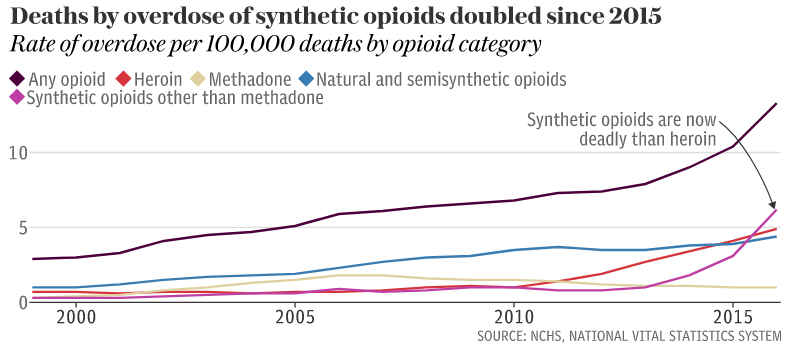
The rate of American deaths caused by overdoses of heroin-like synthetic opioids has doubled since 2015, in a tragic symptom of the opioid epidemic ravaging the United States.

The US’s Centre for Disease Control and Prevention has published figures showing that the rate of deaths due to synthetic opioids excluding methadone, such as fentanyl and tramadol, jumped from 3.1 per 100,000 in 2015 to 6.2 per 100,000 in 2016.

The total number of deaths due to opioid overdoses also climbed from 52,400 to 63,600, a 21 per cent increase – marking a steady rise since 1999.

Synthetic opioids are the biggest killers

The dramatic rise in the use of synthetic opioids owes more to practicality than demand, Dr David Herzberg, a University of Buffalo expert in the history of drug addiction, told The Telegraph.

“Fentanyl [the most widely used synthetic opioid] is much easier to smuggle than heroin because you need less of it,” he said.

Since synthetic opioids are made in labs rather than from plants, like traditional heroin, they can be made anywhere in the world, and vary dramatically in strength.

Fentanyl is around 50 times stronger than heroin – and some new strains are up to 10,000 times stronger.

This huge variation in potency is what makes makes synthetic opioids so deadly, since users are often completely unaware of the strength of the substance they are injecting, said Dr Jon Zibbell, a Senior Public Health Scientist at RTI International, a nonprofit that funds opioid research.

“I know a kid who buys carfentanil [a newer strand of fentanyl] online and that’s all he injects; he argues it’s totally safe but people mixing it with other stuff don’t really know what they’re doing.

“It’s not the drugs themselves that are killing people but the inability of people to adapt to the uneven potency in the illicit market,” he said.

The rise in fentanyl dates back to 2013, when drug traffickers in Mexico started adding it to heroin to stretch their product further to meet growing demand.

Now fentanyl has also grown in popularity with small drug dealers within the US who buy it online from China, which Dr Zibbell said has led to a bloated supply of fentanyl with no standardization of strength.

Rise of drug overdose death most pronounced among men

Fentanyl is not the only heroin-like drug experiencing a boom in users in the US; the country’s mushrooming opioid crisis is well documented, with the overall rate of opioid drug overdoses increasing every year since 1999.

This owes much, Dr Herzberg said, to a history of over-prescription of painkillers dating back more than three decades to the Reagan administration, when tight controls on opioid sales were relaxed: “Opioid markets were opened up to the full range of strategies drug companies use to sell their products. So a large volume of these drugs were pumped into the market without adequate warnings about the risks.”

While data shows a higher rate of overdoses in men, recent research has found the serious health impacts for women are just as severe.

A recent paper by Dr Zibbell published in the American Journal of Public Health demonstrated that those regions of the US particularly ravaged by the opioid epidemic have also seen an outbreak of new cases of the degenerative blood disease hepatitis C.

While the rate of death by opioid overdose is lower for women, the rate of new hepatitis C cases developing is much higher. This is particularly concerning as researchers have also documented a large increase in babies born to infected mothers, along with a rise in neonatal abstinence syndrome (babies born physically dependent on opioids).

The trouble in poor, white states may be spreading

Rust belt states such as Ohio, Pennsylvania and West Virginia – with an astonishing rate of 52 drug overdose deaths per 100,000 – have shouldered the brunt of the opioid crisis.

This is partly due to the poverty of these states, but race is also a huge factor – areas with large white populations are disproportionately impacted since the epidemic is rooted in prescription drug abuse, said Dr Herzberg.

“Studies prove that physicians are less likely to prescribe opioids to African Americans or other racial minorities – even when they need them – because of the stereotypes associating them with drug abuse,” he said.

There are signs, however, that the problem has spread to other communities. The mostly non-white District of Columbia, for example, had a rate of death by drug overdose of 38.8 per 100,000 – almost most twice the national average of 19.8.

Dr Zibbell’s research also found high rates of drug treatment and new hepatitis C cases among hispanics. “That was a big deal because the epidemic has been described as mostly affecting the white population,” he said.

Experts say the spread of the opioid crisis beyond the mostly white rust belt states is particularly worrying as it highlights the nationwide extent of the crisis.

“The Trump administration is not putting action or money behind its pronouncements on the problem. If the present trajectory continues it will claim many more young lives,” he said.

President Trump remained defiant in his speech, however.

“The struggle will be long and it will be difficult,” he acknowledge, before adding “we will succeed”.

Source: https://www.telegraph.co.uk/news/2018/01/31/deadly-fentanyl-behind-dramatic-doubling-synthetic-opioid-death/ January 2018

A USA TODAY NETWORK-Wisconsin project

Heroin entered their lives so easily.

For 10 addicts, the hard part is staying clean.

They got the pills from their doctors, then kept using them until they couldn’t stop. They switched to heroin because it was cheaper, because a friend said it was an easier, better way to get high.

They went to parties as teens, took pills, snorted powders. They got bored with the drugs they were doing and then found heroin, the drug they loved the most.

They had faced abuse, poverty, tragedy. Their pain was deep, and psychological, and the drug was an escape.

The stories of 10 recovering heroin addicts from Wisconsin are the stories of millions of Americans who have been hooked on opiates and either died, or lived with the consequences. They’ve lost friends. They’ve been arrested. They’ve lost touch with their family and friends, lost custody of their children.

COUNTY BY COUNTY: Deaths and ODs in Wisconsin.

“It wasn’t what they always told us it was going to be,” said Moriah Rogowski, a 22-year-old recovering addict, about her first time using heroin. She didn’t develop an addiction right away. But somewhere, more gradually than she expected, she lost control.

Like the other nine recovering heroin users profiled in this special report from USA TODAY NETWORK-Wisconsin, Rogowski has taken back control of her life. She’s clean. She lives in a different city, imagines a different future for herself.

Recovery from opiate addiction is hard, filled with setbacks. But these 10 people from across Wisconsin have taken the first steps toward a life after heroin. In photos, in words and in their own voices, these are their stories about how they started on heroin and fought to get off the drug.

‘That was the only way I liked to get high’

Moriah Rogowski, Green Bay

Moriah Rogowski liked the feeling of downers: Percocet, Vicodin, Oxycontin. She and her friends, the summer before high school, would go out to parties and crush pills and snort them.

She and her three siblings lived in a rural home near Mosinee, where she was homeschooled until eighth grade. In high school, she found her place among the stoners. One night she found herself in a drug house in Marshfield with 33-year-olds. She was 15.

That was the day she first tried heroin. She was afraid of needles, so she let someone else shoot the drug into a vein in her arm.

“That was the only way I liked to get high after that,” she said.

Rogowski is now 22. She’s been in and out of programs in Minnesota and Green Bay as she tried to get clean. But she’d come home and hang out with the same friends; each time they led her back to the drug.

She sought treatment at the methadone clinic in Wausau, where she saw others abusing the methadone and still using heroin. She fell into the same pattern.

She mixed heroin, crack, Xanax. There is a week of her life she can’t remember. She took her brother’s car and got an OWI. Her license was suspended.

Then, from somewhere, she found the will to change. She called her mom to come get her because she wanted to get clean. She began to use the methadone program correctly, taking classes and attending therapy sessions.

Rogowski has lived in Green Bay for two years. She hopes to complete her GED. And she’s trying to help others by working toward becoming a recovery coach.

— Laura Schulte, leschulte@gannett.com

A soldier’s widow masks her pain

Sarah Bear, Wausau

Sarah Bear didn’t want to feel anymore.

Her husband, Jordan, was killed in Afghanistan in 2012 during an attack at his base in the Kandahar province. More than a year later, just when she started being able to grieve her husband’s death, her oldest son’s dad died.

Bear’s addiction started in the summer of 2014 with pills — Vicodin, Oxycontin, Percocet. They dampened the pain of her losses. A friend had been prodding her to try heroin: It was cheaper, he said, and she wouldn’t have to use as much. She swore she would never touch it.

One day, Bear couldn’t get any pills. The withdrawals hit. She got sick; she couldn’t take care of her children. Eventually, she called the friend, and within a half hour was snorting heroin for the first time in her Antigo apartment.

Then, she felt nothing, just like she wanted.

“I completely, seriously fell in love with that drug,” she said. “There was nothing that compared to it, honestly. Sadly.”

She did heroin every day, either snorting or smoking it, and eventually injecting it.


Beginning in January 2015, Bear was in and out of jail, and on and off heroin. She tried methadone treatment but it didn’t stick.

In October 2016, Bear’s four children were taken from her. Two went to stay with her mom, and two with her grandmother.

Almost a year later, Bear, 33, found herself in North Central Health Care’s Lakeside Recovery in Wausau, a 21-day medically monitored substance abuse treatment program. She believes she hit rock bottom.

She started the program in mid-September and could feel the change within her as her Oct. 6 graduation approached. She’s determined to get better.

“I remember a time when my life was good, and I know that I can be back there,” she said. “I know that I can have that again.”

— Haley BeMiller, hbemiller@gannett.com

He laughed at the idea he could be saved

Nathan Scheer, Fond du Lac

Nathan Scheer felt the bottom drop out the day before Christmas Eve 2016. His wife and kids watched the cops haul him away.

His probation officer had heard he would test dirty and showed up at his home unannounced.

“On the way to jail I was higher than I’d been in years, but I remember my probation officer telling me she was going to save my life,” he said. “I laughed and told her you can’t save someone who doesn’t want to be saved.”

He first used prescription opiates after a car crash. One day he didn’t have enough money for hydrocodone pills. In their place, he was offered “dog food” —  a street name for heroin.

A decade-long fling with heroin followed, and it turned the 35-year-old factory worker from a regular, middle-class guy into a liar and a thief.


“I once explained to my wife that it (heroin) felt like what I imagine looking into the eyes of God would feel like,” Scheer said. “It’s the most religious experience you could ever imagine.”

But since the day the probation officer showed up a little more than a year ago, Scheer got clean through counseling, group support and a local church. He learned to feed his addictive personality through the gratification that comes with community service.

Today, Scheer and his 4-year-old son, Bentley, have gained recognition in Fond du Lac by cleaning up parks and playgrounds. Giving back is his metaphor for recovery. Father and son call it #cleanstreetforkids.

“I call it my beautiful disaster, because the way everything happened, I was so lucky. I had people who stuck by me while I waged war on myself.”

— Sharon Roznik, sroznik@gannett.com

‘They just kept prescribing pain meds’

Rebecca Palmieri, Wisconsin Rapids

Rebecca Palmieri’s house is quiet now. In August, a court commissioner ordered her to give up her five children. It was the second time in two years that she lost them.

She’s lost everything since she started using heroin. She’s been homeless. She has a record.

Palmieri, 39, had medical complications when she had her fifth child. That was in 2013.

“They just kept prescribing pain meds for five months after I had my son. They did corrective surgery, but, by then, I was hooked.”

She used pills for about two years. In January 2015, a friend came to her Wisconsin Rapids apartment with heroin. He told her to hold out her arm. In the empty bedroom, with her children in another part of the house, he injected her.

Using wasn’t an everyday thing, she said, until it was. She would look around her apartment to see what she could sell or return for money to buy the drug.

The courts put her kids into foster care. She was homeless for about six months. The kids went to live with her husband; they came back to her when he went to prison. She got clean and found a house. But the courts sent the kids back to her husband when he got out.

Palmieri said she has been clean since November 2016. She goes to the YMCA every day to work out; she attends addiction support group meetings. She wants to get her kids back.

“It’s probably the hardest thing I ever had to do,” she said, “to get clean and stay clean.”

— Karen Madden, kmadden@gannett.com

Sacred fire lights a path to recovery

Joey Powless, Oneida

Joey Powless stood by the sacred fire burning under a tepee in the center of Oneida. He busied himself by keeping the fire steady and clean, moving ash and coals out of the flames.

Powless, 36, a member of the Oneida Nation, called it the Grandpa Fire, and without it, he said, he would not have been able to stay clean for the past five years or so.

The sacred fire represents the spirit of native people, a connection to the past and present, a source of strength, a place to pray, a gateway to understanding.

“Without fire, we couldn’t live,” Powless said. “This is what we cooked our food with. This is what gave us life. Gave us heat. So without it we could never live. This is our very first teaching right here.”

His mother abandoned him and his family when he was a kid, and he responded at a young age with anger, he said. He started drinking and smoking pot at age 13. By the time he was in his early 20s, he added opioid medications and cocaine to the mix.


Powless was 28 when he first tried heroin at a party. He was deep into drug culture, and selling drugs to pay for his own drugs. “Cocaine really wasn’t doing nothing for me no more,” he said. Snorting heroin seemed like a natural thing to do.

It made him sick at first, but as that feeling eased, he felt the high. “That’s when the magic happens,” he said. He continued to chase that high. He graduated from snorting heroin to shooting it into his veins.

He was about 31 when he was jailed, and put into solitary confinement. It was there that he decided he didn’t want to be an addict anymore. “Because I have children,” he said. (Powless is the father of two teenagers.) “I didn’t want to be out of their lives no more.”

— Keith Uhlig, kuhlig@gannett.com

Arrests pile up after friend overdoses

Jennifer Solis, Stevens Point

Jennifer Solis was out of pills and already felt sick.

In the bathroom of her friend’s house in Stevens Point, she crushed up a little heroin and snorted it. It was the first time she had tried the drug.

Her friend, close by, was injecting it. They didn’t talk.

Solis, who was in her mid-20s at the time, looked down on people who used needles. She told herself she wouldn’t cross that line. She would.

Solis, now 34, was born in Colorado but moved to Wisconsin as a teenager. She was already using drugs with her friends — first marijuana, then cocaine — by the time she was 16.

“I think I was always looking for the next best thing,” she said. “I didn’t see myself as an addict back then.”

Solis became addicted to pain pills after she suffered a serious back injury as a result of domestic abuse, she said. After her friend introduced her to heroin, she used it every day.

She called paramedics when a friend overdosed a few years ago, then watched as they used the counteracting drug naloxone to revive her. She was charged in that incident, and then arrests piled up quickly.


She joined Portage County’s drug court in May and stayed clean for her first three months. Then she relapsed by using heroin and methamphetamine. By October 2017, Solis had again been clean for three months.

Solis has five children but no contact with them. Her three oldest live with a relative and her two youngest were adopted as infants.

She wants to go back to school for interior design. But for now, Solis lives at the Salvation Army in Stevens Point, working to put her life back together.

— Chris Mueller, cmueller@gannett.com

‘I smoked pot with both my parents’

Kevin Williams, Wisconsin Rapids

Kevin Williams is 35 and lives in a Wisconsin Rapids assisted-care facility. His mother and father divorced when he was 8, and, he said, “I basically smoked pot with both my parents by the time I was 15.”
By the time Williams was an adult, he tried every drug he could.

Cocaine: “Why not? I was already stoned on weed.”

Meth: “I tell people I used meth once in my life for eight months.”

Opiates: A friend first gave him an oxycodone pill, “and I was like, ‘Why not?’ I crushed it up and snorted it. … It was like the absolute, most warmest hug I ever felt.”

He can’t remember when he first switched from prescription opiates to heroin. But shooting up the drug, he said, “was like stepping into the perfect temperature of bath water, and (the feeling) would go all the way up, and all the way down.”

Williams is disabled. He walks with a limp and his left arm hangs at his side.


“I went to prison a couple years back. I found out I had a brain tumor. They went in to take it out, and they cut a blood vessel … gave me a stroke.”

One day, two years ago, he ran out of money and got clean. He can’t explain why.

“These days … I feel better about my life than I ever have before. Which sounds pretty crazy, doesn’t it? I only got half a freakin’ body right now. … But I get by. I still joke and love and make it to the Dollar Tree. All my essentials are taken care of.”

— Keith Uhlig, kuhlig@gannett.com

Addiction becomes a legacy of abuse

Jodi Chamberlain, Stevens Point

Jodi Chamberlain couldn’t get pills. They cost too much.

She got heroin from a friend instead. She was alone in her bedroom the first time she snorted the drug.

She didn’t have to think or feel. She didn’t have to deal with anything. But, Chamberlain said, “when it ends, you just crave more.”

She used heroin again within a week.

Chamberlain was living in Stevens Point at the time. She was barely in her 20s, but was already a regular drug user — mostly pain pills, but also cocaine and other stimulants. Her addictions grew out of a turbulent childhood, which, she said, included incidents of sexual abuse by a relative.

“I was taught to lie and to not have feelings,” she said. “I’ve never felt feelings.”

Now 41, Chamberlain has been clean for about eight months. She moved back to Stevens Point late last year after living in Eau Claire. Sometimes she slept in a truck.

Chamberlain was arrested again and again. She was sentenced in May on felony drug charges, but instead of going to prison, a judge allowed her to participate in Portage County’s drug court. She’s never made it through treatment without going back to heroin. If she fails in drug court, she faces a prison sentence.

Chamberlain regrets how many people she hurt with her drug use, particularly her two children, who watched their mother struggle with addiction.

She wants to stay clean, but even she can’t say whether she will make it.

“I can’t make that promise to anyone, not even myself,” she said. “But I choose to have people in my life now who can help me when I am going through rough times.”

— Chris Mueller, cmueller@gannett.com

‘A very functional addict’ awaits prison

Kyle Keding, Wisconsin Rapids

Kyle Keding was 26 years old and had been a heavy user of drugs for years before he tried heroin.

He had been drinking and smoking marijuana for about half his life. He had been dependent on opiate painkillers such as Percodan and Oxycontin for about five years. The pills helped him get through long days as a welder and they helped him forget about the crap life handed him.

Keding was sexually molested when he was about 5 years old, first by a babysitter, then by a relative, he said. Those memories never left him, unless he was high. So he got high. A lot. For him, that was just part of life, in addition to work, being a parent and a husband.


“I was what you call ‘a very functional’ addict,” he said.

The heroin was a practical choice. Opiate painkiller manufacturers had changed the formula of their pills, making them more difficult to use to get high, and also created a huge opiate shortage.

“So I couldn’t find what I wanted. I called up my friend, and he was like, ‘Well, I’ve got some ‘ron (heroin). … (I was) kind of skeptical,” Keding said. “I had not done it before.”

He did not feel as if he had stepped over any kind of line. He had already liquefied prescription opiates and shot those up intravenously.

Shooting up, both synthetic opiates and heroin, gave him a stronger high. He chose the needle because his friend and dealer did not have enough pills to get Keding as high as he wanted.

“I can remember the words that came out of my mouth once I released the strap off my arm,” he said. “‘Oh, my God. This is amazing.’ And I knew right there, this is it. I was like, there was no turning back now. But there was.”

He used heroin for five years, until Dec. 2, 2014. That night he was with friends, getting high, and one of the people he was with died. He was charged with first-degree reckless homicide/deliver drugs. He accepted a plea deal on that charge on Dec. 1, 2017. He awaits sentencing in February and could face years in prison.

— Keith Uhlig, kuhlig@gannett.com

‘This is a lifelong battle’

Tommy Casper, Neenah

Tommy Casper said one of the main reasons he has stayed clean for more than seven months is because of his nephew Owen, who has only ever known him sober. Casper sees his sister Carly Fritsch, who overcame her own struggle with addiction, and Owen most days of the week after work. Casper plays on a recreational volleyball team with other recovering addicts and attends Narcotics Anonymous meeting three times a week.

Tommy Casper was alone in the basement of the two-story home where he grew up.

He sat on his bed and opened a small bag of heroin that had been on top of a dresser beside him. He hadn’t used the drug before, but at about $120 a bag, it was cheaper than the pills he used. He snorted it.

He found himself asking one thing as the feeling went away: “What do I need to do in order to feel that way again?” He used heroin again three hours later.

Casper was 21 years old and living in Muskego, a community of fewer than 25,000 people on the outskirts of Milwaukee. His mother had died about six months earlier and he struggled with the loss. His sporadic use of pain pills became an addiction.

“The first time I used (as a way) to cope — rather than using to have fun or go out — was at her funeral,” he said.

After he turned to heroin, Casper told himself he wouldn’t use a needle because “then I wasn’t as bad as other people.” He used a needle for the first time a year later.

After his mother died, Casper moved around — to a house in West Allis, then an apartment in Neenah. He began to steal to support his addiction, but got caught shoplifting at a Walmart in Fond du Lac. He was charged and went to treatment a few days later.

Casper hardly slept or ate for two weeks as he fought through the physical withdrawal from the drug.


Casper, now 29, has relapsed twice since going to treatment. He hasn’t used for about the last seven months and attends Narcotics Anonymous meetings three times a week. He has a full-time job at a call center in Appleton and hopes to use his story to help others.

“This is a lifelong battle that we’re going to be in,” he said.

— Chris Mueller, cmueller@gannett.com

About this project

Wisconsin has a heroin problem directly linked to its opioid epidemic. Every corner of the state has been affected, every taxpayer, every school district, every police department, every social service agency, every hospital.

But why do an estimated 6,600 Wisconsin residents regularly snort, inject or smoke heroin? And how do we get our state off this deadly drug?

A team of journalists from USA TODAY NETWORK-Wisconsin went to 10 people who know firsthand how heroin enters a person’s life, and how best to get away from its grip. Their stories are part of a project the news organization will continue in 2018 to investigate Wisconsin’s response to the opioid crisis and the most successful paths to recovery.

All photos and videos by Alexandra Wimley/USA TODAY NETWORK-Wisconsin

Send feedback to Robert Mentzer, project editor: rmentzer@gannett.com

How to get help

For people who want to get help with heroin addiction:

Emergency: In a life-threatening emergency, call 911.

United Way 2-1-1: If it’s not an emergency but you want information over the phone at any hour about local options, call 211.

Narcotics Anonymous: Local meetings can be found online at wisconsinna.org or by calling 1-866-590-2651.

Wisconsin Department of Health Services: Guide to treatment resources statewide, online at dhs.wisconsin.gov/opioids/.

Source: http://www.wisinfo.com/usat/heroin_addiction/?for-guid=7ba874c6-08dd-e611-b81c-90b11c341ce0#start


Back to top of page

Powered by WordPress