|

Promoting Good Practice In Prevention
|
The researchers found that teens who have more “demand” for cannabis (meaning they are willing to consume more when it is free and spend more overall to obtain it) are likely to use it for enjoyment.
Using cannabis for enjoyment (“to enjoy the effects of it”) was linked to using more of it and experiencing more negative consequences.
Teens who have more demand for cannabis were also likely to use it to cope (“to forget your problems”). Using cannabis to cope was linked to experiencing more negative consequences, as identified by the Marijuana Consequences Checklist. Examples of negative effects include having trouble remembering things, difficulty concentrating and acting foolish or goofy.
Cannabis — also called marijuana, pot or weed — is the most used federally illegal drug in the United States. As of November 2023, 24 states and the District of Columbia have legalized cannabis for medicinal and recreational use. At the federal level, marijuana remains a Schedule One substance under the Controlled Substances Act.
“Understanding why adolescents use marijuana is important for prevention and intervention,” said Nicole Schultz, first author of the study and an assistant professor in the UC Davis Department of Psychiatry and Behavioral Sciences. “We know that earlier onset of cannabis use is associated with the likelihood of developing a cannabis use disorder. It is important we understand what variables contribute to their use so that we can develop effective strategies to intervene early,” Schultz said.
We know that earlier onset of cannabis use is associated with the likelihood of developing a cannabis use disorder. It is important we understand what variables contribute to their use so that we can develop effective strategies to intervene early.”—Nicole Schultz, assistant professor, Department of Psychiatry and Behavioral Sciences
Cannabis is the most used psychoactive substance among adolescents. In 2022, 30.7% of twelfth graders reported using cannabis in the past year, and 6.3% reported using cannabis daily in the past 30 days.
The increased use is a public health concern, as cannabis can have significant impacts on teen health. A study earlier this year from Columbia University found teens who use cannabis recreationally are two to four times as likely to develop psychiatric disorders, such as depression and suicidality, than teens who do not use cannabis. Teens are also at risk for addiction or cannabis use disorder, where they try but cannot quit using cannabis.
When talking about prevention and intervention with addictive substances, it is essential to know why people use the substances, according to Schultz.
“The reasons often change over time. At the beginning, someone might use a substance for recreational reasons but have different motives later when the substance has become a problem for them,” she said.
For the study, the researchers used mediation analysis to focus on two motives: enjoyment and coping. They examined how these two motives explained the relationship between cannabis demand — a measure of how important or “reinforcing” cannabis is to the user — and cannabis-related outcomes, which included negative consequences and use.
Study participants were between the ages of 15 and 18. Participants completed an initial survey and follow-up surveys at three months and six months. High school students comprised 60.7% of the participants, and four-year college students comprised 24.7%. All lived in the greater metropolitan area of Seattle, where the legalized age for recreational cannabis use is 21 and older.
Of these participants, 87.6% identified as white, 19.1% as Asian or Asian American, 16.9% identified as Hispanic or Latinx, 4.5% as Black or African American, 3.4% as American Indian or Alaska Native and 3.4% identified with another race. Participants could choose more than one selection for race.
The researchers found that greater cannabis demand was significantly associated with using cannabis for enjoyment. Using for enjoyment was also significantly associated with cannabis use for the young study participants.
“This finding makes sense because using for enjoyment is typically related to the initiation of use versus problematic use. And given the age of the participants in this study, they may have short histories of use,” Schultz said.
Being willing to consume more cannabis at no cost, spend more money on cannabis overall, and continue spending at higher costs was positively associated with using cannabis for coping reasons.
Participants who used cannabis for coping and enjoyment both reported experiencing negative consequences from cannabis use. These included feeling increased anxiety, making decisions that were later regretted and getting in trouble with school or an employer.
The researchers noted several limitations of the study, including a lack of diversity, with nearly 88% of the survey participants identifying as white. Another limitation was that the participants’ cannabis usage was self-reported. The study results may also be specific to regions like Seattle, where cannabis has been legalized for adults.
“The current study suggests that encouraging substance-free activities that are fun for adolescents and help adolescents cope with negative feelings may help them use less cannabis and experience fewer negative consequences from use,” said Jason J. Ramirez senior author of the study. Ramirez is an assistant professor in the Department of Psychiatry and Behavioral Sciences at the University of Washington and a faculty member of the Center for the Study of Health and Risk Behaviors.
Additional authors include Tessa Frohe from the University of Washington and Christopher J. Correia from Auburn University.
The Substance Abuse and Mental Health Services Administration has a website and a national hotline, at 1-800-662-4357, for individuals and families facing substance use disorders. Information about cannabis use disorder is available on the Centers for Disease Control webpage.
This research was supported by the National Institute on Drug Abuse (R21DA045092) and the National Institute on Alcohol Abuse and Alcoholism (F32AA028667, T32AA007455, K01AA030053)
December 11, 2023
Source: https://health.ucdavis.edu/news/headlines/teens-use-cannabis-for-coping-enjoyment/2023/12
Krista Lisdahl has been studying cannabis use among adolescents for two decades, and what she sees makes her worried for her teenage son.
“I see the data coming in, I know that he is going to come across it,” she says.
As a clinical neuropsychologist at the University of Wisconsin–Milwaukee, she sees plenty of young people who have come into contact with the drug to varying degrees, from trying it once at a party to using potent preparations of it daily. The encounters have become more frequent as efforts to legalize cannabis for recreational use intensify around the world. In some of her studies, around one-third of adolescents who regularly use cannabis show signs of a cannabis use disorder — that is, they can’t stop using the drug despite negative impacts on their lives. But she wants more conclusive evidence when it comes to talking about the drug and its risks to young people, including her son.
Deciding what to say is difficult, however. Anti-drug messaging campaigns have dwindled, and young people are forced to consider sometimes-conflicting messages on risks in a culture that increasingly paints cannabis and other formerly illicit drugs as harmless or potentially therapeutic. “Teenagers are pretty smart, and they see that adults use cannabis,” Lisdahl says. That makes blanket warnings and prohibitions practically useless.
It’s now a decade since the drug was officially legalized for recreational use by adults aged 18 and older in Uruguay, and aged 21 and older in the states of Colorado and Washington. Many other states and countries have followed, and researchers are desperately trying to get a handle on how usage patterns are changing as a result; how the drug impacts brain development; and how cannabis use correlates with mental-health conditions such as depression, anxiety and schizophrenia.
The data so far don’t tell clear stories: young people don’t seem to be using in greater numbers than before legalization, but there seem to be trends towards more problematic use. Frequent use also coincides with higher rates of mental-health issues and the risk of addiction, but there could be other explanations for these trends. Experimental studies in humans and animals could help, but they are stymied by the fact that cannabis is still illegal in many places. And it is difficult to study the same products and potencies that people can now readily access.
As a result, some researchers worry that society is stumbling, unaware, into a big public-health problem. “I am concerned that this will hit us like tobacco hit us,” says Nora Volkow, director of the National Institute on Drug Abuse in Bethesda, Maryland. Even if the risks of cannabis use are small, “it’s like playing roulette,” she says.
In the hope of getting a better handle on the situation, her agency funded the Adolescent Brain Cognitive Development (ABCD) study. Started in 2015, ABCD recruited more than 10,000 children aged 9 and 10, with the goal of taking annual images of their brains to monitor how different factors affect their development. Participants are now between 16 and 18, and some are starting to come into contact with the drug, says Lisdahl, who co-leads the project. “So we should be able to really measure the impact of starting cannabis,” she says.
Medicinal cannabis has been legal in some parts of the United States since 1996, but Colorado and Washington led the way on legalizing its recreational use when the issue was put to public votes in 2012. Uruguay was the first country to legalize the sale of the drug for recreational use the following year. There were fears that legalization would result in a flood of adolescent users, but so far, this doesn’t seem to be the case, says Angela Bryan, a neuroscientist at the University of Colorado, Boulder. “Paradoxically, the legalization of cannabis has decreased use among adolescents”, at least in her state, she says.
A series of biennial surveys by the Colorado Department of Public Health and Environment found that cannabis use among students aged 14–18 declined from a stable rate of about 21% during 2005–19 to 13% in 2021 (see go.nature.com/47yojx9). Nationwide usage patterns seem to show a similar dip, which one study associated with the COVID-19 pandemic1.
But legalization is bound to have varying effects in different areas, says James MacKillop, a clinical psychologist at McMaster University in Hamilton, Canada. There was no initial spike in cannabis use among adolescents when it was legalized in Canada for adults aged 18 and older 5 years ago. But there was a rise in use when illegal cannabis stores that are not licensed by the government began to open, he says.
Now, “There are more cannabis storefronts than there are Tim Hortons,” says MacKillop, referring to a famously ubiquitous Canadian coffee shop. Some negative consequences might also be emerging. A recent study in Ontario found that residents who were within walking distance of a cannabis dispensary were more likely to attend a hospital for treatment of psychosis2 — which is increasingly being linked to high-potency cannabis products.
A hemisphere away, Uruguay saw an initial spike in usage among those age 18 to 21 as legalization rolled out in 2014. But usage quickly went back to pre-legalization levels, according to survey results3. The survey also found no increase in adolescents developing addiction or having more problematic use of cannabis. This could be because of a slew of factors, says Ariadne Rivera-Aguirre, a social epidemiologist at New York University, who led the survey. These include the fact that Uruguay has set limits on the potency of products sold legally, banned advertisements on packaging and only permits the sale of cannabis flower products — no edibles or concentrates.
Rivera-Aguirre measured not just how many adolescents were using cannabis, but also how many were using it at problematic levels, which she says many past surveys haven’t taken into account. The spike in use might have been the result of increased discussion and media attention surrounding legalization, Rivera-Aguirre says. Many others are also interested in understanding when casual use becomes problematic. “That’s where I think the research needs to focus, rather than worrying about the typical 17-year-old who has a joint at a party,” says Bryan.
Whereas use hasn’t exploded in people under 21, there are concerns about the types of product being sold. Increasingly, what is available at dispensaries — at least outside Uruguay — has much higher concentrations of delta-9-tetrahydrocannabinol (THC), the main active ingredient in cannabis. “The cannabis of today is not the cannabis of yesteryear,” says Ryan Sultan, a clinical psychiatrist at Columbia University in New York City. The THC concentration in products obtained by the US Drug Enforcement Administration has increased by more than threefold since 1996 (see go.nature.com/3r7fmbm), and many dispensaries sell vaping fluids and products for ‘dabbing’, a method of consuming concentrated THC that can deliver large amounts of the drug into a person’s lungs.
High-potency preparations carry much higher risks of inducing psychosis, and some researchers fear that this could have long-term effects. “The thing that the psychiatric community is scared to their bones about is the link between cannabis and schizophrenia,” says Sultan.
A study of more than 40,000 people with schizophrenia in Denmark, where cannabis has been legal since 2018, found that around 15% of cases could be tied to cannabis use disorder, with that figure being even higher in young men4.
But it is unclear whether the association in Denmark is causal or not, says Carsten Hjorthøj, an epidemiologist at the University of Copenhagen who led the work. It could be that those with schizophrenia are seeking out cannabis to self-medicate. There are similar issues in clarifying the connections between cannabis and depression and anxiety, but the associations are there.
In a study of almost 70,000 adolescents in the United States, Sultan found that around 1 in 40 were addicted to cannabis. Another 1 in 10 used cannabis but were not addicted. Even in this group, young people were twice as likely to experience bouts of depression along with other negative outcomes, such as skipping school, having lower grades than non-users and being arrested5.
Some researchers are working on establishing possible mechanisms by which cannabis can affect mental health, and others are finding connections through surveys and health records. Many are hoping that more conclusive results will come from long-term studies such as ABCD.
Studies that just look at connections at a single point in time are limited. “You have to wonder, what is the reason that you find that adolescent cannabis users show higher levels of depression?” asks Madeline Meier, a clinical psychologist at Arizona State University in Tempe. “Is that because the cannabis caused depression in these adolescents, or is it because adolescents with depression selectively seek out cannabis? Or is there some third variable?”
Cannabis works by mimicking natural cannabinoid neurotransmitters in the body, which can activate a handful of receptors in the brain. “It’s mimicking that system, but it’s cheating the system,” Lisdahl says, because high-potency THC products are stimulating receptors much more than everyday activities would.
In adolescents, one of the main concerns is THC’s ability to bind easily to one receptor, called CB1. These receptors are found all over the brain, but they are particularly common in areas associated with reward and executive functioning — which includes memory and decision-making. CB1 is more abundant in adolescent brains than in adult ones.
Regulators need to rethink restrictions on cannabis research
Researchers are trying to see how the prolonged use of cannabis, especially products with high concentrations of THC, can affect mental health or cognitive function. Meier and her colleagues analysed the effect of cannabis use into adulthood for a group of around 1,000 people born between 1972 and 1973. They found that those who used cannabis consistently scored lower, on average, on IQ tests than did those who used cannabis less frequently or not at all. And this effect was most pronounced in people who started using cannabis in adolescence6.
Meier says her work points to infrequent cannabis use in adolescence not leading to significant cognitive decline. But, she says, “it’s enough to urge caution against using.” The bigger issue, to her, is that people who start using during adolescence are at a higher risk of long-term use.
One criticism of her team’s study, Meier says, is that it didn’t account for other factors that affect cognitive function, such as genetics and socio-economic status7.
These criticisms were all considered when designing the ABCD study, Volkow says. By recruiting 10,000 children from various backgrounds, the study is likely to include a sufficiently large and diverse group of frequent cannabis users. Over the course of the study, researchers will be imaging participants’ brains, tracking academic test scores and measuring cognitive function, all while interviewing them about their contact with drugs. Many think that it will be able to paint as accurate a picture of the effects of cannabis as one study can.
And its timing should also help researchers to understand the long-term effect of high-potency THC products, because many of the participants are likely to end up trying these. Efforts to study such products in the United States have been hampered by the fact that cannabis is still illegal at the federal level. Publicly funded research institutions can access only one strain of cannabis, and it is notoriously weaker than the products sold in dispensaries or on the street.
“Certain kinds of research are not being done because it takes so many complicated steps,” says R. Lorraine Collins, a psychologist at the University at Buffalo in New York. “It adds extra costs and extra staffing.” And as for research-grade cannabis, study participants “don’t like it at all”, says psychiatrist Jesse Hinckley, who specializes in adolescent addiction at the University of Colorado Anschutz Medical Campus in Aurora.
Some researchers have created workarounds to study cannabis on the streets. Bryan and others in Colorado have fashioned several vans into mobile laboratories, which they call canna-vans, to allow them to test the blood of cannabis users before and after they take the drug. The researchers have begun to expand their work to adolescents.
Volkow is working to make research on cannabis relevant to the current landscape — one rife with vaping, dabbing, edibles and other products. And Lisdahl is gearing up for the next stage of the ABCD study. Most of her cohort is now aged between 16 and 18 — the point at which she and others are expecting that some will begin using cannabis. When Lisdahl talks to the young people in her study and their parents, she worries that there’s little concrete guidance on cannabis safety — so she has to give advice on a case-by-case basis.
“I would just like to have information for the teens and for the adults to make better decisions for themselves,” Lisdahl says.
She also hopes to nail down how much cannabis is too much, and what contributes to the risk of developing a cannabis use disorder. This might differ from person to person, and could involve genetics and even the structure of the brain. All of this could help her in conversations with her own son. “He has lofty academic goals and I’ve seen that cannabis disrupts things like speed of thinking, complex attention and short-term memory, and it affects grades negatively.” For now, she hopes that pointing this out will make a difference, or at the very least, keep him informed of the risks.
Source: https://doi.org/10.1038/d41586-023-03860-3

Navigating the Adolescent Overdose Crisis: Insights and Prevention Strategies
Recent years have seen a worrisome increase in drug-related fatalities among adolescents in the United States. As relayed by Dr. Joseph R. Friedman, this alarming trend necessitates a more aggressive approach to overdose prevention. While the reasons behind this rise are multifaceted, the surge in opioid-related deaths, particularly due to fentanyl poisoning, is a crucial factor to consider.
In 2022, an average of 22 adolescents aged 14 to 18 died each week in the U.S. from drug overdoses, according to a study published in The New England Journal of Medicine. This death rate is more than double what it was in 2018, with 75% of these drug overdose fatalities attributed to fentanyl poisoning. This issue became particularly pronounced during the COVID-19 pandemic, with states like Arizona, Colorado, and Washington identified as hotspots for adolescent drug overdose death rates.
The Washington State Department of Health (DOH) has taken proactive measures against this crisis by offering naloxone to all public high schools across the state. This initiative aims to combat the surge in opioid-related fatalities among adolescents by providing access to naloxone, a substance capable of reversing the harmful effects of an opioid overdose. The initiative also aligns with a recent directive from the U.S. Department of Education and the White House drug policy office, urging schools to train staff and students on the use of naloxone and keep it on hand.
Equipping adolescents with the knowledge and tools to keep themselves safe from drug overdose is paramount. Parents are encouraged to discuss the dangers of counterfeit pills, which often contain lethal amounts of fentanyl. Additionally, they are advised to keep Naloxone or Narcan, an over-the-counter overdose reversal medication, readily available at home. Efforts have been made on this front through the X Foundation, established in honor of a teenager who died of fentanyl poisoning. The foundation aims to raise awareness and provide education about the epidemic.
The take-home naloxone program, studied by ScienceDirect, has shown potential in reducing the number of opioid-related fatalities. The program focuses on distributing naloxone to people at risk of overdosing, especially those who frequently use opioids alone. However, the study underlines the need for multifaceted interventions, highlighting that naloxone distribution should go hand-in-hand with overdose prevention education.
The rise in adolescent drug-related mortality is a pressing issue that requires immediate attention. While the distribution of naloxone in schools and overdose prevention education play significant roles in combating this crisis, a comprehensive approach is necessary. This includes proactive measures at home, open discussions about the dangers of drug misuse, and accessibility to life-saving medications. Together, these efforts can help turn the tide against the alarming trend of adolescent drug overdoses.
Source: https://medriva.com/addictions/navigating-the-adolescent-overdose-crisis-insights-and-prevention-strategies/
ORLANDO, Fla., Jan. 24, 2024 /PRNewswire/ — Victoria’s Voice Foundation, a nonprofit providing evidence-based drug education and addiction prevention support for families, marked a major milestone yesterday, surpassing one million children and parents impacted through its education programs – with a school assembly in Nashville on the dangers of vaping and drug use. The event was held at Davidson Academy for 375 students in grades 7-12.
During the assembly, Michael DeLeon – director of youth outreach and school programs for Victoria’s Voice and founder of Steered Straight, a drug prevention program for school systems nationwide – discussed vaping, stressing the escalating incidence of overdose deaths from vapes laced with fentanyl, as well as drug use information, associated risks, and tools for prevention. DeLeon also shared his personal story of addiction, incarceration and recovery, and reinforced with students the importance of making responsible, informed choices.
“We are very proud to achieve this important milestone,” said Victoria’s Voice co-founders Jackie and David Siegel, who were on hand at the Davidson assembly. “This marks a significant step in our ongoing efforts to educate and empower families about drug use and addiction. It is our life’s work to spare other parents the pain and grief we experienced.”
Victoria’s Voice has created a diverse and versatile collection of education and prevention programming to meet the needs of communities and at-risk populations nationwide. The foundation’s live school speaker series encourages students to live drug-free. The series also includes prevention resources and activities to engage students year-round, programming tailored for parents and educators, and complimentary copies of Victoria’s Voice, the powerful, personal diary of the Siegels’ late daughter, Victoria.
The foundation also offers Vital Signs, a free program that prepares parents to recognize the early signs of drug use in their children; a community speaker program; free video programming for life skills and drug prevention; and Victoria’s Voice, which the foundation provides for free to schools and other organizations.
About Victoria’s Voice Foundation
Victoria’s Voice Foundation was established in 2019 by Jackie and David Siegel after losing their 18-year-old daughter to an accidental drug overdose. Victoria’s Voice is dedicated to providing evidence-based drug education and addiction prevention support for families, including access to Naloxone. Since its founding, Victoria’s Voice has positively impacted more than one million parents and children through its education programs. For more information about Victoria’s Voice, please visit www.victoriasvoice.org.
Source: https://finance.yahoo.com/news/victorias-voice-foundation-marks-milestone-194100724.html?
The International Narcotics Control Board (INCB) study recommends responding with the same methods, running counter-narcotics campaigns offering advice that can be trusted on popular online platforms.
Criminal gangs take advantage of the chance to reach large global audiences on social media channels by turning them into marketplaces and posting inappropriate, misleading and algorithm-targeted content that is widely accessible to children and adolescents, the board noted.
The authors of the report observed a significant decline in opium poppy cultivation and heroin production in Afghanistan following the Taliban’s ban on drugs. But, South Asia’s methamphetamine trafficking boomis linked to its manufacture in Afghanistan with outlets in Europe and Oceania.
In Colombia and Peru, there has been a notable increase in illicit coca bush cultivation, rising by 13 per cent and 18 per cent respectively in 2022.
Cocaine seizures also reached a record level in 2021 in West and Central Africa, a major transit region.
And Pacific island States have transitioned from being solely transit sites along drug trafficking routes to becoming destination markets for synthetic drugs.
In North America, the opioid crisis persists, with the number of deaths involving synthetic opioids other than methadone surpassing 70,000 in 2021. In Europe, several countries are pursuing a regulated market for cannabis for non-medical purposes, which, the INCB experts believe, may be inconsistent with drug control.
Other trends linked to drug dealing today include the use of encryption methods in communications and transactions, anonymous browsing on the darknet and payments in hard-to trace cryptocurrencies, which increase challenges for prosecutors.
The INCB report also highlighted how criminals relocate their operations to regions with less stringent law enforcement or lighter sanctions, often choosing countries where extradition can be evaded.
The latest data also emphasizes the heightened risk of deadly overdoses linked to the online availability of fentanyl – many times more potent than heroin – and other synthetic opioids.
Another area of concern is telemedicine and online pharmacies. While such services have the potential to enhance healthcare access and simplify the prescription and delivery of lifesaving medicines, illegal internet outlets that sell drugs without a prescription directly to consumers are a very real health risk.
The global trade in illicit pharmaceuticals is estimated at $4.4 billion.
In many cases, it is impossible for consumers to know whether the drugs or medicines they are buying are counterfeit, banned or illegal.
To combat the online threat, the report’s authors insist that internet platforms should be used to raise awareness about drug misuse and support public health campaigns, especially targeting young people.
Given the global nature of the challenge, countries should cooperate to identify and respond to new threats, said INCB, whose 13 members are elected by the UN’s Economic and Social Council (ECOSOC).
Source: https://news.un.org/en/story/2024/03/1147252
In its 2023 Annual Report, the International Narcotics Control Board:
– finds that online drug trafficking has increased the availability of drugs on the illicit market;
– warns that patient safety is at risk from illicit Internet pharmacies selling drugs without a prescription directly to the consumer;
– highlights the daunting task facing law enforcement authorities to monitor and prosecute online drug activities;
– sees opportunities to use the Internet and social media for drug use prevention campaigns and to improve access to drug treatment services;
– encourages governments to use the full range of INCB tools and programmes to assist in their efforts to counter exploitation of the Internet for drug trafficking; and
– voices concern about the persistent regional disparities in availability and consumption of licit drugs for the treatment of pain.
VIENNA, 5 March (UN Information Service) – The evolving landscape of online drug trafficking is presenting new challenges to drug control, says the International Narcotics Control Board (INCB) in its Annual Report. There are also opportunities to use the Internet for drug use prevention and treatment to safeguard people’s health and welfare, the Board says.
The increased availability of illicit drugs on the Internet, the exploitation by criminal groups of online platforms including social media, and the increased risk of overdose deaths due to the online presence of fentanyl and other synthetic opioids are some of the key challenges for drug control in the Internet era.
“We can see that drug trafficking is not just carried out on the dark web. Legitimate e-commerce platforms are being exploited by criminals too. We encourage governments to work with the private sector and INCB projects to prevent and detect trafficking of drugs and other dangerous substances online,” said Jallal Toufiq, the President of INCB.
Using social media and other online platforms means drug traffickers can advertise their products to large global audiences. Various conventional social media platforms are being used as local marketplaces and inappropriate content is widely accessible to children and adolescents.
Encryption methods, anonymous browsing on the darknet and cryptocurrencies are commonly used to avoid detection, posing difficulties for prosecuting online trafficking offences. Offenders can move their activities to territories with less intensive law enforcement action or lighter sanctions or base themselves in countries where they can evade extradition. The sheer scale of online activity is an added complication. In one case in France, law enforcement authorities collected more than 120 million text messages from 60,000 mobile phones.
Patient safety is at risk from illicit Internet pharmacies which sell drugs without a prescription directly to consumers. It is impossible for consumers to know whether the drugs are counterfeit, unapproved or even illegal. The global trade in illicit pharmaceuticals is estimated to be worth 4.4 billion USD.
Opportunities for drug treatment and prevention
The Board sees opportunities to use online platforms to prevent non-medical use of drugs, raise awareness about the harms of drug use and support public health campaigns. Governments can use social media platforms to conduct drug use prevention campaigns to prevent substance misuse among young people in particular.
“There are opportunities to use social media and the Internet to prevent drug use, raise awareness of its harms and improve access to drug treatment services,” said INCB President Toufiq, “At the same time we are concerned about the increasing use of social media to market drugs including to children and the ways that criminals are exploiting online platforms for illicit activities.”
Telemedicine and Internet pharmacies could improve access to healthcare and help reach patients with drug use disorders and deliver drug treatment services to more people. Online platforms could also be used for sharing information about adverse consequences of drug use and communicating warnings of adulterated drugs which could save lives.
International cooperation essential to tackle this growing trend
The global nature of online platforms makes collaborative efforts vitally important for identifying new threats and developing effective responses.
INCB is encouraging voluntary cooperation between governments and online industries to tackle the misuse of legitimate e-commerce platforms for drug trafficking. Its initiatives such as the GRIDS programme have led to drug seizures and arrests as well as criminal networks being dismantled.
The manufacturing, marketing, movement and monetization industries are particularly vulnerable to being exploited by those trafficking in dangerous substances. The Board says that increased cooperation is needed between governments, international organizations, regulatory authorities and the private sector to meet these evolving challenges.
Persistent disparities in access to medicines for the treatment of pain
In many parts of the world there is not enough affordable morphine available to meet medical needs. These persistent regional disparities in opioid analgesics used for pain treatment are not due to a shortage of opiate raw materials but rather in part due to inaccurate estimates of the actual medical needs of their populations. Levels of consumption of pain relief medicine remain highest in Europe and North America.
There was an acute need for medicines containing internationally controlled substances in 2023 for people caught up in natural disasters and emergencies related to climate change and conflict. INCB urges governments to use simplified control procedures in such situations to ensure unimpeded availability of these medicines.
Notable developments in illicit drug supply
In Afghanistan, illicit opium poppy cultivation and heroin production declined dramatically. INCB says that alternative livelihoods need to be offered to affected farmers who may not have other sources of income.
The opioid crisis continues to have serious consequences in North America with the number of deaths that involved synthetic opioids other than methadone continuing to increase, reaching more than 70,000 in 2021.
Drug trafficking organizations continue to expand their operations in the Amazon Basin into illegal mining, illegal logging and wildlife trafficking.
Record levels of illicit coca bush cultivation were recorded in Colombia and Peru, rising by 13 percent and 18 per cent respectively. Seizures of cocaine reached a record level in 2021 in West and Central Africa, a significant transit region for cocaine.
Several European countries have continued to establish regulated markets for cannabis for non-medical purposes. These programmes do not appear to be consistent with the drug control conventions.
South Asia appears to be increasingly being targeted for the trafficking of methamphetamine illicitly manufactured in Afghanistan to Europe and Oceania.
Pacific island States have transformed from solely transit sites along drug trafficking routes to destination markets for synthetic drugs. This is posing significant challenges to communities and their public health systems.
Precursors report
As part of international efforts to prevent illicit drug manufacturers from replacing certain controlled chemicals with closely related substitutes, the Board is recommending that a total of 16 amphetamine-type stimulant precursors (two series of closely related chemicals) are put under international control.
Two fentanyl precursors have also been assessed and recommended for international control by INCB, following a request made by the United States. The Precursors report also shows a surge in non-controlled fentanyl precursors in North America in 2023.
The Commission on Narcotic Drugs will vote at its session in March on placing all 18 substances under international control, through placement in Table I of the 1988 Convention.
INCB is concerned about the lack of audits and inspections in certain free trade zones which are susceptible to misuse for illicit activities. The Board calls on governments to ensure proper oversight over these zones to prevent them being exploited for precursor trafficking.
***
INCB is the independent, quasi-judicial body charged with promoting and monitoring Government compliance with the three international drug control conventions: the 1961 Single Convention on Narcotic Drugs, the 1971 Convention on Psychotropic Substances, and the 1988 Convention against Illicit Traffic in Narcotic Drugs and Psychotropic Substances. Established by the Single Convention on Narcotic Drugs of 1961, the thirteen members of the Board are elected in a personal capacity by the Economic and Social Council for terms of five years.
Source: https://unis.unvienna.org/unis/en/pressrels/2024/unisnar1481.html
The lowered rates of substance use that youth reported after the start of the COVID-19 pandemic remained steady into 2023. However, the rate of fatal drug overdoses among youth, which rose in 2020, remained increased well into 2022.
After the COVID-19 pandemic and its associated school closures began in 2020, youth reported that they were using illicit substances significantly less, according to the 2023 Monitoring the Future survey. Among 12th graders, use of any illicit substances in the previous year fell from 36.8% in 2020 to 32% in 2021. Among 10th graders, the rate fell from 30.4% to 18.7%, while it fell from 15.6% to 10.2% among 8th graders.

Many schools have returned to in-person learning since the fall of 2021, and yet the percentage of students reporting any illicit substance use in 2023 has held steady at the lowered levels reported during the pandemic, according to the most recent Monitoring the Future survey. In 2023, 31.2% of 12th graders, 19.8% of 10th graders, and 10.9% of 8th graders reported any illicit substance use in the past year.
Monitoring the Future has tracked national substance use among 8th, 10th, and 12th graders at hundreds of schools across the country annually since 1975. It is conducted by the University of Michigan and funded by the National Institute on Drug Abuse (NIDA).
“This is encouraging news,” said Anish Dube, M.D., M.P.H., chair of APA’s Council on Children, Adolescents, and Their Families. “Peers have a huge influence on young people and the types of decisions they make. For better or worse, the pandemic limited the amount of time young people physically spent with their peers, and this may be at least one reason why we saw less risk-taking behavior among youth.”
Youth who responded to the survey most commonly reported drinking alcohol, vaping nicotine, and using cannabis in the past year. Compared with 2022 levels, past-year use of alcohol fell among 12th graders and remained stable for 10th and 8th graders. Nicotine vaping declined among 12th and 10th graders and remained stable among 8th graders. Finally, cannabis use remained stable among students in all three grades.

Simultaneously, however, in recent years the rate of fatal overdoses among youth has increased. A 2022 study published in JAMA found that, beginning in 2020 until June 2021, adolescents experienced a greater relative increase in overdose mortality compared with the overall population. An analysis by NIDA published last December found that the upward trends previously reported continued into the summer of 2022. Between the end of 2019 and the beginning of 2020, the rate of unintentional overdose deaths per 100,000 population among youth aged 15 to 19 rose from 0.89 to 1.32. The rate has not declined since that increase. In the summer of 2022, the rate was 1.63.
“In my own clinical experience, one of the biggest challenges has been the widespread availability of fentanyl and its derivatives, their lethality, and the ease with which they can be laced into other substances that young people are trying,” Dube said.
The illicit substances available now are highly addictive and can provide a quick and intense high, said Oscar Bukstein, M.D., M.P.H. That is part of the reason the rate of overdose deaths among adults is so high, and the same is likely true for youth.
“Young people in particular are usually novice drug users,” Bukstein pointed out. Just like younger adolescents are more likely to experience alcohol poisoning, youth who are using other illicit substances may similarly be unaware of the true danger of what they are using, he explained. Bukstein is a member of APA’s Council on Children, Adolescents, and Their Families and a professor of psychiatry at Harvard Medical School.
Bukstein also noted that, because Monitoring the Future surveys youth in schools, those who are not in school due to high-risk behaviors such as truancy or dropping out are less likely to be included. That means the survey may not capture youth who are at the highest risk for substance use. These youth need far more resources than are available to them, such as residential treatment for those who need more than intensive outpatient care, Bukstein said.
Overall, Bukstein is optimistic about Generation Z, he added. “I’ve noticed that there’s a greater sense among the general adolescent population that they want something out of life,” he said. “They know these substances are dangerous, that they are not going to get them where they want to go, and they don’t need them.”
Source: https://psychnews.psychiatryonline.org/doi/10.1176/appi.pn.2024.03.3.10
The United States is knee-deep in what some experts call the opioid epidemic’s “fourth wave,” which is not only placing drug users at greater risk but is also complicating efforts to address the nation’s drug problem.
These waves, according to a report from Millennium Health, were the crisis in prescription opioid use, followed by a significant jump in heroin use, then an increase in the use of synthetic opioids like fentanyl.
The latest wave involves using multiple substances at the same time, combining fentanyl mainly with either methamphetamine or cocaine, the report found. “And I’ve yet to see a peak,” said one of the co-authors, Eric Dawson, vice president of clinical affairs at Millennium, a specialty laboratory that provides drug-testing services to monitor use of prescription medications and illicit drugs.
The report, which takes a deep dive into the nation’s drug trends and breaks usage patterns down by region, is based on 4.1 million urine samples collected from January 2013 to December 2023 from people receiving some kind of drug-addiction care.
Its findings offer staggering statistics and insights. Its major finding is how common polysubstance use has become. According to the report, an overwhelming majority of fentanyl-positive urine samples — nearly 93% — contained additional substances. “That is huge,” said Nora Volkow, director of the National Institute on Drug Abuse at the National Institutes of Health.
The most concerning, Volkow and other addiction experts said, is the dramatic increase in the combination of methamphetamine and fentanyl use. Meth, a highly addictive drug often in powder form that poses several serious cardiovascular and psychiatric risks, was found in 60% of fentanyl-positive tests last year. That is an 875% increase since 2015.
“I never, ever would have thought this,” Volkow said.
Among the report’s other key findings:
But Jarratt Pytell, an addiction medicine specialist and assistant professor at the University of Colorado’s School of Medicine, warned these declines shouldn’t be interpreted as a silver lining.
A lower level of heroin use “just says that fentanyl is everywhere,” Pytell said, “and that we have officially been pushed by our drug supply to the most dangerous opioids that we have available right now.”
“Whenever a drug network is destabilizing and the product changes, it puts the people who use the drugs at the greatest risk,” he said. “That same bag or pill that they have been buying for the last several months now is coming from a different place, a different supplier, and is possibly a different potency.”
In the illicit drug industry, suppliers are the controllers. It may not be that people are seeking out methamphetamine and fentanyl but rather that they’re what drug suppliers have found to be the easiest and most lucrative product to sell.
“I think drug cartels are kind of realizing that it’s a lot easier to have a 500-square-foot lab than it is to have 500 acres of whatever it takes to grow cocaine,” Pytell said.
Dawson said the report’s drug use data, unlike that of some other studies, is based on sample analysis with a quick turnaround — a day or two.
Sometimes researchers face a months-long wait to receive death reports from coroners. Under those circumstances, you are often “staring at today but relying on data sources that are a year or more in the past,” said Dawson.
Self-reported surveys of drug users, another method often used to track drug use, also have long lag times and “often miss people who are active for substance use disorders,” said Jonathan Caulkins, a professor at Carnegie Mellon University. Urine tests “are based on a biology standard” and are good at detecting when someone has been using two or more drugs, he said.
But using data from urine samples also comes with limitations. For starters, the tests don’t reveal users’ intent.
“You don’t know whether or not there was one bag of powder that had both fentanyl and meth in it, or whether there were two bags of powder, one with fentanyl in it and one with meth and they took both,” Caulkins said. It can also be unclear, he said, if people intentionally combined the two drugs for an extra high or if they thought they were using only one, not knowing it contained the other.
Volkow said she is interested in learning more about the demographics of polysubstance drug users. “Is this pattern the same for men and women, and is this pattern the same for middle-age or younger people? Because again, having a better understanding of the characteristics allows you to tailor and personalize interventions.”
All the while, the nation’s crisis continues. According to the Centers for Disease Control and Prevention, more than 107,000 people died in the U.S. in 2021 from drug overdoses, most because of fentanyl.
Caulkins said he’s hesitant to view drug use patterns as waves because that would imply people are transitioning from one to the next.
“Are we looking at people whose first substance use disorder was an opioid use disorder, who have now gotten to the point where they’re polydrug users?” he said. Or, are people now starting substance use disorders with methamphetamine and fentanyl, he asked.
One point was clear, Dawson said: “We’re just losing too many lives.”
Source: https://lexingtonky.news/2024/02/24/opioid-epidemic-is-in-a-fourth-wave-with-multiple-substances-being-used-at-the-same-time-and-fentanyl-is-the-most-common/
The laboratory Millennium Health said 60% of patients whose urine samples contained fentanyl last year also tested positive for methamphetamine. Cocaine was detected in 22% of the fentanyl-positive samples.
Millennium officials said the report represents the impact of the “fourth wave” of the nation’s overdose epidemic, which began over a decade ago with the misuse of prescription opioids, then came a heroin crisis and more recently an increase in the use of illicit fentanyl. The study found that people battling addiction are increasingly using illicit fentanyl along with other substances, including stimulants such as methamphetamine and cocaine.
The report suggests heroin and prescription opioids are being abused less often than they were a decade ago. Of the urine samples containing fentanyl analyzed in the report, 17% also contained heroin and 7% showed the presence of prescription opioids.
The Millennium report is based on analyses of urine samples collected from more than 4.1 million patients in 50 states from Jan. 1, 2013, to Dec. 15, 2023. The samples were collected in doctors’ offices and clinics that see patients for pain, addiction and behavioral health treatment.
Overall, 93% of fentanyl samples tested positive for at least one other substance, a concerning finding, said Dr. Nora Volkow, director of the National Institute on Drug Abuse.
“I did not expect that number to be so high,” she said.
Drug overdose deaths in the United States surged past 100,000 in 2021 and increased again in 2022. Provisional data from the Centers for Disease Control and Prevention showed overdose deaths through September 2023 increased about 2% compared with the year before.
Other reports show that stimulants, mostly methamphetamine, are increasingly involved in fentanyl overdoses. In 2021, stimulants were detected in about 1 in 3 fentanyl overdose deaths, compared with just 1 in 100 in 2010.
The finding of methamphetamine in so many samples is especially concerning, said Eric Dawson, vice president of clinical affairs Millennium Health.
“Methamphetamine is more potent, more pure and probably cheaper than it’s ever been at any time in this country,” Dawson said. “The methamphetamine product that is flooding all of our communities is as dangerous as it’s ever been.”
As methamphetamine use appears to play a larger role in the addiction crisis, the medical community does not have the same tools to counter its misuse.
Naloxone and similar overdose reversal medications counteract opioid overdoses by blocking opioid receptors in the brain to quickly reverse the effects of an overdose. Narcan, a nasal spray version of naloxone, can be purchased and is kept in stock by public health departments, schools, police and fire departments and federal agencies nationwide. Chain retailers such as CVS, Walgreens, Rite Aid and Walmart began selling Narcan over the counter without a prescription.
But there is no medication approved by the Food and Drug Administration for overdoses involving stimulants such as methamphetamine.
Opioid substitute medications such as methadone and buprenorphine are used to reduce cravings and ease withdrawal symptoms from opioids. There are no equivalent medications, however, for people who are dependent on methamphetamine or other stimulants, Dawson said.
That deficit is glaring, Dawson said: “We need effective treatments for stimulant-use disorder.”
The Millennium report also found that drug use differed by region, and methamphetamine samples were detected more frequently in the western U.S.
Methamphetamine was detected in more than 70% of fentanyl-positive urine samples in the Pacific and Mountain West states. Meth showed up least often in fentanyl-positive samples in the mid- and south-Atlantic states, the report said.
Cocaine appeared to be more prevalent in the eastern U.S. More than 54% of fentanyl-positive samples in New England also had cocaine. By comparison, fewer than 1 in 10 of the samples showed cocaine in the mountain region of the West, the report said.
Other findings from the report:
∎ The presence of cocaine samples in fentanyl-positive specimens surged 318% from 2013 to 2023.
∎ The presence of heroin in fentanyl-positive specimens dropped by 75% after a peak in 2016.
∎ The presence of prescription opioids in fentanyl-positive specimens dropped to an all-time low in 2023, which researchers cite as evidence that the U.S. addiction crisis has shifted from pain medications.
Nationwide, the addiction epidemic has evolved to a phase in which people are often using multiple substances, not just fentanyl, Volkow said. This polysubstance abuse complicates matters for public health authorities seeking to slow the nation’s overdose deaths.
Volkow said reports such as Millennium Health’s are important because they give researchers a snapshot of the nation’s evolving drug use and provide more timely data than death investigations from overdoses can offer.
Source: https://eu.usatoday.com/story/news/health/2024/02/21/methamphetamine-plays-increasing-role-in-addiction-crisis/72661430007/
Why Do People Relapse? Understanding and Overcoming Relapse in Substance Abuse Recovery: Embarking on the journey of addiction recovery is a tough, but worthwhile goal. However, it is not uncommon for you to face setbacks in the form of relapse during your recovery journey.
In this blog post, we will explore the reasons why people relapse in drug addiction, explore the various stages of relapse, and discuss effective strategies for preventing relapse. Understanding these aspects is crucial for you, your family members, and addiction treatment programs to help you best achieve recovery.
The biggest stumbling block people face on the path of recovery is when they slip up. Knowing why relapse happens is critical for those working on getting clean and those helping them out. Let’s dive into the four big causes of going back to drugs during recovery – how mental health problems, ineffective ways of dealing with stress or emotions, intense withdrawal symptoms, and not setting solid limits work together to trip people up.
Mental health challenges often coexist with substance abuse. Attending a dual diagnosis treatment program, which addresses both mental health issues and substance use disorder, can significantly increase the effectiveness of your recovery efforts.
Your dual diagnosis treatment team understands how substance use disorders are a chronic disease and will work to give you the tools you need to successfully tackle recovery and lay the groundwork for a sober life.
Many individuals turn to drugs or alcohol as a coping strategy to deal with negative emotions, stress, conflict in relationships, and peer pressure. As the Marlatt and Gordon model establishes, the seeds of relapse are planted in a high-risk scenario and nurtured by unhealthy coping skills.
If you are facing elevated stress levels, coupled with poor coping skills, you are at a much greater risk for addiction relapse. Negative emotions like anger, depression, anxiety, and boredom can also increase your risk for returning to drug and alcohol use for comfort.
Simply put, without effective coping skills, relapse rates drastically increase.
The physical discomfort experienced during withdrawal can be overwhelming, leading your to turn to substance use to alleviate these symptoms. All will to stay sober can easily vanish in the face of intense cravings and physical pain, even if you are fully aware of the consequences.
The vulnerability during the withdrawal phase, coupled with the desire to avoid physical and mental distress, underscores the importance of comprehensive support and coping strategies to navigate this critical stage of the recovery journey successfully.
A strong contributor to relapse is your social environment- the people you surround yourself with. Having friends or family members who engage in drug abuse and significantly challenge your recovery and your resolve to stay sober. Even just being around them can trigger intense cravings, heightening your risk of relapse.
Establishing and maintaining well-defined boundaries is crucial for preventing relapse. Without clear boundaries, individuals may find themselves in situations that trigger drug use.
A relapse can happen in many ways. What is commonly seen as a “traditional” relapse happens when you consciously decide to consume alcohol or use drugs. This might involve choosing to smoke marijuana to reduce stress after a substantial period of sobriety or having a glass of wine with friends, believing you can handle it without spiraling into excessive use.
On the flip side, a “freelapse” is the informal term for an accidental relapse, which occurs when you unintentionally use drugs or alcohol.
At times, the path toward a relapse unfolds without you even realizing it, manifesting in actions taken weeks or months before using drugs or alcohol. Specific thoughts, emotions, and events can act as triggers, sparking cravings and urges for drug use. If not effectively addressed, these triggers can significantly elevate the risk of relapse, which is why it is extremely important to proactively manage these risk factors in the recovery process.
The onset of the emotional relapse stage before actually picking up a drug or sipping a drink. In this phase, you may find yourself struggling to manage your negative emotions in a healthy manner. Rather than addressing your feelings openly, there might be a tendency to bottle them up, withdraw from social interactions, deny the existence of problems, and overlook self-care.
Although the thought of drug and alcohol use may not be at the forefront of your mind during this stage, the avoidance of confronting emotional pain and challenging situations sets the stage for potential relapse in the future. Recognizing and addressing these early signs becomes crucial in preventing future relapse and fostering a healthier recovery journey.
In the mental relapse phase, you may struggle with conflicting emotions surrounding sobriety. Within this stage, there is an internal struggle: one side strives to remain sober, while the other wrestles with cravings, harboring secret thoughts about a potential relapse.
Mental relapse goes beyond mere internal conflict; it includes romanticizing past drug use, downplaying the negative feelings and consequences, and actively seeking opportunities for using drugs or alcohol. This intricate mental struggle highlights the delicate balance you have to maintain between your substance addiction and your will to recover.
The physical relapse stage is where the actual addiction relapse occurs. What starts out as an initial slip, perhaps with just a few sips of a drink or or hit of a drug, can quickly escalate into a full-blown relapse, characterized by a complete loss of control over your actions and total drug dependence.
The importance of recognizing early warning signs and implementing effective strategies to prevent progression towards physical relapse in the ongoing journey of drug recovery.
Whether you have relapsed before or not, knowing what to do if you slip back into the throws of drug abuse is critical for getting back on track and preventing future relapse. No relapse is insurmountable and there’s always an opportunity for recovery.
If you have experienced a relapse, quickly follow these proactive steps to minimize the negative effects of drug use and prevent further substance use.
1. Ask for help. Seeking assistance from family members, friends, and other addicts in the recovery process can significantly help you navigate the challenges of relapse. Create a sober support system and immerse yourself in it. The worst thing you can do in early recovery is suffer in silence.
2. Find support groups near you. Both traditional twelve-step support groups like Alcoholics Anonymous (AA) and Narcotics Anonymous (NA), as well as science-based alternatives like SMART Recovery, offer nonjudgmental spaces for you to discuss substance abuse relapses openly. With meetings available on a daily basis, you can quickly find a support group that’s right for you, allowing you to talk about your relapse experiences within 24 hours of it happening.
3. Avoid triggers at all costs. Being around people, places, situations, etc… that are triggering to you, in the aftermath, of a relapse can be detrimental to your recovery, and actually intensify your cravings. By putting distance between yourself and your triggers helps to create an environment ripe for addiction recovery.
4. Establish healthy boundaries. In all stages of substance abuse recovery, but especially shortly after a relapse, it’s vital to set boundaries to protect yourself from threats against your sobriety. A key component to maintaining firm personal boundaries is steering clear of people who are not completely onboard with your choice to be sober. These people will only try to pressure you back into a lifestyle of using drugs or alcohol, so surrounding yourself with your sober support system is the only way to remain sober after a relapse.
5. Prioritize your self-care. Both your mental and physical well-being should be taken care of, especially in the wake of a relapse, and is one of the key components of recovery, and it gives you a way to relieve tension and reduce stress.
6. Self-reflect about why the relapse happened. Rather than seeing a relapse as a setback, you can see it as a learning tool. Dedicate time to reflect on the circumstances leading to the relapse. Explore the events that unfolded before the relapse occurred. Did you try out any other coping mechanisms prior to resorting to substance use? Think about potential alternatives to using or drinking that you could have used.
Asking yourself these questions offers insights into what you can do differently, encouraging a constructive approach to managing challenges that arise along your path to substance use disorder recovery.
7. Come up with a relapse prevention plan. This is a guide designed to be a steadfast companion to help you maintain sobriety. It should be as detailed as possible, and easy to follow when needed.
Acting promptly after a relapse significantly increases your chances of a quick recovery with minimal negative consequences. It is important to remember that recovery is not linear or bound by time constraints. It is never too late to regain control after a relapse.
If early recovery seems too overwhelming, seek drug addiction treatment to help manage the task. Some treatment centers offer an inpatient program with medical detox and behavioral therapies to help you regain your footing and relapse prevention classes to help you assimilate back into your daily life with the help of addiction specialists.
Preventing relapse in addiction recovery involves a complex approach that addresses both the physical and psychological aspects of your substance use.
To start off, recognizing the specific situations or emotions that may lead to relapse and developing effective coping strategies, whether through therapy, mindfulness, or healthy activities, is paramount in navigating through moments of weakness. Building and maintaining a strong support system, made up of supportive friends, family, and possibly support groups, provides a crucial safety net.
Additionally, the creation of a personalized relapse prevention plan, including detailed strategies for recognizing and managing triggers, is vital to staying sober. Regular self-reflection and adjustments to the plan over time ensure its continued effectiveness, empowering you to maintain lifelong sobriety.
Creating a personalized plan to prevent addiction relapse is a crucial component of substance abuse recovery. This plan should include strategies for recognizing triggers and coping with cravings. It should also outline your specific triggers for drug use, as well as at least 3 positive coping skills that work for you.
Additionally, your relapse prevention plan should list specific people who are in your sober support system, with their phone numbers, who you can call for help when you are feeling the urge to use. You should also compile a list of local addiction support groups that can be there for you in your time of need.
Regularly consulting and revising this plan is instrumental, making sure it stay relevant to your evolving life experiences and fortifying your commitment to a sober life.
Building a strong support system and fostering a supportive environment are key factors in maintaining long-term sobriety. Creating a nurturing atmosphere involves not only external factors but also the changes you make within yourself.
Most addicts relapse because they do not change both the people they hang around with, as well as the way they approach situations in life after completing an addiction treatment program and in the early stages of recovery. By attending a local support group meeting, you can meet and befriend people who are going through the same things you are and you can be pillars of strength for each other.
Further, you may find it helpful to make a list of fun activities that do not involve drinking alcohol or using drugs. This list may be helpful when you are experiencing cravings and need to divert your attention.
Cultivating a positive mindset not only enhances your motivation and resilience during challenging times but also reinforces your belief in yourself and your capacity for personal growth and living a fulfilling, sober life. Your positive outlook serves as a powerful ally in overcoming obstacles, nurturing a sustainable foundation for lasting recovery.
Prioritizing self-care, including healthy habits and activities, contributes to overall well-being and reduces the risk of relapse. Self-care encompasses a range of activities that bring you pleasure without causing harm, including but not limited to yoga, meditation, exercise, reading, journaling, and eating healthy foods.
Recovery from drug addiction is a complex journey that requires dedication, resilience, and ongoing support. By understanding the reasons behind relapse, implementing effective treatment programs, and adopting preventative strategies, you can increase your chances of achieving and maintaining long-term sobriety.
Remember, relapse does not signify failure but rather serves as an opportunity for growth and reinforcement of your commitment to recovery.
Source: https://www.hippocraticpost.com/addiction/understanding-and-overcoming-substance-abuse-relapse/
Washington tribal leaders are looking at an overseas model to combat the rise in opioid use among teens.
It’s called the Icelandic Prevention Model, and it’s helped slash alcohol use among Icelandic 15- and 16-year-olds from 77% to 35% in 20 years.
“There’s no other model in the world that has that kind of turnaround in the community,” said Nick Lewis, councilmember of the Lummi Nation and chairman of the Northwest Portland Area Indian Health Board.
Washington has dubbed its effort the “Washington Tribal Prevention System” and the Health Care Authority, along with five tribes, will partner with Planet Youth, a non-profit bringing the Icelandic Prevention Model to other places.
The model involves re-thinking how to discourage drug use by placing responsibility on the community, rather than the individual. Instead of asking kids to “just say no,” the Icelandic Prevention Model calls on the adults in a child’s life to create an environment without drugs and alcohol, said Margrét Lilja Guðmundsdóttir, chief knowledge officer at Planet Youth.
“The child should never be responsible for the situation in the community,” Guðmundsdóttir said.
The Washington Tribal Prevention System officially kicked off its ten-year pilot program with the ceremonial signing of contracts on Feb. 14. The five tribal governments participating are Jamestown S’Klallam Tribe, Lummi Nation, Tulalip Tribes, Swinomish Indian Tribal Community and Colville Tribes.
In Washington, American Indian and Alaska Native residents have the highest rate of death from opioid overdoses, far outpacing other races and ethnicities, according to state Department of Health data.
“Our stories might be different,” Lewis said. “But if they can turn things around, we can too.”
The first two years, the Health Care Authority officials said, are just administrative planning, which will cost $2 million to $3 million a year. Gov. Jay Inslee has called for $1 million for the project in his supplemental budget proposal this year, and the rest of the money would come from federal grants.
Whether lawmakers will provide the $1 million Inslee requested or some other amount for the program will become clearer in the days ahead as the Legislature irons out budget legislation.
When the program moves out of the planning phase – scheduled to happen in its third year – costs are expected to go up dramatically. But Aren Sparck, tribal affairs administrator for the Health Care Authority, said he’s optimistic about finding funding from both private and public entities because of how much interest there is in the model.
Sparck also said the program could be adopted by other tribes and communities. “I think this is going to be a test for the entire state,” he said.
In Iceland, youth, parents, schools, the government and other community members work in tandem to create an environment that discourages drug use.
For example, the country has free after-school activities funded by the government. Kids are bussed directly to those activities. Youth councils help shape what activities happen, so teens are actually interested. It’s about making drug-use prevention a lifestyle, said Loni Greninger, tribal vice chair at Jamestown.
Last year, Health Care Authority officials and several tribal delegations visited Iceland to see the model for themselves. Sparck said he was skeptical at first — but when he saw the model in person, “jaws were on the floor.” The way Iceland has managed to make its model just a part of daily life, Sparck said, is exactly what he wants to see in Washington.
“I was talking to some of the youth and asking them, ‘What’s it like to be in the world’s most successful prevention model? And they asked us, ‘What’s the Icelandic Prevention Model?’” Sparck said.
Sparck said one of the things he learned about was a large dance party that young people in Iceland helped plan. Students invited one of the well-known DJs in Europe and policed each other, ensuring there were no drugs and alcohol at the event.
“What we saw was empowering the youth to make their decisions together. So they own this, and they’re a part of it and invested in it,” Sparck said.
Putting trust in youth to help create an alcohol and drug-free environment is also a big part of the model, officials said.
“A child wants a healthy environment,” Lewis said. “A child wants to grow up and be healthy. You never hear a child say ‘I want to grow up and be a drug addict.’”
The Icelandic Prevention Model relies on cultural practices within Iceland. Planet Youth works with its partners to translate the model into their own cultures, Guðmundsdóttir said.
While this is the first time Planet Youth has worked with tribal governments, Guðmundsdóttir and tribal leaders said Iceland and Washington’s tribes share a lot of values in common — namely the belief that it takes a community to raise a child.
“You’re literally wrapping your arms around these kids in everything prevention and wellness,” Greninger said about Iceland’s model.
“That’s what we tribes aspire to do,” she said. “But when you are working with separate entities, we all have our own visions and missions and agendas, we’re all busy every single day. It’s hard to line up all of that.”
Planet Youth — and efforts to implement Iceland’s model in other places — are relatively new, and it took Iceland decades to get where it is now. But there’s already research suggesting Iceland’s model is transferable.
“It’s not a quick fix,” Guðmundsdóttir said. “It’s a never-ending story. You will always have new kids, new parents, new kinds of substances.”
“It’s not a one-year project. It’s a long-term way of thinking,” she added.
When Lummi Nation policymakers presented the Iceland Prevention Model to Lewis, he said he recognized it as just another name for what his tribe is already doing, but without the resources they need to implement it at the level Iceland has.
According to Lewis, it’s often difficult to get funding for tribal drug treatment practices because they aren’t always considered evidence-based — and it’s almost impossible to gather enough proof that a tribal practice works because tribal populations are so small.
The Icelandic Prevention Model, to Lewis, proves that what tribes have already been trying to do works when it’s fully resourced. He hopes using Iceland’s model will help raise the funding needed and remove the silos between different efforts in Washington.
“If we’re going to break this cycle, we need to go back to creating healthy environments and get back to the values that bring people together,” Lewis said.
Source: https://www.anacortesnow.com/news/health/5285-washington-tribes-look-to-iceland-for-help-getting-teens-off-drugs
Alice*, a 15-year-old living in a rural area in Nigeria, was struggling. Feeling lonely at home, subjected to punishment for the smallest of reasons, she had tried everything in an effort to cope. Running away from home. Cutting her wrists with a razor in a failed suicide attempt. Drinking alcohol. Taking too many sleeping pills.
Her drug use, once discovered by her father, threatened to further derail her young life, for he would delay paying her school fees, claiming her education had been a wasted investment. Cut off from her friends, Alice’s isolation deepened.
Eventually, Alice returned to school, where she was enrolled in the United Nations Office on Drugs and Crime (UNODC)’s “Line Up Live Up” (LULU) programme. LULU uses sports-based life skills training to empower youth and enhance their resilience to violence, crime, and drug use.
The programme struck a chord with Alice, who reported that the “LULU programme gave me a whole new meaning and understanding of life.” Alice recalled several lessons that stuck out for her during LULU, including one which required the students to run to the opposite side of the hall without being hit by balls flying from all directions. Each time the students were struck, they would have to start all over again.
Alice noted that at first, she was embarrassed each time a ball would hit her. It reminded her of the shame she had felt facing her friends after her father reported her drug use to the school. “I kept having to start all over again,” she said, but “I succeeded at the tail end and it taught me to never give up.”
Youth face many challenges that make them vulnerable to crime, violence, and victimization. Sports can offer vulnerable youth a sense of identity and belonging while also enhancing their physical and mental health and wellbeing. When used in an intentional, well-designed manner, sports can serve as a useful vehicle for cognitive, social, and emotional learning and key life skills. They can challenge harmful stereotypes and normative beliefs linked to violence and crime, including gender-based violence. Finally, sports can create safe spaces for young people and local communities to positively interact, promote tolerance, and contribute to building safe, just, and fair societies.
The UNODC Global Initiative on Youth Crime Prevention through Sport promotes the effective use of sport as a tool for addressing known risk and protective factors to youth violence and crime in order to reduce juvenile delinquency and offending and prevent drug use. It also supports the design and delivery of tailored sport-based interventions to prevent youth victimization and recruitment by organized criminal groups, including from gangs and violent extremist groups.
Alice’s principal attested to the transformation she witnessed among her students. “I thought that the LULU programme would be targeting drugs and academics,” she said. “Little did I know that this knowledge could be transferred to other, deeper personal and social life situations. The program digs for the biggest problems in the student’s lives and helps them solve them in their own ways.
Truly, I never imagined that sports could do this.”
Source: https://www.unodc.org/conig/en/stories/i-never-imagined-that-sports-could-do-this_-unodc-celebrates-the-power-of-sports-in-preventing-violence–crime–and-drug-use-among-youth-on-the-international-day-of-sports.html
The majority of adults with substance use disorders start during their adolescent years. That’s why experts say prevention efforts in schools are paramount, but many schools struggle with implementation.
According to a survey by the Education Week Research Center in 2022, 67% of school health workers say that dealing with students who are vaping and using alcohol, marijuana, or opioids is “a challenge” or “a major challenge.”
The moment to address a gap in school prevention could not be more prime for action, experts say, as more young people between the ages of 10 and 19 have died of overdoses across the U.S. The driving factor behind those deaths is fentanyl, a potent synthetic opioid.
“In the era of fentanyl, with experimentation, plenty of kids die because they just don’t know that that’s a risk,” said Chelsea Shover, an epidemiologist who studies substance use at the University of California, Los Angeles.
Even a tiny amount of fentanyl can kill. In 2021, the synthetic opioid was identified in more than three-quarters of adolescent overdose deaths.
Some experts pointed out that children may purchase pain medication or prescription stimulant pills on social media, which –– unbeknown to them –– can be counterfeit and laced with fentanyl.
The U.S. Drug Enforcement Administration has seized a record 86 million fentanyl pills in 2023, which already exceeds last year’s total of 58 million pills.
Shover said, with this rapidly changing landscape, schools are slow to adapt.
“Your [school’s] alcohol and tobacco curriculum can probably stay pretty much the same. But your curriculum around opioids and overdose and street drugs needs to be updated to what’s actually happening,” she said.
Prevention sometimes takes a backseat
Schools often have more robust processes in place to react when a student is known to use substances – prevention often takes a back seat.
The goal of these prevention efforts, experts say, should not be to tell kids to say no to drugs. Ideally, they would provide young people with facts about the health, social, and legal concerns that come with substance use and hone social skills and competencies that help kids cope with stressors.
Research suggests that social influences are central and powerful factors in both promoting and discouraging substance use among adolescents, and that many of them turn to substances to cope with anxiety or stress and some do it when they’re bored.
“When you’re talking about substance use prevention, what you’re really talking about is helping children develop the skills and competencies to withstand the pressures and to be able to prevent them from starting to use substances in the first place, or at least, knowing where to turn and those kinds of skills get built up very early,” said Ellen Quigley, vice president at the Richard M. Fairbanks Foundation. The foundation provides funding to 159 Indianapolis Schools through its Prevention Matters initiative.
Students who are not engaged in school or fail to develop or maintain relationships and those who fail academically are more likely to engage in substance use, one study found. Some of the crucial skills to teach as part of prevention efforts include conflict resolution, how to make friends, and how to deal with bullying, Quigley said.
Then, comes the messenger.
Experts say kids may be reluctant to ask for help from people who can get them in trouble like teachers and police officers. A report from the National Council for Mental Wellbeing found that only 17% of teenagers said they trust teachers or other educators. The report suggests that students have more trust in doctors, nurses and nonprofit workers.
“Drug education, it’s partly to tell students about what’s going on, and what tools are there, what risks there are, but it’s also to open a conversation for students who are struggling either themselves with substance use, or their friends are,” Shover at UCLA said.
Limited resources stand in the way
There has been substantial progress in developing and studying prevention programs for adolescent drug use, but challenges to effective implementation persist.
“While there was a lot of attention to treatment, which makes a lot of sense, there weren’t a lot of resources available for prevention,” said Quigley
Integrating prevention programs requires time and money, which some schools say they don’t usually have –– especially in lower-income communities where resources overall are limited.
One place where this is evident is Logansport School Corporation, the largest school district in Cass County, Ind. It’s a rural part of the state that is around an hour and a half north of Indianapolis, with a below-average income level. Major employers in the county are mostly manufacturing plants and meat processing facilities. Compared to most other rural communities in Indiana, the county has a large immigrant population.
Over the past few years, it has seen a steady increase in opioid use.
The school district has leaned in on peer mentorship as an approach for prevention and support to those who use substances, said Logansport School District Superintendent Michele Starkey.
“We know that those positive relationships are key to the success of students. And so that’s something that we have identified as being a huge need,” she added.
Experts say peer mentorship is a promising approach.
But the school district has had to halt other programs due to lack of funding, said Jennifer Miller, the principal of the Junior High.
“There used to be a program throughout the county that would specifically address substance abuse, vaping with the junior high level kids. And so, that doesn’t exist anymore. But there is such a need for it,” Miller said.
Tens of millions of dollars are coming to states across the country. It’s part of a major settlement with opioid manufacturers and distributors for their role in the opioid epidemic. There’s also federal and state funding available.
Logansport school district and 4C Health, a federally qualified healthcare center, got a million dollars in federal funding a few months ago.
Lisa Willis-Gidley, the Chief Revenue Officer at 4C Health, said they depend on such grants because prevention programs are not covered by insurance. Still, she says implementing effective programs can be a challenge.
“Schools don’t have a ton of time,” she said. “They’ve got to focus on their goals and their academics. And so, you have to look at can we give them these pieces of valuable material in a manner that’s not going to be totally disruptive to their academic goals and performance?”
Experts say federal and state legislation can help set standards for substance use education and ensure enough funding for schools that need it.
Source: https://www.wbaa.org/health-and-science/2024-03-13/school-substance-use-prevention-efforts-are-crucial-the-question-is-how-to-do-it
Appointing Jeff Sessions as US Attorney General infused new life into those of us who know that marijuana is destroying our nation from within. But were we premature in believing that Donald Trump would put an end to what Barack Obama and George Soros inflicted on this nation in the last eight years? After eight months, we still don’t have federal drug policy flowing from the President.
Obama downgraded the position of Drug Czar from cabinet level to reporting to the Vice President. He then allowed, or directed, Attorney General Eric Holder to ignore the inherent responsibility of the Executive Branch to enforce federal law. Drug strategy in ONDCP was changed to focus on ‘harm reduction’, the subversive ploy of Soros to focus on treatment and rehabilitation, at the expense of primary prevention. The President espoused the claim that ‘marijuana is no worse than alcohol’, leaving most people with a flawed impression. Federal agencies such as the Substance Abuse and Mental Health Services Administration (SAMHSA) spent their fortunes on anything other than marijuana. Congress passed the Rohrabacher/Farr Bill which withheld federal dollars from the Drug Enforcement Administration (DEA) so they couldn’t even enforce the law. The result? Twenty-nine states now have some form of legalised pot. Marijuana users had increased from about 15million to 22.3million Americans at the last count.
Now comes President Trump. During the campaign he indicated he felt legalising marijuana should be a state’s right. He is wrong, but could be forgiven if he took the time to learn why. He was building a hotel empire while many of us have been fighting the drug problem for 40 years. The truth about marijuana has been so misrepresented and suppressed for the last 20 years that he, like most people, doesn’t know what to believe. He has the best scientific information in the world available to him, but the question is: who is giving him advice? Anyone? Or drug legalisers such as Rohrabacher, Peter Theil, Trump confidant Roger Stone? Or even George Soros?
Experts such as Dr Stuart Reece from Australia or Dr Bertha Madras of Harvard will attest that marijuana use by either parent can cause congenital abnormalities in a foetus. What’s worse, these abnormalities can affect the next four generations.
Psychotic breaks, mental illness and addiction caused by marijuana have led to a substantial increase in crime, homelessness, erosion of the quality of our inner cities, academic failure, traffic fatalities and public health costs. The combined economic impact in the US is well over $1trillion per annum.
Only the federal government has the resources to combat billionaire-backed legalisation campaigns and the illicit drug trade; the enforcement of federal laws is the only thing that will save California and the nation. Hopefully the President will step up and get us back on track without further delay.
Source: https://www.conservativewoman.co.uk/roger-morgan-trump-must-clamp-marijuana-america-doomed/ October 2017
Foreword
The National Institute on Drug Abuse (NIDA) is pleased to publish in its Research Monograph series the proceedings of the 48th Annual Scientific Meeting of the Committee on Problems of Drug Dependence, Inc. (CPDD). This meeting was held at Tahoe City, Nevada, in June 1986.
The scientific community working in the drug abuse area was saddened by the untimely death of one of its very productive and active leaders: Joseph Cochin, M.D., Ph.D. Joe was a talented scientist who was greatly admired by his students and colleagues. For the past five years, Joe had served as the Executive Secretary of the CPDD. This monograph includes papers from a symposium on “Mechanisms of Opioid Tolerance and Dependence,” dedicated to his memory. These papers were presented by many of his friends and colleagues, who took the opportunity to express their high esteem for Joe.
The CPDD is an independent organization of internationally recognized experts in a variety of disciplines related to drug addiction. NIDA and the CPDD share many interests and concerns in developing knowledge that will reduce the destructive effects of abused drugs on the individual and society. The CPDD is unique in bringing together annually at a single scientific meeting an outstanding group of basic and clinical investigators working in the field of drug dependence. This year, as usual, the monograph presents an excellent collection of papers. It also contains progress reports of the abuse liability testing program funded by NIDA and carried out in conjunction with the CPDD.
This program continues to represent an example of a highly successful government/private sector cooperative effort. I am sure that members of the scientific community and other interested readers will find this volume to be a valuable “state-of-the art” summary of the latest research into the biological, behavioral, and chemical bases of drug abuse.
Charles R. Schuster, Ph.D.
Director
National Institute on Drug Abuse
For the full contents, please go to:
Source: https://babel.hathitrust.org/cgi/pt?id=ien.35557000188076&seq=11 This version September 2023
We tested whether cannabinoids (CBs) potentiate alcohol-induced birth defects in mice and zebrafish, and explored the underlying pathogenic mechanisms on Sonic Hedgehog (Shh) signaling. The CBs, Δ9-THC, cannabidiol, HU-210, and CP 55,940 caused alcohol-like effects on craniofacial and brain development, phenocopying Shh mutations. Combined exposure to even low doses of alcohol with THC, HU-210, or CP 55,940 caused a greater incidence of birth defects, particularly of the eyes, than did either treatment alone. Consistent with the hypothesis that these defects are caused by deficient Shh, we found that CBs reduced Shh signaling by inhibiting Smoothened (Smo), while Shh mRNA or a CB1 receptor antagonist attenuated CB-induced birth defects. Proximity ligation experiments identified novel CB1-Smo heteromers, suggesting allosteric CB1-Smo interactions. In addition to raising concerns about the safety of cannabinoid and alcohol exposure during early embryonic development, this study establishes a novel link between two distinct signaling pathways and has widespread implications for development, as well as diseases such as addiction and cancer.
Source: https://www.nature.com/articles/s41598-019-52336-w November 2019

Cannabis is harmful to the lungs, but in a different way to tobacco, causing significant respiratory symptoms such as bronchitis with evidence to suggest it can result in destructive lung disease – sometimes referred to as ‘bong lung’ – in heavy cannabis users.
These are the key findings from a review of research on the effects of smoking cannabis on the lungs undertaken by respiratory specialists, Professor Bob Hancox, from the University of Otago’s Department of Preventive and Social Medicine and Dr Kathryn Gracie, from Waikato Hospital’s Respiratory Department.
Cannabis is the second-most commonly smoked substance after tobacco and the most widely-used illicit drug world-wide. Although cannabis remains illegal in most countries, many countries – like New Zealand – are considering decriminalising or legalising its use.
Professor Hancox explains that much of the debate about legalising cannabis appears to revolve around the social and mental health effects. Both he and Dr Gracie believe policies around the liberalisation of cannabis should consider the wider health effects of smoking cannabis.
“The potential for adverse effects on respiratory health from smoking cannabis has had much less attention than the social and mental health effects,” Professor Hancox says.
“We believe policies around the liberalisation of cannabis should consider the potential impacts on the lungs.
“Whether liberalising availability will lead to further increases in cannabis use remains to be seen, but it is likely that patterns of cannabis use will change, with resulting health consequences.”
Because cannabis has been an illegal and unregulated substance and the fact most cannabis users also smoke tobacco, making the effects difficult to separate, Dr Gracie explains that it has been difficult to carry out research on cannabis and its direct impact on the lungs.
“Perhaps, most importantly, the individuals who are extremely heavy users of cannabis may not be well represented in the existing epidemiological research. Most case reports of cannabis-related destructive lung disease document very heavy cannabis consumption.
“Despite these limitations there is sufficient evidence that cannabis causes respiratory symptoms and has the potential to damage both the airways and the lungs.”
“Cannabis may also increase the risk of lung cancer, but there is not enough evidence to be sure of this yet,” Dr Gracie says.
Professor Hancox says there is still a lot to learn about cannabis, but there is sufficient evidence to show that smoking cannabis is not harmless to the lungs.
A combination of smoking both cannabis and tobacco is likely to result in poorer health outcomes.
“Many people smoke both cannabis and tobacco and are likely to get the worst of both substances.”
Source: https://www.otago.ac.nz/news/news/smoking-cannabis-causes-bronchitis-and-changes-to-lung-function May 2020

Source: https://www.researchgate.net/publication/330347576_Perspective_Iceland_Succeeds_at_Preventing_Teenage_Substance_Use February 2019
US DRUG CZAR EXPLAINS CAUSES AND RSDT TOOL TO PREVENT TEEN DRUG USE AND OVERDOSE DEATH INTERVIEW WITH U.S. DRUG CZAR JOHN WALTERS
Introduction: In response to recent news of a huge increase in drug overdose deaths and arrests for drug trafficking among Fairfax County youths, Fox News TV5 reporter Sherri Ly interviewed U.S. Drug Czar John Walters for his expert views on the cause and potential cure for these horrific family tragedies. Following is a transcript of that half-hour interview with minor editing for clarity and emphasis added. The full original interview is available through the 11/26/08 Fox5 News broadcast video available at link:
WALTERS: Well, as this case shows, while we’ve had overall drug use go down, we still have too many young people losing their lives to drugs, either through overdoses, or addiction getting their lives off track. So there’s a danger. We’ve made progress, and we have tools in place that can help us make more progress, but we have to use them.
Q 1: You meet with some of these parents whose children have overdosed. What do they tell you, and what do you tell them?
WALTERS: It’s the hardest part of my job; meeting with parents who’ve lost a child. Obviously they would give anything to go back, and have a chance to pull that child back from the dangerous path they were on. There are no words that can ease their grief. That’s something you just pray that God can give them comfort. But the most striking thing they say to me though is they want other parents to know, to act. And I think this is a common thing that these terrible lessons should teach us.
Many times, unfortunately, parents see signs: a change in friends, sometimes they find drugs; sometimes they see their child must be intoxicated in some way or the other. Because it’s so frightening, because sometimes they’re ashamed – they hope it’s a phase, they hope it goes away – they try to take some half measures. Sometimes they confront their child, and their child tells them – as believably as they ever can – that it’s the first time. I think what we need help with is to tell people; one, it’s never the first time. The probability is low that parents would actually recognize these signs – even when it gets visible enough to them – because children that get involved in drugs do everything they can to hide it. It’s never the first time. It’s never the second time. Parents need to act, and they need to act quickly. And the sorrow of these grieving parents is, if anything, most frequently focused on telling other parents, “Don’t wait: do anything to get your child back from the drugs.”
Secondly, I think it’s important to remember that one of the forces that are at play here is that it’s their friends. It’s not some dark, off-putting stranger – it’s boyfriends, girlfriends. I think that was probably a factor in this case. And it’s also the power and addictive properties of the drug. So your love is now being tested, and the things you’ve given your child to live by are being pulled away from them on the basis of young love and some of the most addictive substances on earth. That’s why you have to act more strongly. You can’t count on the old forces to bring them back to safety and health.
Q 2: When we talk about heroin – which is what we saw in this Fairfax County drug ring, alleged drug ring – what are the risks, as far as heroin’s concerned? I understand it can be more lethal, because a lot of people don’t know what they’re dealing with?
WALTERS: Well it’s also more lethal because one, the drug obviously can produce cardiac and respiratory arrest. It’s a toxic substance that is very dangerous. It’s also the case that narcotics, like heroin – even painkillers like OxyContin, hydrocodone, which have also been a problem – are something that the human body gets used to. So what you can frequently get on the street is a purity that is really blended for people who are addicted and have been long time addicted. So a person who is a new user or a naïve user can more easily be overdosed, because the quantities are made for people whose bodies have adjusted to higher purities, and are seeking that effect that only the higher purity will give them in this circumstance. So it’s particularly dangerous for new users. But we also have to remember, it almost never starts with heroin. Heroin is the culmination here. I think some of the – and I’ve only seen press stories on this — some of these young people may have gotten involved as early as middle school.
We have tools so that we don’t have to lose another young woman like this– or young men. We now have the ability to use Random Student Drug Testing (RSDT) because the Supreme Court has, in the last five years, made a decision that says it can’t be used to punish. It’s used confidentially with parents. We have thousands of schools now doing it since the president announced the federal government’s willingness to fund these programs in 2004. And many schools are doing it on their own. Random testing can do for our children what it’s done in the military, what it’s done in the transportation safety industry– significantly reduce drug use.
First, it is a powerful reason not to start. “I get tested, I don’t have to start.” We have to remember, it’s for prevention and not a “gotcha!” But it’s a powerful reason for kids to say, even when a boyfriend or girlfriend says come and do this with me, “I can’t do it, I get tested. I still like you, I still want to be your friend; I still want you to like me, but I just can’t do this,” which is very, very powerful and important. And second, if drug use is detected the child can be referred to treatment if needed.
Q 3: Is the peer pressure just that much that without having an excuse, that kids are using drugs and getting hooked?
WALTERS: Well one of the other unpleasant parts of my job is I visit a lot of young people in treatment; teenagers, sometimes as young as 14, 15, but also 16, 17, 18. It is not uncommon for me to hear from them, “I came from a good family. My parents and my school made clear what the dangers were of drugs. I was stupid. I was with my boyfriend (or girlfriend) and somebody said hey, let’s go do this. And I started, and before I knew it, I was more susceptible.”
We have to also understand the science, which has told us that adolescents continue to have brain development up through age 20-25. And their brains are more susceptible to changes that we can now image from these drugs. So it’s not like they’re mini-adults. They’re not mini-adults. They’re the particularly fragile and susceptible age group, because they don’t have either the experience or the mental development of adults. That’s why they get into trouble, that’s why it happens so fast to them, that’s why it’s so hard for them to see the ramifications.
So what does RSDT do? It finds kids early– if prevention fails. And it allows us to intervene, and it doesn’t make the parent alone in the process. Sometimes parents don’t confront kids because kids blackmail them and say “I’m going to do it anyway, I’m going to run away from home.” The testing brings the community together and says we’re not going to lose another child. We’re going to do the testing in high school – if necessary, in middle school. We’re going to wrap our community arms around that family, and get those children help. We’re going to keep them in school, not wait for them to drop out. And we’re certainly not going to allow this to progress until they die.
Q 4: And in a sense, if you catch somebody early, since you’re saying the way teenagers seem to get into drug use is a friend introduces it to a friend, and then next thing you know, you have a whole circle of friends doing it. Are you essentially drying that up at the beginning, before it gets out of hand?
WALTERS: That is the very critical point. It’s not only helping every child that gets tested be safer, it means that the number of young people in the peer group, in the school, in the community that can transfer this dangerous behavior to their friends shrinks. This is communicated like a disease, except it’s not a germ or a bacillus. It’s one child who’s doing this giving it behaviorally to their friends, and using their friendship as the poison carrier here. It’s like they’re the apple and the poison is inside the apple. And they trade on their friendship to get them to use. They trade on the fact that people want acceptance, especially at the age of adolescence. So what you do is you break that down, and you make those relationships less prone to have the poison of drugs or even underage drinking linked to them. And of course we also lose a lot of kids because of impaired driving.
Q 5: And how does the drug testing program work, then, in schools– the schools that do have it. Is it completely confidential? Are you going to call the police the minute you find a student who’s tested positive for heroin or marijuana or any other illicit drug?
WALTERS: That’s what is great about having a Supreme Court decision. It is settled – random testing programs cannot be used to punish, to call law enforcement; they have to be confidential. So we have a uniform law across the land. And what the schools that are doing RSDT are seeing is that it’s an enormous benefit to schools for a relatively small cost. Depending on where you are in the country, the screening test is $10-40. It’s less than what you’re going to pay for music downloads in one month for most teenage kids in most parents’ lives. And it protects them from some of the worst things that can happen to them during adolescence. Not only dying behind the wheel, but overdose death and addiction.
Schools that have done RSDT have faced some controversy; so you have to sit down and talk to people; parents, the media, young people. You have to engage the community resources. You’re going to find some kids and families that do have treatment needs. But with RSDT you bring the needed treatment to the kids.
I tell, a lot of times, community leaders – mayors and superintendents, school board members – that if you want to send less kids into the criminal justice system and the juvenile justice system, drug test — whether you’re in a suburban area or in an urban area.
What does the testing do? It takes away what we know is an accelerant to self-destructive behavior: crime, fighting in school, bringing a weapon, joining a gang. We have all kinds of irrefutable evidence now – multiple studies showing drugs and drinking at a young age accelerate those things, make them worse, make them more violent, as well as increasing their risks of overdose deaths and driving under the influence. So drug testing makes all those things get better. And it’s a small investment to make everything else we do work better.
Again, drug testing is not a substitute for drug education or good parenting or paying attention to healthy options for your kid. It just makes all those things work better.
Q 6: And I know you’ve heard this argument before, but isn’t that big brother? Aren’t there parents out there who say to you, “I’m the parent: why are you going to test my child for drugs in school; that’s my job?”
WALTERS: I think that is the critical misunderstanding that we are slowly beginning to change by the science that tells us substance abuse is a disease. It’s a disease that gets started by using the drug, and then it becomes a thing that rewires our brain and makes us dependent. So instead of thinking of this as something that is a moral failing, we have to understand that this is a disease that we can use the kind of tools for public health – screening and interventions – to help reduce it.
Look, let me give you the counter example. It’s really not big brother. It’s more like tuberculosis. Schools in our area require children to be tested for tuberculosis before they come to school. Why do they do that? Because we know one, they will get sicker if they have tuberculosis and it’s not treated. And we can treat them, and we want to treat them. And two, they will spread that disease to other children because of the nature of the contact they will have with them and spreading the infectious agent. The same thing happens with substance abuse. Young people get sicker if they continue to use. And they spread this to their peers. They’re not secretive among their peers about it; they encourage them to use them with them. Again, it’s not spread by a bacillus, but it’s spread by behavior.
If we take seriously the fact that this is a disease and stop thinking of it as something big brother does because it’s a moral decision that somebody else is making, we can save more lives. And I think the science is slowly telling us that we need to be able to treat this in our families, for adults and young people. We have public health tools that we’ve used for other diseases that are very powerful here, like screening – and that’s really what the random testing is. We’re trying to get more screening in the health care system. So when you get a check up, when you bring your child to a pediatrician, we screen for substance abuse and underage drinking. Because we know we can treat this, and we know that we can make the whole problem smaller when we do.
Q 7: You have said there were about 4,000 schools across the country now that are doing this random drug testing. What can we see in the numbers since the Supreme Court ruling in 2002, as far as drug use in those schools, and drug use in the general population?
WALTERS: Well, what a number of those schools have had is of course a look at the harm from student drug and alcohol use. Some of them have put screening into place, random testing, because they’ve had a terrible accident; an overdose death; death behind the wheel. What’s great is when school districts do this, or individual schools do this, without having to have a tragedy that triggers it. But if you have a tragedy, I like to tell people, you don’t have to have another one. The horrible thing about a tragic event is that most people realize those are not the only kids that are at risk.
There are more kids at risk, obviously, in our communities in the Washington, DC area where this young woman died. We know there’s obviously more children who are at risk of using in middle school and high school. The fact is those children don’t have to die. We cannot bring this young lady back. Everybody knows that. But we can make sure others don’t follow her. And the way we can do that is to find, through screening, who’s really using. And then let’s get them to stop – let’s work with their families, and let’s make sure we don’t start another generation of death. So what you see in these areas is an opportunity to really change the dynamic for the better.
Q 8: Now, although nationally drug use among our youth is going down – what does it say to you – when I look at the numbers specific to Virginia, the most recent that I could find tells me that 3% of 12th graders, over their lifetime, have used a drug like heroin? What does it say to you? To me, that sounds like a lot.
WALTERS: Yeah, and it’s absolutely true. I think the problem here is that when you tell people we are taking efforts that are making progress nationwide, they jump to the conclusion that that means that we don’t have a problem anymore. We need to continue to make this disease smaller. It afflicts our young people. It obviously also afflicts adults, but this is a problem that starts during adolescence — and pre-adolescence in some cases — in the United States. We can make this smaller. We not only have the tools of better prevention but also better awareness and more recognition of addiction as a disease. We need to make that still broader. We need to use random testing. If we want to continue to make this smaller, and make it smaller in a permanent way, random testing is the most powerful tool we can use in schools.
We want screening in the health care system. We have more of that going on through both insurance company reimbursement and public reimbursement through Medicare and Medicaid for those who come into the public pay system. That needs to grow. It needs to grow into Virginia, it’s already being looked at in DC; it needs to grow into Maryland and the other states that don’t have it. We are pushing that, and it’s relatively new, but it’s consistent with what we’re seeing – the science and the power of screening across the board.
We need to continue to look at this problem in terms of also continuing to push on supply. We’re working to reduce the poisons coming into our communities, which is not the opposite of demand; that we have to choose one or the other. They work together. Keeping kids away from drugs and keeping drugs away from kids work together. And where we see that working more effectively, we’ll save more lives. So again, we’ve seen that a balanced approached works, real efforts work, but we need to follow through. And the fact that you still have too many kids at risk is an urgent need. Today, you have kids that could be, again, victims that you have to unfortunately tell about on tonight’s news, that we can save. It’s not a matter we don’t know how to do this. It’s a matter of we need to take what we know and make it reality as rapidly as possible.
Q 9: Where are these drugs coming from? Where’s the heroin that these kids allegedly got coming from?
WALTERS: We do testing about the drugs to figure out sources for drugs like heroin. Principally, the heroin in the United States today has come from two sources. Less of it’s coming out of Colombia. Colombia used to be a source of supply on the East Coast, but the Colombian government, as a part of our engagement with them on drugs, has radically reduced the cultivation of poppy and the output of heroin. There still is some, but it’s dramatically down from what it was even about five years ago. Most of the rest of the heroin in the United States comes from Mexico. And the Mexican government, of course, is engaged in a historic effort to attack the cartels. You see this in the violence the cartels have had as a reaction. So we have promising signs. There are dangerous and difficult tasks ahead, but we can follow through on that as well.
Most of the heroin in the world comes from Afghanistan; 90% of it. And we are working there, of course, as a part of our effort against the Taliban and the forces of terror and Al Qaeda, to shrink that. The good news is that last year we had a 20% decline in cultivation and a 30% decline in output there. Most of that does not come here, fortunately. But it has been funding the terrorists. It’s been drained out of most of the north and the east of the country. It’s focused on the area where we have the greatest violence today, in the southwest. We’re working now – you see Secretary Gates talking to the NATO allies about bringing the counter-insurgency effort together with the counter-narcotics effort to attack both of these cancers in Afghanistan. We have a chance to change heroin availability in the world in a durable way by being successful in Afghanistan. We’ve started that path in a positive way. Again, it’s a matter of following through as rapidly as possible.
Q 10: Greg Lannes, the father of the girl in Fairfax County who died, told me that one of his main efforts, as you imagined, was to let people know that those drugs, they’re coming from where it is produced, outside our country; that they’re getting all the way down to the street level and into our neighborhoods– something that people don’t realize. So when you hear that they busted a ring of essentially teenagers who have been dealing, using and buying heroin, what does that say to you as the man in charge of combating drugs in our country?
WALTERS: Well again, we have tools that can make this smaller. But we have to use those tools. And we have multiple participants here. Yes we need to educate. And we need to make sure that parents know they need to talk to their children, even when their children look healthy and have come from a great home. Drugs – we’ve learned, I think, over the last 25 years or more, drugs affect everybody; rich or poor, middle class, lower class or upper class. Every family’s been touched by this, in my experience, by alcohol or drugs. They know that reality– we don’t need to teach them that.
What we need to teach them is the tools that we have that they can help accelerate use of. Again, I think – there is no question in my mind that had this young woman been in a school, middle school or high school that had random testing – since that’s where this apparently started, based on the information I’ve seen in the press – she would not be dead today. So again, we can’t go back and bring her to life. But we can put into place the kind of screening that makes the good will and obvious love that she got from her parents, the obvious good intentions that I can’t help but believe were a part of what happened in the school, the opportunities that the community has to have a lot of resources that she didn’t get when she needed them. And now she’s dead. Again, we can stop this: we just have to make sure we implement that knowledge in the reality of more of our kids as fast as possible.
Q 11: Should anyone be surprised by this case? And that such a hardcore drug like heroin is being used by young people?
WALTERS: We should never stop being surprised when a young person dies. They shouldn’t die. They shouldn’t die at that young age, and we should always demand of ourselves, even while we know that’s sometimes going to happen today, that every death is a death too many. I think that it is very important not to say we’re going to accept a certain level. Never accept this. Never! That’s my attitude, and I know that’s the president’s attitude as well here. Never accept that heroin’s going to get into the lives of our teenagers. Never accept that our children are going to be able to use and not be protected. It’s our job to protect them. They have a role, also, obviously in helping to protect themselves. But we need to give them the tools that will help protect them.
When I talk to children and young adults in high school or college, they know what’s going on among their peers. And in some ways, when you get them alone and they feel they can talk candidly, they tell us they don’t understand why we, as adults who say this is serious, don’t act. They know that we see children who are intoxicated; they know that we must see signs of this, because as kid’s lives get more out of control, they show signs of it. They want to know why we don’t act.
We can use the tools of screening, and we can use the occasion of a horrible event like this to bring the community together and say it’s time for us to use the shock and the sorrow for something positive in the future. I haven’t met a parent of a child who’s been lost who doesn’t say I just want to use this now for something positive. And that’s understandable, and I think we ought to honor that wish.
Q 12: Well, I guess I’m not asking should we accept that this is in our schools, but is it naïve for people not to understand or realize that these hardcore drugs are in our schools, and in our communities, and in our neighborhoods.
WALTERS: Yeah. Where it is naïve, I think, is to not recognize the extent and access that young people have to drugs and alcohol. I think we sometimes think that because they come from a home where this isn’t a part of their lives now, that it’s not ever going to be part of their lives. Look, your viewers should go on the computer. Type marijuana into the Google search engine and see how many sites encourage them to use marijuana, how to get marijuana, how to grow marijuana, the great fun of marijuana. Go on YouTube and type in marijuana, and see how many videos come up using marijuana, joking around about marijuana. And then when you start showing one, of course the system is designed to show you similar things. Type in heroin. See what kind of sites come up, and see what kind of videos come up on these sites. Young people spend more time on these sites than they do, frequently, watching television. Remember, there is somebody telling your children things about drugs. And if it’s not you, the chances are they’re telling them things that are false and dangerous. So there is a kind of naiveté about what the young peoples’ world, as it presents itself to them, tells them about these substances. It minimizes the danger, it suggests that it’s something that you can do to be more independent, not be a kid anymore.
We, from my generation — because I’m a baby boomer — unfortunately have had an association of growing up in America with the rebellion that’s been associated with drug use. That’s been very dangerous, and we’ve lost a lot of lives. We have to remember that it’s alive and well, and has become part of the technological sources of information that young people have. I also see young people in treatment centers who got in a chat room and somebody offered them drugs or offered them to come and buy them alcohol and flattered them, and got them involved in incredibly self-destructive behavior. The computer brings every predator and every dangerous influence into your own child’s home – into their bedroom in some cases, if that’s where that computer exists. You wouldn’t let your kids go out and play in the park with drug dealers. If you have a computer and it’s not supervised, those drug dealers are in that computer. Remember that. And they’re only a couple of keystrokes away from your child.
Q 13: And you talk about the YouTube and the computers and all those things. What about just the overall societal image? Because we have this whole image with heroin, of heroin chic. How much does that contribute to the drug use, and how difficult does it make your job, when a drug is being made out to be cool in society by famous people?
WALTERS: There are still some elements of that. It was more prominent a number of years ago. I would say you see less of that now glamorized in the entertainment industry, or among people who are celebrities in and out of entertainment. You see more cases of real harm. But it’s still out there. The one place that I think is replacing that, just to get people ahead of the game here, is prescription pharmaceuticals. Those have been marketed to kids on the internet as a safe high. They falsely suggest that you can overcome the danger of an overdose because you can predict precisely the dosage of OxyContin, hydrocodone, Vicodin. And there are sites that suggest what combination of drugs to use. We’ve seen prescription drug use as the one counter example of a category of drug use going up among teens. We’re trying to work on that as well, but that’s something that’s in your own home, because many people get these substances for legitimate medical care. Young people are going to the medicine cabinet of family or friends, taking a few pills out and using those. And those are as powerful as heroin, they’re synthetic opioids, and they have been a source of overdose deaths.
So let’s not forget – while this Fairfax example reminds us of the issues of heroin chic and of the heroin that’s in our communities, the new large problem today is a similar dangerous substance in pill form in our own medicine cabinets. Barrier to access is zero. They don’t have to find a drug dealer; they just go find the medicine cabinet. They don’t have to pay a dime for it because they just take it and they share that with their friends. We need to remember, that’s another dimension here. Keep these substances out of reach – under our control when we have them in our home. Throw them away when we’re done with them. Make sure we talk to kids about pills. Because people, again, are telling them that’s the place to go to avoid overdose death, is to take a pill.
Q 14: When you see a lot of these celebrities checking in and out of rehab, does it sort of glamorize it for kids? And teach them hey, you can use, you can check into rehab, you can come back, you can – you know. Is there a mixed message there?
WALTERS: There is. Some young people interpret it the way you describe; of it’s something you do and you can get away with it by going into rehab. We do a lot of research on young people’s attitudes for purposes of helping shape prevention programs in the media, as well as in schools and for parents. We do a lot with providing material to parents. I would say that compared to where we’ve been in the last 15 or 20 years, there’s less glamorization today.
I think we should also remember the positive, because we reinforce that. A lot of young people – obviously not all or we wouldn’t have this death – believe that taking drugs makes you a loser. They’ve seen that a lot of those celebrities are showing their careers going down the toilet because they can’t get away from the pills and the drugs and the alcohol. And I think they see that even among some of their peers. That’s a good thing. We should reinforce that as parents: teaching our kids that drug and alcohol use may be falsely presented to you as something you do that would make you popular, make you seem like you should have more status in society generally. But actually, look at a lot of these people; they’ve had enormous opportunities, enormous gifts, and they can’t stop themselves from throwing them away. And they may not stop themselves from throwing away their lives.
I think you could use these events as a teachable moment. It can go two ways. Help your child understand what the truth is here. And I tell young people – and I think parents have to start this more directly – this is the way this is going to come to you: Somebody you really, really want to like you; somebody you really, really like; someone you may even love — or think you love — they’re going to say come and do this with me. If you can’t find any other reason to not do this with them, say, “Before we do this, let’s go to a treatment center. Let’s go talk to people who stood where we stood and said it’s not going to happen to me.” If everybody, when they got the chance to start, thought of an addict or somebody who was dead, they wouldn’t start. The fact is that does not enter their mind.
Many people in treatment centers understand that part of the task of recovery is helping other people avoid this. So they’re willing to talk about it. In fact, that’s part of their path of staying clean and sober, which not many kids are going to be able to do on their own. But it makes them think that what presents itself as something overwhelmingly attractive has behind it a horrible dimension, for their friends as well as for themselves. And more and more, I think kids understand this.
We can use the science of this as a disease, and the experience of many families. Remember, uncle Joe didn’t used to be like this. Especially Thanksgiving, when we have families getting together and all of a sudden mom’s going to get loaded and become ugly in the corner. We also have to remember we have an obligation to reach out to those people, and to get them help. We can treat them. Nobody gets sober, in my experience, by themselves. They have to take responsibility. But you have to overcome the pushback, and addiction and alcoholism have, as a part of the disease, denial. When you tell somebody they have a problem, they get angry with you. They don’t say hey thanks, I want your help. They don’t hit bottom and become nice. That’s a myth. They need to be grabbed and encouraged and pushed. Almost everybody in treatment is coerced – by a family member, by an employer, sometimes by the criminal justice system.
So remember that, when you find your child using and they want to lie to you up down and sideways saying, “It’s the first time I’ve ever done it.” No, no, no, no, no, that’s the drugs talking. That shows you, if anything, you have a bigger problem than you realized and you need to reach out, get some professional help. But don’t wait!
Source: National Institute of Citizen Anti-drug Policy (NICAP)
DeForest Rathbone, Chairman, Great Falls, Virginia, 703-759-2215, DZR@prodigy.net
3,4-Methylenedioxymethamphetamine (MDMA, Ecstasy) tablets are widely used recreationally, and not only vary in appearance, but also in MDMA content. Recently, the prevalence of high-content tablets is of concern to public health authorities. To compare UK data with other countries, we evaluated MDMA content of 412 tablets collected from the UK, 2001-2018, and investigated within-batch content variability for a sub-set of these samples. In addition, we investigated dissolution profiles of tablets using pharmaceutical industry-standard dissolution experiments on 247 tablets. All analyses were carried out using liquid chromatography-tandem mass spectrometry (LC-MS/MS). Our data supported other studies, in that recent samples (2016-2018) tend to have higher MDMA content compared to earlier years. In 2018, the median MDMA content exceeded 100 mg free-base for the first time. Dramatic within-batch content variability (up to 136 mg difference) was also demonstrated. Statistical evaluation of dissolution profiles at 15-minutes allowed tablets to be categorized as fast-, intermediate-, or slow-releasing, but no tablet characteristics correlated with dissolution classification. Hence, there would be no way of users knowing a priori whether a tablet is more likely to be fast or slow-releasing. Further, within-batch variation in dissolution rate was observed. Rapid assessment of MDMA content alone provides important data for harm reduction, but does not account for variability in (a) the remainder of tablets in a batch, or (b) MDMA dissolution profiles. Clinical manifestations of MDMA toxicity, especially for high-content, slow-releasing tablets, may be delayed or prolonged, and there is a significant risk of users re-dosing if absorption is delayed.
Source: https://pubmed.ncbi.nlm.nih.gov/31009168/ August 2019
These waves, according to a report from Millennium Health, began with the crisis in prescription opioid use, followed by a significant jump in heroin use, then an increase in the use of synthetic opioids like fentanyl.
The latest wave involves using multiple substances at the same time, combining fentanyl mainly with either methamphetamine or cocaine, the report found.
“And I’ve yet to see a peak,” said one of the co-authors, Eric Dawson, vice president of clinical affairs at Millennium Health, a specialty laboratory that provides drug testing services to monitor use of prescription medications and illicit drugs.
The report, which takes a deep dive into the nation’s drug trends and breaks usage patterns down by region, is based on 4.1 million urine samples collected from January 2013 to December 2023 from people receiving some kind of drug addiction care.
Its findings offer staggering statistics and insights. Its major finding: How common polysubstance use has become. According to the report, an overwhelming majority of fentanyl-positive urine samples — nearly 93% — contained additional substances.
“And that is huge,” said Nora Volkow, director of the National Institute on Drug Abuse at the National Institutes of Health.
The most concerning, she and other addiction experts said, is the dramatic increase in the combination of meth and fentanyl use. Methamphetamine, a highly addictive drug often in powder form that poses several serious cardiovascular and psychiatric risks, was found in 60% of fentanyl-positive tests last year. That is an 875% increase since 2015.
“I never, ever would have thought this,” Volkow said.
Among the report’s other key findings:
But Jarratt Pytell, an addiction medicine specialist and assistant professor at the University of Colorado’s School of Medicine, warned these declines shouldn’t be interpreted as a silver lining.
A lower level of heroin use “just says that fentanyl is everywhere,” Pytell said, “and that we have officially been pushed by our drug supply to the most dangerous opioids that we have available right now.”
“Whenever a drug network is destabilizing and the product changes, it puts the people who use the drugs at the greatest risk,” he said. “That same bag or pill that they have been buying for the last several months now is coming from a different place, a different supplier, and is possibly a different potency.”
In the illicit drug industry, suppliers are the controllers. It may not be that people are seeking out methamphetamine and fentanyl but rather that they’re what drug suppliers have found to be the easiest and most lucrative product to sell.
“I think drug cartels are kind of realizing that it’s a lot easier to have a 500-square-foot lab than it is to have 500 acres of whatever it takes to grow cocaine,” Pytell said.
Dawson said the report’s drug use data, unlike that of some other studies, is based on sample analysis with a quick turnaround — a day or two.
Sometimes researchers face a months-long wait to receive death reports from coroners. Under those circumstances, you are often “staring at today but relying on data sources that are a year or more in the past,” said Dawson.
Self-reported surveys of drug users, another method often used to track drug use, also have long lag times and “often miss people who are active for substance use disorders,” said Jonathan Caulkins, a professor at Carnegie Mellon University’s Heinz College. Urine tests “are based on a biology standard” and are good at detecting when someone has been using two or more drugs, he said.
But using data from urine samples also comes with limitations.
For starters, the tests don’t reveal users’ intent.
“You don’t know whether or not there was one bag of powder that had both fentanyl and meth in it, or whether there were two bags of powder, one with fentanyl in it and one with meth and they took both,” Caulkins said. It can also be unclear, he said, if people intentionally combined the two drugs for an extra high or if they thought they were using only one, not knowing it contained the other.
Volkow said she is interested in learning more about the demographics of polysubstance drug users: “Is this pattern the same for men and women, and is this pattern the same for middle-age or younger people? Because again, having a better understanding of the characteristics allows you to tailor and personalize interventions.”
All the while, the nation’s crisis continues. According to the Centers for Disease Control and Prevention, more than 107,000 people died in the U.S. in 2021 from drug overdoses, most because of fentanyl.
Caulkins said he’s hesitant to view drug use patterns as waves because that would imply people are transitioning from one to the next.
“Are we looking at people whose first substance use disorder was an opioid use disorder, who have now gotten to the point where they’re polydrug users?” he said. Or, are people now starting substance use disorders with methamphetamine and fentanyl, he asked.
One point was clear, Dawson said: “We’re just losing too many lives.”
KFF Health News is a national newsroom that produces in-depth journalism about health issues and is one of the core operating programs at KFF—an independent source of health policy research, polling, and journalism. Learn more about KFF.
Source: https://dailymontanan.com/2024/03/17/fourth-wave-of-opioid-epidemic-crashes-ashore-propelled-by-fentanyl-and-meth/
We’re building on the momentum of SAMHSA’s 20th Prevention Day and looking ahead to National Prevention Week (May 12-18).
About 4,300 prevention professionals, researchers, and advocates from across the country attended SAMHSA’s 20th Prevention Day held outside of Washington, D.C., on January 29, 2024. This was the largest Prevention Day gathering to date, offering 83 sessions with about 200 speakers ― leading with science, advancing the prevention of substance use and misuse, and enhancing lives. The prevention field’s synergy and positive energy were palpable.
The opening plenary featured:
Then, to tell the story of prevention, I started with data. The data show us a few things.
We need to:
I also took the opportunity to share the Center for Substance Abuse Prevention’s (CSAP’s) new vision, mission, strategic priorities, guiding principles, and a comprehensive path forward. CSAP’s key imperatives are:
Ultimately, we aim to prevent use in the first place, prevent the progression of use, and reduce harm. And we have the prevention playbook to do so.
We then transitioned to a panel with former CSAP directors (Dona Dmitrovic, Johnnetta Davis-Joyce, Frances M. Harding, and Beverly Watts Davis). During a Q&A, they reflected on their prevention journeys and shared pearls of wisdom:
Later, Dr. Delphin-Rittmon hosted an “Ask the Assistant Secretary” meeting with youth, at which she shared resources for youth preventionists and answered a range of questions.
Throughout the day at the Prevention Action Center (CSAP’s interactive learning hub), attendees took part in activities and learned about SAMHSA’s campaigns.
In the closing plenary, Tom Coderre, Principal Deputy Assistant Secretary of SAMHSA, emphasized that SAMHSA’s doors are open and made one request to the audience: go back to your communities and share the value of prevention with potential new partners. Thanks to you, prevention is working.
The next day, for the SAMHSA Power Session at CADCA’s National Leadership Forum, Mr. Coderre joined the directors of SAMHSA’s centers for prevention, treatment, and mental health services, showcasing our collaborative work in advancing the nation’s behavioral health.
Reflecting on our 20th Prevention Day, I walked away with a strong feeling of hope and community, energized by the voices of thousands of people who share the common goal of helping individuals, families, and communities to thrive. That is the work of prevention.
We look forward to your participation in National Prevention Week (May 12-18, 2024), and to seeing you at the next SAMHSA Prevention Day on February 3, 2025.
Source: https://www.samhsa.gov/blog/samhsas-20th-prevention-day-leading-with-science-improving-lives
Vienna (Austria), 22 March 2024 — The 67th session of the Commission on Narcotic Drugs (CND) concluded today, after a two-day high-level segment focusing on the Midterm Review of the 2019 Ministerial Declaration and five days of discussions focused on the implementation of international drug control treaties and drug policy commitments.
In his closing remarks, H.E. Philbert Johnson of Ghana, Chair of the CND at its 67th session, thanked all delegations for contributing to the biggest gathering of the Commission ever, with 140 Member States of the United Nations represented as well as representatives of 18 intergovernmental organizations, 141 non-governmental organizations, and nine UN entities. More than 2500 participants attended in total.
Ghada Waly, Executive Director of the United Nations Office on Drugs and Crime (UNODC), in her closing remarks acknowledged that a fundamental truth had emerged from this year’s high-level segment – that even in times of division and fractures, common ground can be found, as embodied in the High-Level Declaration adopted at the opening session.
The Executive Director made the following pledge on behalf of UNODC as part of the Chair’s Pledge4Action initiative: “UNODC pledges to support a paradigm shift towards much stronger frameworks for prevention in Member States, whether to prevent drug use and harmful behaviours, to prevent illicit economies from exploiting and expanding, or to prevent violence associated with the illicit drug trade, with a focus on children and adolescents, as well as those who are in settings of vulnerability.”
She continued: “We will strive to provide and improve low-cost and accessible tools that build prevention skills, identify and share best practices for prevention in different contexts, and encourage and support far greater investment in prevention nationally and globally, to build the resilience of individuals and communities.”
The Commission decided to place one benzodiazepine, one synthetic opioid, two stimulants, one dissociative-type substance, sixteen precursors of amphetamine-type stimulants and two fentanyl precursors under international control. The scheduling of the two series of amphetamine-type stimulant precursors is part of – for the first time – the taking of a pre-emptive measure to address the proliferation of closely related designer precursors with no known legitimate use.
During the 67th session of the CND, four resolutions were also adopted, covering topics including: alternative development; rehabilitation and recovery management programmes; improving access to and availability of controlled substances for medical purposes; and preventing and responding to drug overdose.
In accordance with the 2019 Ministerial Declaration, Commission conducted a midterm review of progress made in the implementation of all international drug policy commitments during the two-day High-Level Segment, consisting of a General Debate and two multi-stakeholder round-table discussions on the topics “Taking stock: work undertaken since 2019” and “The way forward: the road to 2029”. The final review is planned for 2029.
As part of the General Debate, 66 countries pledged concrete actions towards addressing and countering the world drug problem as part of the Chair’s Pledge4Action initiative.
The CND is the policymaking body of the United Nations with prime responsibility for drug control and other drug-related matters. The Commission is the forum for Member States to exchange knowledge and good practices in addressing and countering the world drug problem.
Source: https://www.unodc.org/unodc/en/frontpage/2024/March/twenty-three-new-substances-precursors-placed-under-international-control-four-resolutions-passed-at-67th-session-of-the-commission-on-narcotic-drugs.html
Between 2021 and 2022, data shows the fatal overdose rate for synthetic opioids other than methadone — which the CDC defines as fentanyl, fentanyl analogs and tramadol — increased 4.1%. Rates for cocaine and psychostimulants with abuse potential — which includes drugs such as methamphetamine, amphetamine and methylphenidate — also increased.
There were also some declines seen in certain drugs, with lower rates reported for heroin, natural and semisynthetic opioids, and methadone.
The overdose death rate for females declined for the first time in five years, according to the report. But the male overdose death rate continued to inch up, the report said, accounting for about 70% of U.S. overdose deaths.
There were also shifts among age groups from 2021 to 2022, with a decreased rate of drug overdose deaths among those aged 15 to 24, and 25 to 34.
Rates increased, however, among adults aged 35 and older, with the highest rates for adults aged 35 to 44.
While adults aged 65 and older had the lowest rates in both 2021 and 2022, they also experienced the largest percent increase at 10.0% (from 12.0 per 100,000 in 2021 to 13.2 per 100,000 in 2022).
The overall drug overdose death rate rose from 2021 to 2022, but the increase was so small it was not considered statistically significant.
Earlier provisional data estimated more than 109,000 overdose deaths in 2022, but provisional data includes all overdose deaths, while the final numbers are limited to U.S. residents.
The CDC has not yet reported overdose numbers for 2023, although provisional data through the first 10 months of the year suggest overdose deaths continued to be stable last year.
In an effort to prevent drug overdoses and deaths in young people, the American Medical Association has called for school staff to “put naloxone in schools so it can save lives.” The association also issued a statement in conjunction with other organizations encouraging states, schools and local communities to allow students to carry naloxone in schools of all grade levels.
State and federal legislators have introduced legislation to require schools carry naloxone, and the Biden administration encouraged schools at the end of last year to keep the medication on-hand and teach staff how to use it.
Source: https://www.cbsnews.com/news/us-drug-overdose-deaths-2022-record/
The United States faces a complex and evolving crisis when it comes to substance use disorders (SUDs). These disorders affect people across demographics. It destroys lives and strains families, communities, and healthcare systems.
Understanding the shocking scale of this problem, along with its risk factors, is crucial for creating prevention and treatment programs that save lives.
This article draws on the most recent and reliable data sources available. By focusing on up-to-the-minute information, we gain the clearest possible picture of the challenges and the best ways to address them.
Substance use disorders (SUDs) affect a significant portion of the US population. In 2022, the numbers reveal the varying prevalence of different substance-related disorders:
Suicidal thoughts are concerningly common, especially linked to mental health struggles:
These statistics show the widespread impact of substance use disorders. It’s crucial to address both substance use and mental health needs, as they often go hand-in-hand.
Substance use and addiction rates vary significantly based on both age and gender. Here’s a breakdown of the key trends:
Generally, men are more likely to use illicit drugs and have higher rates of alcohol use/dependence. However:
Socioeconomic status plays a significant role in addiction risk. Here’s how factors like income, education, and social circumstances contribute:
Addiction doesn’t discriminate based on socioeconomic status. Effective prevention and treatment must address the unique challenges faced by people from all backgrounds.
People can struggle with both substance use disorders (SUDs) and mental health conditions, known as co-occurring disorders or dual diagnoses. Here’s a look at how prevalent this is:
The significant overlap between mental health and addiction underscores the need for treatment that addresses both conditions simultaneously.
Despite the importance of treatment, many individuals with mental health and substance use disorders never receive the help they need. Here’s a look at the numbers:
There are various barriers to accessing proper care for SUD treatment. Closing the treatment gap requires addressing these obstacles:
Substance use disorders (SUDs) are a widespread problem in the US. It affects nearly 50 million people. This crisis cuts across all demographics and has devastating consequences for individuals, families, and communities.
Alarmingly, despite the need, treatment rates remain low. Only a tiny fraction receive help, especially for co-occurring mental health issues.
We must strive for improved access to treatment programs that address both substance use and mental health needs. Considering the unique challenges different populations face will lead to more effective solutions.
Source: https://www.addictiongroup.org/resources/addiction-statistics/#:~:text=An%20estimated%2048.7%20million%20Americans%20aged%2012%20or,substance%20use%20disorder%20%28SUD%29%20in%20the%20past%20year
Nearly 95% of those not receiving treatment didn’t believe they needed help—but for 1.8 million adults who thought they did, barriers to treatment left them unwilling or unable to get support. Counseling Schools analyzed findings from the 2022 National Survey on Drug Use and Health (the most recent data available), compiled by SAMHSA, to highlight the most common barriers to care for adults seeking substance abuse treatment. Among these obstacles are stigma, a lack of access, various socioeconomic factors and inequities, and a person believing they could handle their disorder on their own.
A substance use disorder is caused by shifts in brain structure and function due to a pattern of substance use (including alcohol) that renders further use compulsive. These chronic conditions range in severity from mild to severe while impacting cognitive, behavioral, and physiological systems and making treatment notoriously difficult. SUDs have enormous potential to cause long-term negative impacts on people’s health, relationships, home lives, careers, and education. Changes in brain chemistry may cause some with SUDs to act out of character by lying, stealing, or showing aggression—actions that can further alienate individuals from loved ones while reinforcing stigmas around substance abuse.
In 2022, the 18- to 25-year-old age group represented the largest percentage of adults who reported having a SUD in the last year, with more than a quarter of people participating in the SAMHSA survey making that claim.
Treating substance use is among the most expensive health issues in the United States. The Biden administration in 2022 budgeted $9.7 billion for SAMHSA—up $3.7 billion the year prior—with $6.6 billion earmarked for substance use prevention and treatment. In 2023, the total budgeted for SAMSHA reached $10.7 billion. Cumulative spending for mental health and SUD treatment from public and private sources was an estimated $280.5 billion in 2020.
The constellation of care options for SUDs can be complicated to navigate, as successful treatment options are often multi-pronged and specific to an individual. Care may include inpatient and outpatient services, medications, individual and group counseling, case management with a social worker, and more.
Research into substance use science and treatment has afforded the medical community a better appreciation for addressing the full breadth of a patient’s needs, such as putting a focus on mental health care and tailoring specific treatment plans and therapy.
A multidisciplinary approach to care is paramount to tackling the complex symptoms of SUDs, while coordination between caregivers ensures any prescribed medications are complementary (especially if comorbidities such as anxiety or depression are present in a patient) and that the care provided by clinical social workers, psychiatrists, and other professionals works together holistically.
Keep reading to learn more about barriers to care for individuals living with SUDs.
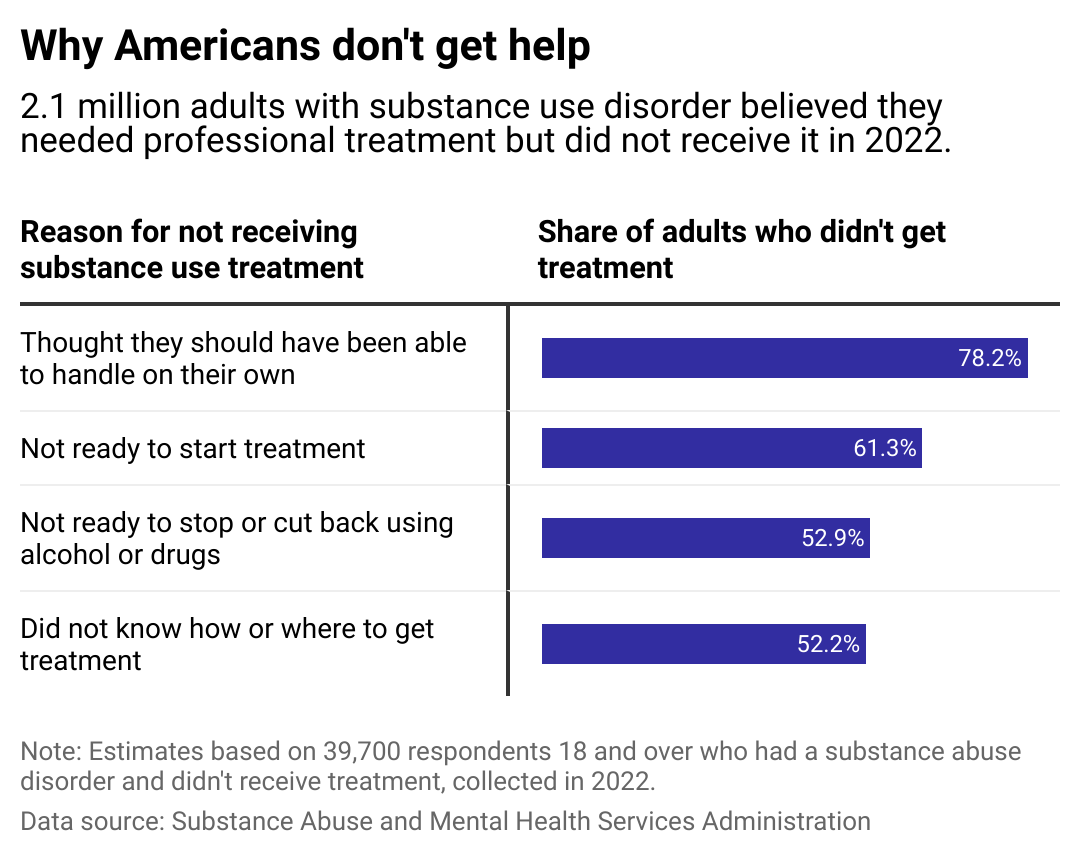
Analysis of the SAMSHA survey shows that more than three-quarters of adults who did not get treatment for SUDs in 2022 thought they should be able to manage their disease without seeking help. Not being ready to start treatment accounted for 61.3% of the top reasons, and 52.9% weren’t prepared to stop or decrease their use. The SAMHSA survey allowed for multiple answers.
People living with SUDs may be unwilling to seek treatment at a detox center or rehab program if they think their SUD isn’t “bad enough” to warrant it or if they think they can manage their disorder themselves.
The cost of care dissuaded about 48% of respondents. The average cost of drug rehabilitation is $13,475 per person, according to the National Center for Drug Abuse Statistics.
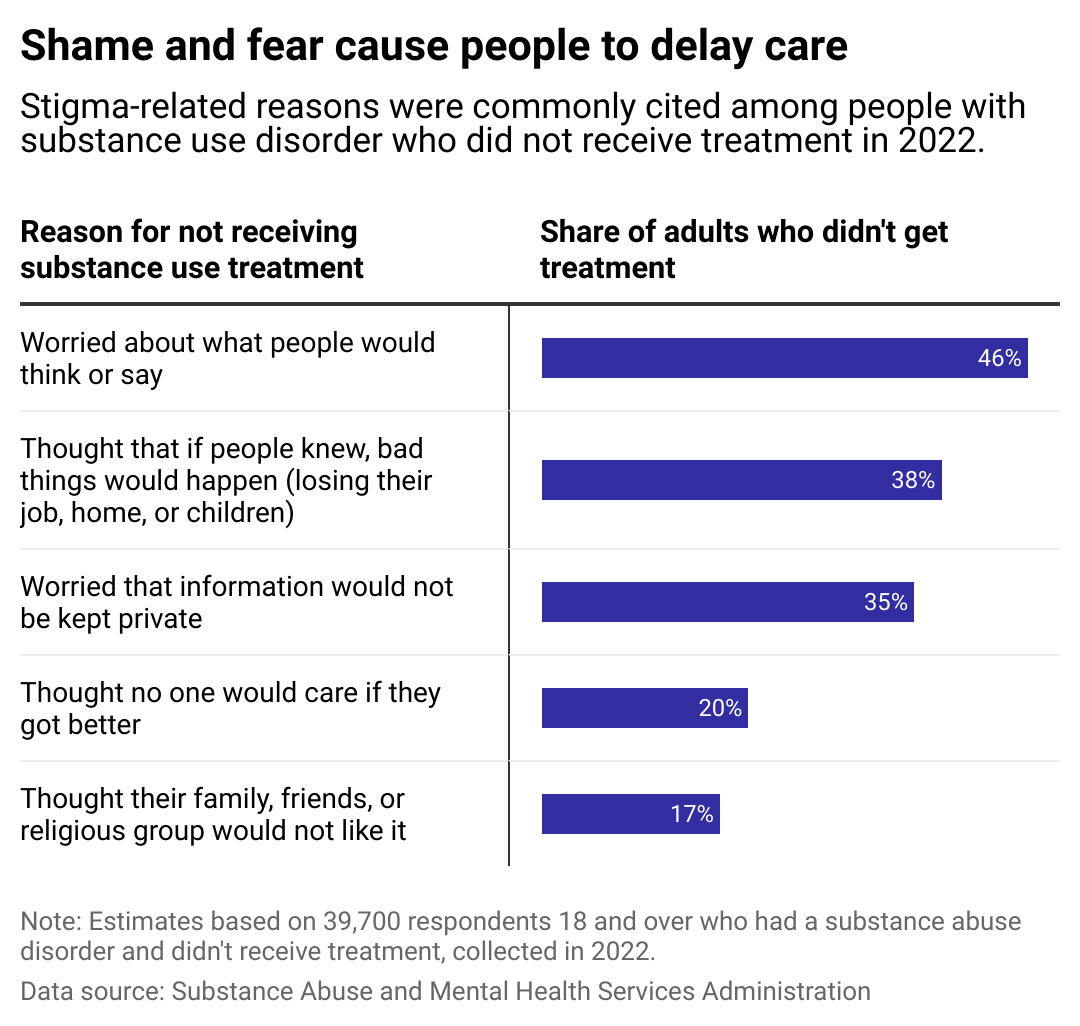
Discrimination against and stigmatization of people living with SUDs are still commonplace despite the relaxation of punitive drug policies in the U.S. Forty-six percent of those surveyed by SAMSHA said they did not pursue treatment out of worry over what others might think or say.
People’s attitudes around the cause and controllability of SUDs play into stigmatization, according to an empirical investigation published in 2010 in the Journal of Drug Issues.
How people label the behaviors of those with SUDS—or characterize the individuals themselves—can impact others’ understanding and have a domino effect on a larger scale. Public perception affects how policymakers allocate resources, the willingness of some providers to screen and address SUDs, and the desire for people living with SUDs to seek or accept treatment themselves.
Fear and shame around breaches of confidentiality are also of major concern for people with SUDs who didn’t get treatment: 38% thought that if people knew they were receiving care, negative repercussions would occur up to and including the loss of their job, home, or children. Thirty-five percent were deterred by the idea that people would find out their private information about their SUD treatment.
Stigmas also play heavily into racial inequities when it comes to treatment. Drug policies in the U.S.—such as the War on Drugs in the ’70s and the Anti-Drug Abuse Act of 1986—have historically criminalized Black Americans with substance use, deterring them from getting needed treatment.
Racial bias in the health care system further contributes to treatment gaps. In a study released in 2023 by researchers at Dartmouth’s Geisel School of Medicine and the Harvard T.H. Chan School of Public Health, white patients with opium use disorders who experienced an infection, overdose, or other high-risk event received and filled prescriptions as much as 80% more frequently than Black patients and 25% more than Hispanic patients, among Medicare beneficiaries with active OUD symptoms and disability.
The study’s authors concluded: “These disparities are unlikely to close without the structural barriers and structural racism obstructing equitable access to medications for OUD, such as stigma and geographic maldistribution of relevant providers, being addressed.”
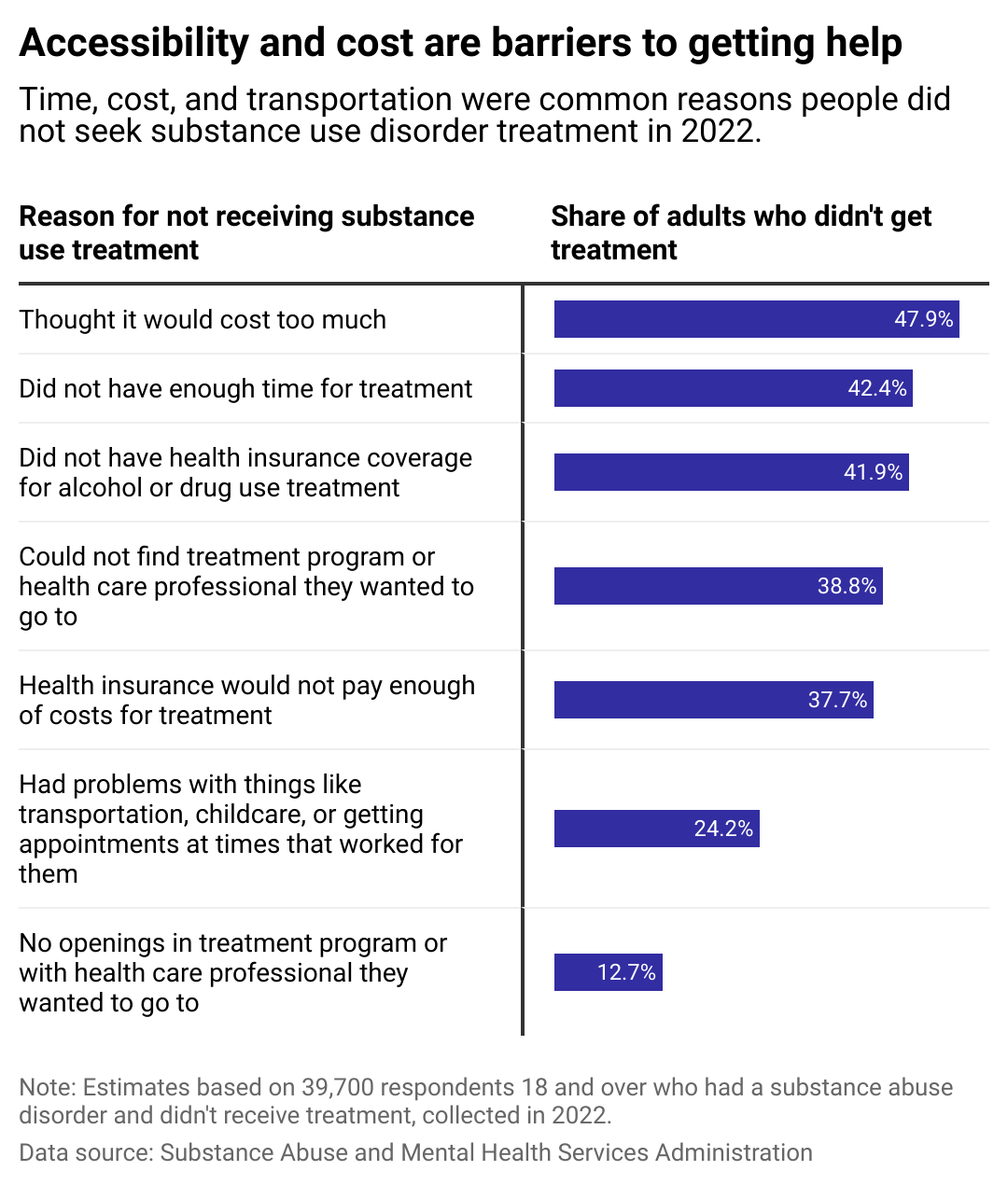
Those who do want to seek treatment may face a range of barriers inhibiting access to services, including a lack of capacity to meet demand—or, for 42% of adults living with SUDS, insufficient health insurance to cover it. Nearly 38% of respondents said their health insurance wouldn’t cover enough of the costs to make it feasible.
Treatment can also be logistically unpractical and time-intensive. People needing time off work might experience anxiety over losing their jobs and affording health care, childcare, or housing. Care may also be geographically far—even hours—away, particularly for people living rurally with large service areas. Long distances require even more logistics around transportation, time, and accommodations.
Barriers to receiving care in the U.S. can be high—but so can the toll on those not receiving vital treatment. Emergency department visits for alcohol use disorders and SUDs rose by 30% on average between 2014-2018 in the U.S. while SUDS-related hospitalizations climbed by 57%, according to a study published in the Journal of General Internal Medicine.
At the same time, experts are understanding more about gender- and race-based inequities when it comes to treatment due to a growing body of research that leverages an intersectional approach to the study of SUD treatment. Additional research like this, along with the dismantling of stigmas and increased access to essential care, can begin to remove some of the most common barriers to SUD treatment.
Story editing by Nicole Caldwell. Copy editing by Kristen Wegrzyn.
This story originally appeared on Counseling Schools and was produced and distributed in partnership with Stacker Studio.
Source: https://seattlemedium.com/why-most-americans-who-need-substance-use-disorder-treatment-dont-get-it/
After two fouled attempts to sway the Colorado Legislature that these sites will curb the state’s overdose crisis, harm reduction advocates persuaded a majority in the House Health and Human Services Committee to pass the bill on a 9-4 party-line vote.
These sites are illegal under federal law; the bill, however, appears poised to pass the House in the same party-line fashion.
While persistence may be on the proponents’ side, the facts, when thoroughly considered, are not in their corner.
Bill advocates use a sole metric of “effectiveness” to support their claim that these sites will reduce overdose deaths.
In the North American communities where these sites have been piloted, including Vancouver, British Columbia, San Francisco, and New York’s Harlem neighborhood, there are virtually no reported overdose deaths on the sites themselves. Conveniently omitted is the data showing that drug overdose rates have soared in the communities surrounding the pilot sites.
In Vancouver, where the normalization of such behavior over 20 years is likely to have had some effect, deaths due to illicit drug toxicity have risen by 840% since its first site opened in 2004. Heroin possession and trafficking incidents increased by nearly 170% from 2004 to 2018.
Still, a more thorough look at the overdose death rate should not be the sole metric used by the Colorado Legislature to evaluate comprehensive effectiveness.
One consideration is whether these sites reduce overall harm to a person struggling with addiction.
The Centers for Disease Control and Prevention classifies addiction as a medical condition, a brain disease that needs treatment.
San Francisco’s site experiment revealed that “revived” drug abusers often continue to take the drugs and overdose. There are documented cases of the same person being revived from an overdose more than 30 times, making them further subject to toxic brain injury, according to the Brain Injury Association. Repeated drug abuse destroys frontal lobe tissue, the source of motor function and judgment, and can lead to further injury to the brain, including hypoxia or brain anoxia, in which the body forgets how to breathe. Enabling the disease is hardly a benign effort.
Further, legislators should evaluate the impact on the surrounding neighborhoods. The neighbors of the sites in Harlem reported an uprising of drug markets where dealers have unlimited access to customers. At the same time, Harlem’s children are forced to navigate used syringes along the sidewalks. In San Francisco, the neighbors endured a similar experience, which led the city to shut down the site within one year of operations.
The linking of site visitors to treatment programs must also be considered. In Vancouver, less than 2% of the site visitors access treatment of any sort. In the San Francisco pilot program, it was less than 1%. Notably, the site operators in Harlem don’t measure this indicator.
Finally, Colorado legislators must consider last week’s bipartisan repeal of Oregon’s Measure 110 by its Legislature. In 2020, Measure 110 was overwhelmingly passed by Oregon voters, who were told that the decriminalization of drugs would “reduce stigma” and reduce use for those struggling with addiction. In three short years, Oregon is now one of the nation’s leaders in addiction and overdose death rates and now has the second-highest increase in homelessness in the country.
More than 1 in 10 Coloradoans struggle with addiction — one of the highest rates in the nation. Colorado’s homeless population grew by nearly 40% in 2023 over 2022. Colorado can ill afford another public policy experiment that rejects recovery and restoration that is not only possible for the individual struggling with addiction but also necessary for a functioning society.
Colorado lawmakers must serve as the backstop to this failed policy. They must look through the portal of experience versus through the narrow lens imparted by the bill’s authors to see the broad implications to all Coloradoans if HB 24-1028 were to pass.
Source: https://www.iwf.org/2024/03/29/safe-injection-sites-are-no-answer-to-addiction/

Nowadays, teaching your child to make healthy choices is crucial for their development and well-being. Understanding the importance of nutritious eating and an active lifestyle can set the foundation for a lifetime of health and happiness. This article, which has been developed by www.recoveryproud.com links to a number of sites which can help young people to keep control of their lifestyles. Additionally, a large body of generic information can be derived by visiting the National Drug Prevention Alliance.
Make your home a haven for healthy choices. Keep nutritious snacks within easy reach and involve your child in meal preparation. This not only makes healthy eating more appealing but also instills a sense of responsibility and appreciation for wholesome food. It’s a practical way to teach them about nutrition and the benefits of eating well. By letting them assist in simple cooking tasks and making choices about the meals, you empower them with knowledge and skills that foster a lifetime of healthy eating habits.
Talking to your kids about drugs is a crucial aspect of parenting that can help safeguard their future. Engaging in open and honest conversations about the dangers of drug use builds a foundation of trust and awareness. It empowers children with the knowledge to make informed decisions and resist peer pressure. This dialogue should be age-appropriate, focusing on the health risks, legal implications, and the impact on mental and emotional well-being. By fostering a supportive environment where children feel comfortable discussing their fears and curiosities about drugs, parents can guide their children towards healthy choices and provide them with coping strategies for dealing with life’s challenges.
Limiting screen time is more crucial now than ever. Encourage your child to embrace physical activities, which are essential for their health and happiness. Present alternatives that divert their attention from screens, like outdoor adventures or sports. This not only fosters physical well-being but also teaches them to value real-world experiences over digital engagements.
Instilling the value of good nutrition in your child’s mind is vital. Explain how choosing foods wisely fuels both their body and brain, supporting their growth, learning, and play. This foundation of understanding encourages them to make healthy decisions that contribute to their overall well-being. By discussing the roles of different nutrients and how they affect the body, you can make the concept of eating well more tangible and engaging for them.
Don’t Forget to Declutter
Teaching your kids about decluttering offers numerous benefits that extend well beyond a tidy home. It instills in them the value of organization and cleanliness, fostering an environment where they can think clearly and focus better on their tasks. So the next time you’re cleaning, get your kids involved. This process also nurtures decision-making skills, as children learn to differentiate between what is necessary and what is superfluous. Additionally, decluttering with your kids encourages mindfulness and appreciation for what they have, promoting a lifestyle of minimalism and sustainability. By understanding the importance of decluttering, children can develop healthier habits that contribute to their overall well-being and success in life.
Water is the body’s best friend. It keeps everything running smoothly, from digestion to maintaining a healthy temperature. Encouraging kids to drink water throughout the day is pivotal to their overall health. Simple reminders and having water easily accessible can make all the difference.
Encouraging your child to explore new foods is a journey of discovery. Introduce them to the diverse world of fruits, vegetables, and whole grains, highlighting how each contributes to their health. This exploration is not just about tasting new flavors; it’s about teaching them the benefits of a varied diet, rich in nutrients, that powers their body and mind. By making this journey exciting, you help them develop a love for foods that are good for them.
A consistent bedtime routine is key to your child’s health. Establish rituals that promote relaxation and signal to their body that it’s time to rest. Emphasizing the importance of quality sleep can help them understand how it supports their growth and readiness for daily activities, ensuring they prioritize it as part of their healthy lifestyle. This can include activities like dimming the lights, reading a story together, or practicing some gentle yoga, which can all aid in transitioning from the day’s excitement to a peaceful night’s sleep.
Teaching healthy choices to kids lays the foundation for a lifetime of wellness. By leading by example and fostering an environment where making healthy decisions is both encouraged and celebrated, parents can significantly influence their children’s habits. This journey, while requiring patience and consistency, promises a rewarding outcome for the entire family.
Further guidance can be obtained by referring to www.recoveryproud.com and to the National Drug Prevention Alliance.
Source: www.recoveryproud.com
Democratic Gov. Tina Kotek signed legislation Monday to recriminalize the possession of small amounts of certain drugs as the state grapples with a major overdose crisis, ending a legalization experiment backed by voters four years ago.
The new law makes keeping drugs such as heroin or methamphetamine a misdemeanor punishable by up to six months in prison. It also enables police to confiscate the drugs and crack down on their use on sidewalks and in parks.
Back in 2020, voters backed Measure 110, which made minor possession of personal-use amounts of certain drugs a non-criminal violation on par with a traffic ticket.
It took effect in February 2021, making Oregon the first state to officially decriminalize minor drug possession.
Since then, the Beaver State has seen a significant uptick in homelessness, homicides and overdose deaths.
In 2020, unintentional opioid overdose deaths clocked in at 472 and hit at least 628 in 2023, according to state data.
In 2022, Portland set a new record for murders with 101 — breaking the mark of 92 set the previous year.
Back in January, Kotek declared a fentanyl state of emergency in the city, saying at the time: “Our country and our state have never seen a drug this deadly and addictive, and all are grappling with how to respond.”
The new law, which will take effect Sept. 1, will let local law enforcement decide whether to give violators the chance to pursue treatment before booking them into jail
Another bill Kotek signed Monday, Senate Bill 5204, allocates $211 million to mobilize resources for behavioral health and education programs, including expanded access to substance abuse treatment and prevention education.
“Success of this policy framework hinges on the ability of implementing partners to commit to deep coordination at all levels,” Kotek emphasized in a letter to legislative leaders.
The governor further called on the Department of Corrections to ensure a “consistent approach for supervision when an individual is released” from detention and to “exhaust non-jail opportunities for misdemeanor sanctions.”
Source: https://nypost.com/2024/04/02/us-news/oregon-recriminalizes-drugs-after-upswing-in-overdose-deaths/
Historically speaking, it’s not a bad time to be the liver of a teenager. Or the lungs.
Regular use of alcohol, tobacco and drugs among high school students has been on a long downward trend.
In 2023, 46% of seniors said they had had a drink in the year before being interviewed; that is a precipitous drop from 88% in 1979, when the behavior peaked, according to the annual Monitoring the Future survey, a closely watched national poll of youth substance use. A similar downward trend was observed among eighth and 10th graders, and for those three age groups when it came to cigarette smoking. In 2023, just 15% of seniors said that they had smoked a cigarette in their life, down from a peak of 76% in 1977.
Sign up for The Morning newsletter from the New York Times
Illicit drug use among teens has remained low and fairly steady for the past three decades, with some notable declines during the COVID-19 pandemic.
In 2023, 29% of high school seniors reported using marijuana in the previous year — down from 37% in 2017, and from a peak of 51% in 1979.
There are some sobering caveats to the good news. One is that teen overdose deaths have sharply risen, with fentanyl-involved deaths among adolescents doubling from 2019 to 2020 and remaining at that level in the subsequent years.
Dr. Nora Volkow has devoted her career to studying use of drugs and alcohol. She has been director of the National Institute on Drug Abuse since 2003. She sat down with The New York Times to discuss changing patterns and the reasons behind shifting drug-use trends.
Q: What’s the big picture on teens and drug use?
A: People don’t really realize that among young people, particularly teenagers, the rate of drug use is at the lowest risk that we have seen in decades. And that’s worth saying, too, for legal alcohol and tobacco.
Q: What do you credit for the change?
A: One major factor is education and prevention campaigns. Certainly, the prevention campaign for cigarette smoking has been one of the most effective we’ve ever seen.
Some of the policies that were implemented also significantly helped, not just making the legal age for alcohol and tobacco 21 years, but enforcing those laws. Then you stop the progression from drugs that are more accessible, like tobacco and alcohol, to the illicit ones. And teenagers don’t get exposed to advertisements of legal drugs like they did in the past. All of these policies and interventions have had a downstream impact on the use of illicit drugs.
Q: Does social media use among teens play a role?
A: Absolutely. Social media has shifted the opportunity of being in the physical space with other teenagers. That reduces the likelihood that they will take drugs. And this became dramatically evident when they closed schools because of COVID-19. You saw a big jump downward in the prevalence of use of many substances during the pandemic. That might be because teenagers could not be with one another.
The issue that’s interesting is that despite the fact schools are back, the prevalence of substance use has not gone up to the pre-pandemic period. It has remained stable or continued to go down. It was a big jump downward, a shift, and some drug use trends continue to slowly go down.
Q: Is there any thought that the stimulation that comes from using a digital device may satisfy some of the same neurochemical experiences of drugs, or provide some of the escapism?
A: Yes, that’s possible. There has been a shift in the types of reinforcers available to teenagers. It’s not just social media, it’s video gaming, for example. Video gaming can be very reinforcing, and you can produce patterns of compulsive use. So, you are shifting one reinforcer, one way of escaping, with another one. That may be another factor.
Q: Is it too simplistic to see the decline in drug use as a good news story?
A: If you look at it in an objective way, yes, it’s very good news. Why? Because we know that the earlier you are using these drugs, the greater the risk of becoming addicted to them. It lowers the risk these drugs will interfere with your mental health, your general health, your ability to complete an education and your future job opportunities. That is absolutely good news.
But we don’t want to become complacent.
The supply of drugs is more dangerous, leading to an increase in overdose deaths. We’re not exaggerating. I mean, taking one of these drugs can kill you.
Q: What about vaping? It has been falling, but use is still considerably higher than for cigarettes: In 2021, about one-quarter of high school seniors said that they had vaped nicotine in the preceding year. Why would teens resist cigarettes and flock to vaping?
A: Most of the toxicity associated with tobacco has been ascribed to the burning of the leaf. The burning of that tobacco was responsible for cancer and for most of the other adverse effects, even though nicotine is the addictive element.
What we’ve come to understand is that nicotine vaping has harms of its own, but this has not been as well understood as was the case with tobacco. The other aspect that made vaping so appealing to teenagers was that it was associated with all sorts of flavors — candy flavors. It was not until the FDA made those flavors illegal that vaping became less accessible.
My argument would be there’s no reason we should be exposing teenagers to nicotine. Because nicotine is very, very addictive.
Q: Anything else you want to add?
A: We also have all of this interest in cannabis and psychedelic drugs. And there’s a lot of interest in the idea that psychedelic drugs may have therapeutic benefits. To prevent these new trends in drug use among teens requires different strategies than those we’ve used for alcohol or nicotine.
For example, we can say that if you take drugs like alcohol or nicotine, that can lead to addiction. That’s supported by extensive research. But warning about addiction for drugs like cannabis and psychedelics may not be as effective.
While cannabis can also be addictive, it’s perhaps less so than nicotine or alcohol, and more research is needed in this area, especially on newer, higher-potency products. Psychedelics don’t usually lead to addiction, but they can produce adverse mental experiences that can put you at risk of psychosis.
c.2024 The New York Times Company
Source: https://uk.news.yahoo.com/teen-drug-habits-changing-good-142032071.html?
In the run-up to the CND meeting, held in Vienna from 14 to 22 March 2024, it was not clear that member states would be able to reach a consensus on the outcome of the review, reflecting growing challenges to multilateralism. However, after more than 120 hours of negotiations since January 2024, states seemed to keep the UN in Vienna’s usual cooperative spirit alive by adopting a declaration. They committed to broadly agreed compromises to address the ‘world drug problem’ (although many states no longer refer to drugs as a ‘problem’) in accordance with the principles of the UN Charter and international human rights law, and expressed concern about the proliferation and harm of synthetic drugs.
Although consensus was reached, two statements were subsequently issued outlining starkly opposing approaches to drug policy from different sides of the camp. One, delivered by Colombia and representing 62 countries, including most of Europe and the Americas, called for a review and reassessment of the international drug control system, and supported human rights. The other, delivered by Russia and supported by 40 countries, criticized the legalization of cannabis and called for a ‘society free of drug abuse’, echoing an approach to drug policy that prevailed before the UN General Assembly’s landmark special session on drugs in 2016.
The apparent consensus on the declaration was reflected in the fact members showed near unanimity in adding a number of substances to be controlled under the conventions. However, the deeper current of polarization on drug policy seen in the two opposing statements would resurface with dramatic effect when two of the session’s resolutions failed to reach consensus and had to be put to a vote, breaking with longstanding practice in Vienna.
A paradigm shift on harm reduction
Only two of the four resolutions managed to bypass the political drama. The first was a resolution tabled by Chile on promoting recovery and related support services for people with drug-use disorders. The second was a resolution tabled by Belgium, on behalf of the EU, on promoting awareness raising, education, training and data collection to ensure the availability of and access to controlled substances for medical and scientific purposes, while preventing their diversion to illicit channels and non-medical use. Despite extensive debate, both resolutions were adopted by consensus on the penultimate day.
The other two resolutions were put to a vote on the final day. A resolution on alternative development, tabled by Germany, Thailand and Peru, which sought to build on previous efforts (including its predecessor, the resolution adopted in 2023), faced resistance and attempts to change the agreed language. It was held hostage mainly by Iran’s opposition to the inclusion of language on gender and technology transfer (a common dividing line in UN-based processes), as well as attempts to insert language opposing sanctions. The resolution was adopted by a majority vote during the final plenary session.
A resolution on overdose prevention and harm reduction, tabled by the US, received the most attention and resulted in a monumental shift in CND practice, approach and policy. The term ‘harm reduction’, which is recognized by the World Health Organization and widely used throughout the UN system, has long been opposed by states with a more conservative approach to drug policy and was therefore the main obstacle to achieving consensus on the resolution.
The US, which had traditionally opposed the use of the term, introduced the resolution in the context of its opioid crisis, stressing the importance of implementing effective measures and initiatives to minimize the negative public health and social consequences of the non-medical use of synthetic drugs. After lengthy discussions, during which the text was significantly watered down, the resolution was put to a vote, as it was made clear that countries leading advocacy for both sides of the debate would accept a compromise. Russia, who led the opposition to including the term, criticized the adoption process, claiming that it deviated from the norms of the CND. China reiterated its reservations on harm reduction and emphasized the need for a comprehensive approach to global drug issues, highlighting the lack of consensus in the international community on this issue. Most members of the commission (38 out of 53) supported the resolution – including some unexpected states, such as Singapore, Indonesia and Saudi Arabia, all of which take a hard line on drug policy. China and Russia voted against it but were unable to bring more ‘middle ground’ countries into their camp.
The positions of African countries on this resolution were remarkably divided, with the more progressive drug policy environments – represented by Morocco, Ghana and South Africa – voting in favour, but Nigeria and Kenya (two of the most active African delegations in Vienna) choosing not to take part in the vote. Algeria, which has a drug policy and political-ideological stance more in line with China and Russia, chose to abstain. The outcome shows how realpolitik played a key role in the voting process, alongside genuine views on drug policy.
The use of the term ‘harm reduction’ in a resolution is a landmark achievement in drug policy and represents a clear and overdue shift towards a public-health approach to drugs at the UN. This opens the door for more progressive approaches to drugs to be considered by the CND, as the ‘Vienna spirit’ (whereby UN resolutions are adopted by consensus) has clearly held back progress on drug policy. However, the wider implications for drug policy and for the broader range of decision-making forums in Vienna are still unclear, and there will undoubtedly be efforts by opponents of progressive drug policy to organize pushback.
The different perspectives were also reflected in the politics of civil society representation at the CND. The Vienna NGO Committee on Drugs held elections that ended up shifting the composition of its committee towards a more conservative representation, moving in the opposite direction to member states. This change is clearly due to political coordination in this committee, rather than a shift in opinion in civil society as a whole. But these divisions, and the way civil society on both sides of the debate respond to them, carry the risk that the growing differences between member states will be magnified by disagreements within civil society groupings, potentially exacerbating polarization at the CND.
All eyes on synthetics
Besides this resolution, the priority attention given by the US to address the harms caused by synthetic drugs was tangible during this session. Prior to the meeting, the US highlighted its priority of placing two additional fentanyl precursor chemicals under international control, which the commission unanimously adopted, and the US-led Global Coalition to Address Synthetic Drug Threats was heavily promoted during the meeting, including through the presence of US Secretary of State Anthony Blinken, who addressed member states to condemn the harm caused by synthetic opioids and pledge support to combat illicit synthetic drug threats around the world. Other member states organized several events on the topic, demonstrating a growing level of attention to this issue.
This strong focus is a good indicator of how worrying these substances are becoming in the eyes of member states. The rapid increase in the production, trafficking and use of synthetic drugs in recent years, and particularly in the last two, has caught many states by surprise. The results of the 2023 Global Organized Crime Index show that 187 of the 193 UN member states have a domestic market for synthetic drugs – more than the number of countries with a heroin market. Synthetic drugs are proving to be the future of illicit drug economies, and CND member states are quickly recognizing this, as well as the fact that they are currently ill-prepared to respond to the threats that these substances pose to public health and security.
Increased focus on human rights
The CND also made progress in advancing the agenda on the impact of drug policies on human rights. For the first time, a UN High Commissioner for Human Rights, Volker Türk, attended the meeting in person. Türk urged member states to adopt a transformative stance on drug policy, highlighting the serious human rights consequences of the ‘war on drugs’, the challenges facing member states (as addressed in his 2023 report to the UN Human Rights Council), and the need to focus on the right to health of people who use drugs and the right of women to equal access to services.
Türk also welcomed the positive steps taken by countries such as Portugal and Switzerland to adopt health- and rights-based approaches to drug policy, and the renewed commitment to human rights in the declaration adopted by the CND. At the meeting, several side events focused on the human rights implications of punitive approaches to drug policy, including in relation to the enjoyment of economic, social and cultural rights (such as the right to work, and an adequate standard of living and housing). This would indicate evidence of a growing trend to consider the relationship between human rights in general and the impact of drug policy, rather than focusing solely on the right to health and life, as has been the norm.
A step forward, but what next?
The headline results of the CND were not only due to the politics of drug policy. This outcome came about because of widespread frustration among Western and other countries with Iran’s strong-arm tactics across the board in the UN’s sessions in Vienna. Their exploitation of the ‘Vienna spirit’ ultimately led to its demise, and prompted coordination and common cause among various delegations from different regional groups – with a coming together of Colombian, US and European interests in the CND.
Once the dust settles, it is uncertain how member states will respond to these changes, but it is clear that the contours of the drug policy debate have fundamentally shifted and the facade of consensus has visibly crumbled after years of slow but steady erosion. This should come as no surprise and will be seen by many as a natural conclusion, confirming how far the debate has moved on and matured. There will undoubtedly be moves from both sides of the debate to capitalize on votes to advance particular policies and to push back on issues that pass through the CND without consensus.
While progress towards agreeing on more humane approaches to global drug markets and use at the CND is a great step in the right direction, it also formalizes and deepens the different stances dividing the opposing camps. This points to an uncertain and polarized future for international drug policy when the harms of associated illicit markets, such as synthetics, require coordinated action.
Source: https://globalinitiative.net/analysis/uncertain-future-drug-policy-commission-narcotic-drugs-united-nations/
|
How families can help prevent teen substance use disorder
If you or someone you know is in immediate need of help for substance use, or any mental health crisis, the national 988 Lifeline is the best place to start. You can call or text 988 from any phone, or connect via webchat.
Recent studies, both nationally and at Michigan Medicine, report that alcohol, cannabis and nicotine vaping are the most commonly used substances among teens.
Aside from cannabis and prescription drug misuse, teens report relatively low use of illicit substances. Despite this, teen drug overdose deaths have been on the rise in recent years. Monthly overdose deaths among youth aged 10-19 more than doubled from 2019 to 2021.
Parents and caregivers should actively be on the lookout for signs and symptoms of substance use. Addressing substance use early on can help prevent addiction or other problems later in life.
An expert from the University of Michigan Addiction Center recently spoke about the impacts of teen substance use and what families can do to help youth who may be at risk or showing signs of addiction.
Meghan Martz, Ph.D., a research assistant professor of psychiatry, explains concerning trends surrounding adolescent substance use. Although levels have stabilized in recent years, there are new factors for parents to consider.
When it comes to alcohol use, binge drinking remains the leading concern. This harmful consumption pattern can lead to blackouts, vomiting, overdose and mental and physical health problems.
Vaping nicotine products also remains popular among teens. Martz says the flavored products cater directly to its young audience, posing a serious risk of addiction for adolescents.
As cannabis legalization has become widespread, perceptions of harm have decreased, and rates of cannabis use have increased tremendously. In 2023, 29% of 12th graders reported cannabis use in the past year.
“The level of THC is much stronger in cannabis products used today, and there is a direct link between higher potency and risk for disordered use,” Martz said, describing the substance in cannabis that causes most of the “high” sensation that users feel.
Parents should particularly monitor for opioids, even if the use rates are lower than other substances. Due to drugs laced with fentanyl, a highly potent synthetic opioid, there has been a recent surge in overdose deaths.
The exact reasons for substance use can vary, “but teens are the most vulnerable population for disordered use,” Martz said.
It all starts with a curiosity about substances. Ten percent of 9- and 10-year-olds reported curiosity to use alcohol and nicotine, according to research Martz led. The desire to fit in socially can significantly influence the decision to try substances, and teens tend to overestimate the prevalence of substance use among their peers.
Factors that can lead to substance use in teens include:
It’s important to remember that “the risk factors present in teens are associated with the development of the adolescent brain,” said Martz.
Three key functions of the brain are associated with substance use: reward, emotion and cognitive control.
The reward circuit involves the release of dopamine, a naturally occurring chemical attributed to feelings of pleasure. People become hooked to this false sense of happiness and develop an addiction to the drug supplying it.
Similarly, drugs can influence the emotion circuit by reducing feelings of anxiety, irritability and unease. The addiction is reinforced through a cycle of withdrawal symptoms that can range from mild discomfort to life-threatening complications.
But for adolescents, it is the cognitive control circuit that makes them most susceptible to substance use. This brain function is responsible for thinking, planning and problem solving.
“The cognitive control circuit is the last part of the brain to mature,” Martz said.
“This makes youth more prone to act on impulse and engage in risky behaviors, including substance use.”
Teens are also less likely to experience immediate consequences of substance use – such as hangovers – leading to greater consumption and more damaging neurotoxic effects.
Substance use and addiction prevention starts in the home. Parents are the first line of defense against potential drug use disorders.
There is no guarantee that your child won’t use substances, but it is less likely to happen if you:
“As a parent, you may not be able to control the external influences, but you can certainly start the conversation early and set firm boundaries to protect your child from substance use,” Martz said.
Source: https://www.michiganmedicine.org/health-lab/what-parents-should-know-about-teen-drug-and-alcohol-use
The second-annual video challenge is a part of a joint nationwide education initiative titled Operation Prevention that educates students about the science behind addiction and its impact on the brain and body. Available at no cost, the initiative’s resources help promote lifesaving discussions in the home and classroom.
Teens are agents of change, and their actions speak volumes to peers. Together, we can work toward raising awareness, and most importantly, prevention, among our youth population, said Acting Administrator Robert W. Patterson. The video below was one of the entries and was powerful and instructive.
Source: https://www.operationprevention.com/competition/video/archives/2019
Cannabis and cannabinoids are implicated in multiple genotoxic, epigenotoxic and chromosomal-toxic mechanisms and interact with several morphogenic pathways, likely underpinning previous reports of links between cannabis and congenital anomalies and heritable tumours. However the effects of cannabinoid genotoxicity have not been assessed on whole populations and formal consideration of effects as a broadly acting genotoxin remain unexplored. Our study addressed these knowledge gaps in USA datasets. Cancer data from CDC, drug exposure data from National Survey of Drug Use and Health 2003–2017 and congenital anomaly data from National Birth Defects Prevention Network were used. We show that cannabis, THC cannabigerol and cannabichromene exposure fulfill causal criteria towards first Principal Components of both: (A) Down syndrome, Trisomies 18 and 13, Turner syndrome, Deletion 22q11.2, and (B) thyroid, liver, breast and pancreatic cancers and acute myeloid leukaemia, have mostly medium to large effect sizes, are robust to adjustment for ethnicity, other drugs and income in inverse probability-weighted models, show prominent non-linear effects, have 55/56 e-Values > 1.25, and are exacerbated by cannabis liberalization (P = 9.67 × 10 –43 ,2.66 × 10 –15 ). The results confirm experimental studies showing that cannabinoids are an important cause of community-wide genotoxicity impacting both birth defect and cancer epidemiology at the chromosomal hundred-megabase level.
Source: https://www.nature.com/articles/s41598-021-93411-5.epdf July 2021

Kratom, in powder form, can be taken in capsules or brewed into a tea.

A kratom leaf, the source of an herbal supplement that users say can provide pain relief and relieve insomnia, among other uses.
Vivian Allen sought chronic pain relief.
A car wreck left the 55-year-old grandmother immobilized. Six subsequent back surgeries led to severe nerve damage. A doctor advised implanting a morphine pump but Allen, from Walker, Louisiana, worried about the southern climate. A morphine pump implant could not withstand 90-degree heat and could kill her.
She felt desperate.
When a friend from a Facebook group suggested kratom, the herbal supplement derived from leaves of a Southeast Asian tree, Allen decided to try it.
“I couldn’t believe it,” she said. “It alleviated my symptomatic problems and it helped me have a functional life without having to get the implant.”
Kratom, which she began taking in 2015, also allowed her to wean herself from the Xanax pills she’d been prescribed for more than two decades.
“People take kratom because they need it,” she said. “It’s that simple. Very few people take it recreationally.”
But if lawmakers have their way, Allen and other kratom users throughout Louisiana could be out of luck.
A bill set to criminalize kratom in Louisiana was passed several weeks ago.
The legislation, prompted by a Louisiana Department of Health (LDH) report and pushed through by state Rep. Chris Turner, R-Ruston, was passed unanimously by the Senate and the House and signed into law June 11 by Gov. John Bel Edwards.
Kratom will be banned under the act if the U.S. Drug Enforcement Administration (DEA) categorizes it as a Schedule I drug. The category, which includes drugs like heroin, ecstasy and peyote, indicates a lack of medical use and suggests a high potential for abuse.
This move to classify kratom as Schedule I has been attempted before. In 2016, the DEA listed kratom as a “drug and chemical of concern” and temporarily banned it. It’s currently illegal in Alabama, Arkansas, Indiana, Rhode Island, Vermont, and Wisconsin. Other states, including Colorado, Nevada, Illinois and Florida, have outlawed kratom in certain jurisdictions.
The U.S. Food and Drug Administration (FDA) hasn’t approved kratom for human consumption either. In June, the FDA expressed disdain when addressing kratom distributors in Folsom, California and Wilmington, North Carolina for making false medical assertions.
“Despite our warnings, companies continue to sell this dangerous product and make deceptive medical claims that are not backed by science or any reliable scientific evidence,” FDA Commissioner Ned Sharpless said in a statement. “As we work to combat the opioid crisis, we cannot allow unscrupulous vendors to take advantage of consumers by selling products with unsubstantiated claims that they can treat opioid addiction or alleviate other medical conditions.”
The FDA continued to state that “substances” in kratom have opioid properties “that expose users to the risks of addiction, abuse and dependence.”
“There are no FDA-approved uses for kratom, and the agency has received concerning reports about the safety of kratom,” the statement said. “The FDA encourages more research to better understand kratom’s safety profile, including the use of kratom combined with other drugs.”
The FDA also has recommended classifying kratom as a Schedule I drug.
So what exactly is kratom?
Originating from a Southeast Asian evergreen tree, kratom (Mitragyna speciosa) leaves contain mitragynine and 7-a-hydroxymitragynine, organic compounds that target opioid receptors in the brain. It can be taken in capsule or powder form or brewed into a tea. There are several strains including Maeng Da, which is said to boost energy; Red Vein Kali, commonly taken for sedation; and Green Vein Kali, known to treat pain.
Although they work on the same receptors as opiates, they don’t have the same chemical properties.
Wesley Nance, 26, a singer who lives in New Orleans and works at The Herb Import Company in Mid-City, said he used two strains of kratom to ease scoliosis pain.
He took 2 grams of Green Vein Kali in the morning for his aching, and 2 grams of Red Vein Kali at night so he could sleep without discomfort.
“It made my pain go away,” he said. “I was amazed.”
Nance was wary of pharmaceutical drugs after seeing his mother’s addiction to opioids, he said. “Kratom helped me change the family history,” he said. “It helped me heal naturally.”
Scott Ploof, 35, publisher of Big Easy Magazine, began using it after the death of his grandfather.
“It helped me alleviate anxiety and depression in a natural way,” he said.
Ploof believes a partisan political climate is undermining the reality of the drug’s benefits and possible risks. “Politics is getting in the way of reason,” he said. “Kratom is a safe, natural, herbal alternative supplement that can be used to treat a variety of issues and is better than a lot of what else is out there.”
Kratom also has been praised by former opioid users.
Neal Catlett, 39, of Lexington, Kentucky, became hooked on oxycodone and morphine in 2015 after a shoulder injury. He credits kratom with helping him kick the prescription medications by easing withdrawal symptoms and physical pain.
“It’s a lifesaver for those who suffer from drug addiction,” he told Gambit. “It’s an amazing plant.”
The LDH, however, outlined different results of kratom use. The department’s 14-page report, released in February, points to dangers.
In 2017, the FDA reported 44 to 47 deaths related to kratom use, with one caused by “pure kratom.” The rest resulted from mixing other drugs with kratom, including fentanyl, diphenhydramine, caffeine, and morphine. Kratom also was associated with a national salmonella outbreak from January 2017 to May 2018 that affected 199 people ranging from 1 to 75 years old. No deaths were recorded but one-third of the individuals needed hospitalization, the report said.
“Heavy users of kratom often lose weight, become tired and suffer constipation,” the report said. “Facial redness may also occur. Repeated doses of 10 to 25 grams of dried leaves cause perspiration, dizziness, nausea, and dysphoria (a state of unease or generalized dissatisfaction with life), which become quickly replaced by a state of calm, euphoria and a dreaming state which may last up to six hours. The LDH concluded by advocating for a ban.
“Kratom currently has no accepted medical uses,” it goes onto say. “Therefore, the Louisiana Department of Health recommends that kratom be banned from general consumption in the state, with exceptions made only in the context of well-designed scientific studies with appropriate oversight, data safety monitoring boards and regulatory approval.”
LDH spokeswoman Mindy Faciane told Gambit the decision was made with consumer well-being in mind. “The Louisiana Department of Health supports any efforts that help make Louisiana residents safer,” Faciane said.
Kratom has been a boon for New Orleans businesses that sell it, despite any risks. Uxi Duxi in Mid-City and Mushroom New Orleans in Uptown sell kratom products to loyal customers.
Ashley Daily, who owns the Euphorbia Kava Bar in Riverbend, said kratom accounts for more than 50 percent of her business. A ban “wouldn’t shut me down,” she said, “but it would make me very broke and it would affect my employees.”
After five years in business, she is making a profit for the first time, largely because of kratom — but Daily said it’s about more than commerce. “It’s what [a ban] would do to my customers who depend on kratom,” she said. “Twenty percent of my clientele use it as a natural painkiller. Other ex-users get off opioids with it and it truly helps them.”
Christopher Hummel, owner of Mushroom New Orleans, began selling kratom about seven years ago but only saw a sales uptick in the past two years.
“People are now trying to avoid prescription painkillers, and they take kratom so they don’t have to [take them],” he says. “Banning it would cause a major health issue.”
Reza Hardinata, 20, a native of Pontianak, Indonesia, told Gambit kratom is his family’s main source of income. His father harvests it and Hardinata sells kratom to local companies that export the substance each month. “Kratom is very helpful in terms of health, addiction and pain relief and also improves the economy of my family and also the community,” he said. “This [ban] is very unfortunate.”
Others who study the science behind kratom believe the FDA is amplifying adverse effects while ignoring empirical data. Marc T. Swogger, an associate professor in the Department of Psychiatry at the University of Rochester Medical Center, conducted peer-reviewed research on kratom. Although no clinical trials to examine kratom’s benefits have been directed in America, he said, “observational studies” in the United States and Southeast Asia have been “compelling.”
“Across samples, people report pain relief, relief of anxiety or depressed mood, and the utility of kratom to serve as an opioid replacement, easing symptoms of opioid withdrawal,” he said.
Swogger believes criminalization would set up a “new and vibrant black market” for kratom.
“In addition to being ineffective, a kratom ban would be wrong,” he said. “People are using kratom to help with difficult conditions and reporting success. For some of them, lack of access to kratom would lead to the increased use of classical opioids, setting the stage for yet more overdoses.”
The Kratom Information & Resource Center (KIRC) last week launched a campaign to get journalists to cover kratom with “fair and balanced” reporting.
“This is a legal product that is being used by informed adults in the privacy of their homes and dedicated commercial establishments,” KIRC spokesman Max Karlin said in a statement. “If kratom were as much of a problem as it has been made out by some organizations engaging in reckless ‘Leafer Madness’ rhetoric, America’s hospitals and ERs would be choked. … Instead, experts can’t agree whether there has been even one kratom-related death in the U.S.”
McClain “Mac” Haddow, senior fellow on public policy at the American Kratom Association (AKA), agrees, and believes the approximately 5 million kratom users in the U.S. should have access to a regulated product.
That’s why Haddow and the AKA are working with politicians to enact the Kratom Consumer Protection Act, which aims “to regulate preparation, distribution, and sale of kratom products” to prohibit adulterated or contaminated kratom. He believes selling to people over 18 and ensuring the purity of the kratom would be more helpful than a ban.
“If you ban it, people in the kratom community will die,” he says.
Instead, he believes in regulatory measures and thinks kratom advocates in Louisiana will prevail in the end.
“The Louisiana ban is not as bad as it sounds,” he said. “We’re pretty comfortable on the federal side that there is movement. We’re more and more confident that we’re being heard.”
Haddow said he plans to work with Rep. Turner’s office to enact the Kratom Consumer Protection Act in Louisiana during the next legislative session.
Allen, who testified in a June judiciary hearing in Baton Rouge about kratom use, said passing the act would be the most effective compromise. “Having the Kratom Consumer Protection Act is the best thing for Louisiana,” she says. “Consumers need to be protected but they shouldn’t lose what helps them. Mine is only one of 5 million stories. People shouldn’t be denied the ability to heal.”
Source: https://www.theadvocate.com/gambit/new_orleans/news/the_latest/article_b6261ece-b23e-11e9-8739-6f4af0786d5a.html 5 Aug. 2019

Nearly half of all U.S. citizens now live in a state where they can purchase cannabis from a recreational market, and all but 13 states have legalized medical use. These state-level policies have all been developed and adopted under a federal prohibition, which may be changing soon as lawmakers in both the House and the Senate are developing federal proposals to legalize cannabis.
A new USC Schaeffer Center white paper shows how state-level cannabis regulations have weak public health parameters compared to other countries, leaving consumers vulnerable. Federal legalization is an opportunity to implement regulations that better protect consumers and promote reasonable use. Regulations policymakers should consider include placing caps on the amount of the main intoxicant (THC) allowed in products sold in the marketplace and placing purchase limits on popular high-potency cannabis products, like edibles and vape cartridges, as has been done in other legalized jurisdictions abroad.
“Allowing the industry to self-regulate in the U.S. has generated products that are more potent and diverse than in other countries and has led to a variety of youth-oriented products, including cannabis-infused ice cream, gummies and pot tarts,” says Rosalie Liccardo Pacula, a senior fellow at the USC Schaeffer Center and Elizabeth Garrett Chair in Health Policy, Economics & Law at the USC Price School of Public Policy. “Current state regulations and public advisories are inadequate for protecting vulnerable populations who are more susceptible to addiction and other harm.”
High-potency cannabis products have been linked to short-term memory and coordination issues, impaired cognitive functions, cannabis hyperemesis syndrome, psychosis, and increased risks of anxiety, depression and dependence when used for prolonged periods. Acute health effects associated with high-potency products include unexpected poisonings and acute psychosis.
Product innovation within the legal cannabis industry has outpaced state regulations and our knowledge of health impacts of nonmedical, adult-use cannabis, write Pacula and her colleagues. Cannabis concentrates and extracts can reach concentrated THC levels of 90% in certain cases – many, many times more potent than dried flower that ranges between 15-21%. These products are also increasingly popular – sales for concentrates like vape pens rose 145% during the first two years of legalization in Washington state.
But state approaches to regulation have insufficiently considered quantity and potency limits. Just two states, Vermont and Connecticut, have set potency limits on both flower and concentrates. Most states base sales limits on product weight and product type, an approach that allows individuals to purchase excessive amounts of high-potency products in a single transaction.
An individual in most states can purchase 500 10-milligram servings of concentrates in a single transaction. Six states allow purchases that exceed 1,000 servings. By comparison, a full keg of beer, which usually requires registration, provides 165 servings of alcohol.
“Voters in many of these states supported legalization because they were told we would regulate cannabis like alcohol, but in reality, when it comes to product innovation, contents and standard serving sizes, the cannabis market has largely been left on its own,” says Seema Pessar, a senior health policy project associate at the USC Schaeffer Center. “And that is what is concerning for public health.”
“We are seeing evidence of real health consequences from this approach, especially among young adults,” explains Pacula. For example, studies show a rise cannabis-related emergency department visits for acute psychiatric symptoms and cyclical vomiting in states that legalize recreational cannabis.
To better regulate legal cannabis markets and products, researchers find four policy areas in which state laws and federal proposals can do more to encourage responsible use.
While generating tax revenue and reversing damages from prohibition are important, so is prioritizing public health — and prolonged use of high-potency cannabis products has health consequences, the researchers write.
“It is difficult to implement restrictive health regulations in markets that are already operating, generating jobs and revenue,” Pacula says. “Now is when the federal government has the best chance of ensuring a market that fully considers public health.”
Source: Cannabis Regulations Inadequate Given Rising Health Risks of High-Potency Products – USC Schaeffer July 2022
Background
Previous research suggests an increase in schizophrenia population attributable risk fraction (PARF) for cannabis use disorder (CUD). However, sex and age variations in CUD and schizophrenia suggest the importance of examining differences in PARFs in sex and age subgroups.
Methods
We conducted a nationwide Danish register-based cohort study including all individuals aged 16–49 at some point during 1972–2021. CUD and schizophrenia status was obtained from the registers. Hazard ratios (HR), incidence risk ratios (IRR), and PARFs were estimated. Joinpoint analyses were applied to sex-specific PARFs.
Results
We examined 6 907 859 individuals with 45 327 cases of incident schizophrenia during follow-up across 129 521 260 person-years. The overall adjusted HR (aHR) for CUD on schizophrenia was slightly higher among males (aHR = 2.42, 95% CI 2.33–2.52) than females (aHR = 2.02, 95% CI 1.89–2.17); however, among 16–20-year-olds, the adjusted IRR (aIRR) for males was more than twice that for females (males: aIRR = 3.84, 95% CI 3.43–4.29; females: aIRR = 1.81, 95% CI 1.53–2.15). During 1972–2021, the annual average percentage change in PARFs for CUD in schizophrenia incidence was 4.8 among males (95% CI 4.3–5.3; p < 0.0001) and 3.2 among females (95% CI 2.5–3.8; p < 0.0001). In 2021, among males, PARF was 15%; among females, it was around 4%.
Conclusions
Young males might be particularly susceptible to the effects of cannabis on schizophrenia. At a population level, assuming causality, one-fifth of cases of schizophrenia among young males might be prevented by averting CUD. Results highlight the importance of early detection and treatment of CUD and policy decisions regarding cannabis use and access, particularly for 16–25-year-olds.
Source: Association between cannabis use disorder and schizophrenia stronger in young males than in females | Psychological Medicine | Cambridge Core May 2023
Drug Free America Foundation is launching its new digital advertisement campaign targeting viewers in Illinois. The digital animated ad is the second in a series titled “Marijuana…Know the Truth” and discusses the real dangers of marijuana use.
As you know, Illinois is a state that is considering legalizing recreational marijuana this year. We hope this ad campaign will help address the misconceptions about the real dangers of marijuana use
This digital advertising campaign will utilize banner ads to drive viewers to our website where they can view the 2-minute ad. We are excited to say that through a generous donation, this campaign will provide over 10 million digital impressions in Illinois. We are hopeful that through additional donations, we are able to expand this campaign to other states and continue to spread the word on the dangers of marijuana.
Email from Drug Free America Foundation https://www.dfaf.org/ March 2019
A pilot study by Addiction Switzerland traced the alcohol incentives on the routes of 16 to 19-year-old adolescents in everyday life and in social networks. On average, the test subjects in the five largest Swiss cities encountered an alcohol incentive every five minutes. Alcohol was also omnipresent in social networks, transported by friends and influencers, who are often paid for it. The study showed the frightening normality of alcohol in the everyday life of adolescents.
Alcohol marketing is aimed strongly at young people, as they are the customers of tomorrow. A pilot study by Addiction Switzerland , financed by the Federal Customs Administration, looked into the question of how much adolescents are actually exposed to alcohol stimuli. The study layout was partly based on an earlier study on tobacco marketing : Here, too, the typical routes and activities taken by young people in everyday life and when going out in Geneva, Lausanne, Bern, Basel and Zurich were traced. All alcohol incentives encountered were systematically recorded. In addition, the alcohol incentives encountered by the young people in social networks were recorded.
At least half of the incentives are intentional
On average, the distances (including activities such as sports, cinema, restaurant, etc.) were covered within six hours each. 73 alcohol stimuli were recorded per trip, which means, on average, a reminder of the alcohol every five minutes! It should be said that the investigation in autumn 2020 came at a time when the Covid measures were becoming stricter again and the exit bars were closing again, and fewer events were taking place in public spaces. It can be assumed that advertising activity has been reduced accordingly during this period.
Half of the stimuli recorded related to alcohol advertising or the promotion of alcoholic beverages. The other half consisted of apparently random alcohol stimuli: Empty bottles and cans in public spaces, depictions of where alcohol plays a role (e.g. an occasion where people drink), what is offered on a menu card, etc.
In addition, all perceived prevention messages should be recorded. But it turned out that these were almost completely absent on the paths of the young people.
On social media: the power of images and influencers
Alcohol marketing has partly shifted to the internet. 85% of young people between the ages of 12 and 19 spent an hour or more per day on the Internet in 2019 , the majority of them are also on social networks, which has probably increased during the pandemic . On Snapchat, Instagram and Tiktok in particular, they receive numerous pictures and messages from friends and acquaintances who have alcohol as their topic. The alcohol advertising by influencers is also noticeable.
A society banalizing alcohol does not protect its youth
The results of this pilot study impressively show how strongly young people are already confronted with alcohol. It becomes normal for them to include alcohol. This is alarming in view of the around 400 young people who are admitted to hospital in Switzerland every year because of alcohol poisoning. A large part of these alcohol stimuli is consciously placed or at least it is tolerated that adolescents are also advertised. Sucht Switzerland therefore calls for the measures to be taken to protect young people to be stepped up. These include the restriction of alcohol advertising and thus the reduction in the attractiveness of alcohol among young people.
Source: mportner-helfer @ suchtschweiz.ch May 2021
Moderate alcohol consumption is widespread but its impact on brain structure and function is contentious. The relationship between alcohol intake and structural and functional neuroimaging indices, the threshold intake for associations, and whether population subgroups are at higher risk of alcohol-related brain harm remain unclear. 25,378 UK Biobank participants (mean age 54.9 ± 7.4 years, 12,254 female) underwent multi-modal MRI 9.6 ± 1.1 years after study baseline. Alcohol use was self-reported at baseline (2006–10). T1-weighted, diffusion weighted and resting state images were examined. Lower total grey matter volumes were observed in those drinking as little as 7–14 units (56–112 g) weekly. Higher alcohol consumption was associated with multiple markers of white matter microstructure, including lower fractional anisotropy, higher mean and radial diffusivity in a spatially distributed pattern across the brain. Associations between functional connectivity and alcohol intake were observed in the default mode, central executive, attention, salience and visual resting state networks. Relationships between total grey matter and alcohol were stronger than other modifiable factors, including blood pressure and smoking, and robust to unobserved confounding. Frequent binging, higher blood pressure and BMI steepened the negative association between alcohol and total grey matter volume. In this large observational cohort study, alcohol consumption was associated with multiple structural and functional MRI markers in mid- to late-life.
Source: Alcohol consumption and MRI markers of brain structure and function: Cohort study of 25,378 UK Biobank participants – ScienceDirect May 2022

Aaron Hernandez was supposed to be the epitome of the American Dream—overcoming childhood setbacks to earn a spot in the NFL on the New England Patriots. Millions of kids across America wish they could be so lucky. But the 2020 documentary on Netflix, “Killer Inside: The Mind of Aaron Hernandez,” takes a deep dive into his life to investigate how his dream unraveled into a nightmare. Convicted of murdering his friend Odin Lloyd and accused of killing two other men (but found not guilty), Hernandez took his own life in a prison suicide in 2017. He was only 27.
The compelling docuseries explores many of the factors that could have contributed to the tragic end of such a promising life—childhood abuse, unstable parenting, hidden bisexuality. And then there was his brain. The docuseries delivers a fascinating look at his troubled brain, but it misses one key factor that may have contributed to Hernandez’ brain dysfunction.
The Brain of Aaron Hernandez
After Hernandez’s death, his brain was delivered to Boston University, where researchers made razor-thin slices for examination. Their findings? His brain was “riddled” with Stage 3 chronic traumatic encephalopathy (CTE). This neurodegenerative disease, which has 4 stages, has been found in athletes like football players, boxers, and soccer players who endure repeated concussions and other blows to the head. It has been associated with memory loss, cognitive dysfunction, and suicidal thoughts and behavior.
A Boston University publication reported that Ann McKee, director of BU’s Chronic Traumatic Encephalopathy Center, said that his brain was the worst case of CTE ever seen in someone so young. “Especially in the frontal lobes, which are very important for decision-making, judgment, and cognition, we could see damage to the inner chambers of the brain,” she said. The frontal lobes are also involved in impulse control, empathy, and learning from past experiences.
The documentary focuses heavily on CTE and the significant role it likely played in Hernandez’ downfall, and for good reason. The filmmakers also hone in on another aspect of his life that may have contributed to his troubles—cannabis use. It is reported that the football player began smoking marijuana regularly in high school and continued to smoke throughout his pro career. The docuseries calls him a “chainsmoker” with a serious habit, but it neglects to connect the dots between marijuana use and brain dysfunction.
Marijuana and the Brain
A growing body of evidence shows that marijuana use impairs brain activity. In the largest known brain imaging study, which appeared in the Journal of Alzheimer’s Disease, scientists from Amen Clinics, Google, Johns Hopkins University, UCLA, and the UC San Francisco evaluated 62,454 brain SPECT scans of more than 30,000 individuals (ages 9 months to 105 years) to investigate factors that accelerate brain aging. SPECT (single-photon emission computed tomography) is a brain imaging technology that measures brain activity and blood flow. The study found that a number of brain disorders and behaviors predicted accelerated aging. Of all the disorders and behaviors analyzed, cannabis abuse ranked as the second-highest brain ager, topped only by schizophrenia.
The study, which included brain scans from 1,000 cannabis users, 25,168 non-cannabis users, and 100 healthy controls, showed reduced cerebral blood flow among the cannabis users compared to non-users and healthy controls. A significant decrease in blood flow was noted specifically in the right hippocampus, an area of the brain that helps with memory formation. This part of the brain is severely affected in those that suffer from Alzheimer’s disease.

Healthy SPECT Scan

Marijuana Affected SPECT Scan
Other research has concluded that marijuana harms the teenage brain in numerous ways. For example, a 2019 review found that it increases the risk of depression and suicidal thoughts and behaviors. And marijuana use at a young age has also been associated with increased impulsivity.
Although pot promoters would argue that most people who smoke marijuana don’t become murderers and don’t die by suicide, it’s important to understand that in vulnerable people it may have negative impacts on brain function that contribute to unhealthy behaviors. Sadly, considering that Hernandez’s brain was so damaged by CTE, marijuana use was likely only making bad brain function worse.
You Can Change Your Brain
Unfortunately, this information is too late to help Hernandez, but it isn’t too late for other football players who have endured years of helmet-to-helmet tackles. A study at Amen Clinics on 30 retired professional football players who had suffered head trauma showed that after following a brain healthy program for 6 months, 80% showed significant improvement in blood flow to the frontal lobes, as well as improvements in overall cognitive functioning, processing speed, attention, reasoning, and memory. Hall of Fame quarterback Terry Bradshaw spoke openly about his own brain rehabilitation after suffering multiple concussions.
Likewise, it isn’t too late for people who grew up in traumatic households. See how a man named Kevin overcame his traumatic upbringing to enhance his brain health using a variety of innovative therapies. And it isn’t too late for people who have been bad to their brain with drug use. Find out how Arnie broke free from the chains of addiction. It’s never too late to start enhancing brain function.
The world’s largest database of brain scans related to behavior—over 160,000 and growing —shows that when you adopt a brain health program, you can change your brain and change your life for the better.
At Amen Clinics, we take a unique brain-body approach that gets to the root cause of your symptoms. Our comprehensive evaluations include brain SPECT imaging, as well as laboratory testing and assessing other important factors that could be contributing to symptoms. By getting to the root cause of your symptoms, we can create a more effective, personalized treatment plan for you.
If you want to join the tens of thousands of people who have already enhanced their brain health, overcome their symptoms, and improved their quality of life at Amen Clinics, speak to a specialist today at 888-288-9834. If all our specialists are busy helping others, you can also schedule a time to talk.
Source: What the Aaron Hernandez Documentary Missed About His Brain | Amen Clinics Amen Clinics February 2020
Abstract
Background:
Cardiovascular anomalies are the largest group of congenital anomalies and the major cause of death in young children, with various data linking rising atrial septal defect incidence (ASDI) with prenatal cannabis exposure.
Objectives / Hypotheses:
Is cannabis associated with ASDI in USA? Is this relationship causal?
Methods:
Geospatio/temporal cohort study, 1991–2016. Census populations of adults, babies, congenital anomalies, income and ethnicity.
Drug exposure data on cigarettes, alcohol abuse, past month cannabis use, analgesia abuse and cocaine taken from National Survey of Drug Use and Health (78.9% response rate). Cannabinoid concentrations from Drug Enforcement Agency. Inverse probability weighted (ipw) regressions.
Analysis conducted in R.
Results:
ASDI rose nationally three-fold from 27.4 to 82.8 / 10,000 births 1991–2014 during a period when tobacco and alcohol abuse were falling but cannabis was rising. States including Nevada, Kentucky, Mississippi and Tennessee had steeply rising epidemics (Time: Status β-estimate = 10.72 (95%C.I. 8.39–13.05), P < 2.0 × 10 − 16). ASDI was positively related to exposure to cannabis and most cannabinoids.
Drug exposure data was near-complete from 2006 thus restricting spatial modelling from 2006 to 2014, N = 282. In geospatial regression models cannabis: alcohol abuse term was significant (β-estimate = 19.44 (9.11, 29.77), P = 2.2 × 10 − 4 ); no ethnic or income factors survived model reduction.
Cannabis legalization was associated with a higher ASDI (Time: Status β-estimate = 0.03 (0.01, 0.05), P = 1.1 × 10 -3). Weighted panel regression interactive terms including cannabis significant (from β-estimate = 1418, (1080.6, 1755.4), P = 7.3 × 10 -15). Robust generalized linear models utilizing inverse probability weighting interactive terms including cannabis appear (from β-estimate = 78.88, (64.38, 93.38), P = 1.1 × 10 -8).
Marginal structural models with machine-aided Super Learning association of ASDI with high v. low cannabis exposure R.R. = 1.32 (1.28, 1.36). Model e-values mostly > 1.5.
Conclusions:
ASDI is associated with cannabis use, frequency, intensity and legalization in a spatiotemporally significant manner, robust to socioeconomic demographic adjustment and fulfilled causal criteria, consistent with multiple biological mechanisms and similar reports from Hawaii, Colorado, Canada and Australia. Not only are these results of concern in themselves, but they further imply that our list of the congenital teratology of cannabis is as yet incomplete, and highlight in particular cardiovascular toxicology of prenatal cannabinoid and drug exposure.
Albert Stuart Reece and Gary Kenneth Hulse
Source: BMC Pediatrics volume 20, Article number: 539 (2020) https://bmcpediatr.biomedcentral.com/articles/10.1186/s12887-020-02431-z November 2020
One way to deter harmful recreational drug use by teenagers is to treat them like adults. Rather than simply tell them to “Just Say No” to alcohol, tobacco or illicit drugs, it may be more helpful to explain how these substances create unique risks for them risks that arise due to the changing state of the adolescent brain.
It’s an approach recommended by Dr. Robert DuPont, the first director of the National Institute of Drug Abuse, the second White House “drug czar” and the current head of the Institute for Behavior and Health.
Scientists have long recognized that people who use alcohol, tobacco, marijuana and other drugs while adolescents are far more likely to use more dangerous drugs in their 30s and 40s. Back in 1984, researchers writing in the American Journal of Public Health reported that “the use of marijuana is a good predictor of the use of more serious drugs only if it begins early” and that early drinking is a similar “predictor of marijuana use.”
It should come as no surprise, then, that Americans in their 30s and 40s who used recreational drugs as teenagers are the group most severely affected by opioid overdoses today.
Unfortunately, neither the media nor popular culture adequately informs young people about the neurological damage alcohol, nicotine, and marijuana can inflict on the brain. On the contrary, despite strong evidence that early recreational drug use increases the likelihood of future drug addiction, the media and today’s culture often describe marijuana use as an “organic,” “natural” approach to anxiety and stress management. Indeed, Northern Michigan University launched the nation’s first medicinal plant chemistry major, offering students the chance to focus on marijuana-related studies. What message does that send to the still-developing minds of college students?
One group is taking a non-traditional approach to convincing students otherwise.
One Choice is a drug prevention campaign developed for teenagers by the Institute for Behavior and Health. It relies on cutting-edge neuroscience to encourage young Americans to make decisions that promote their brain health.
Pioneered by Dr. DuPont, One Choice specifically advocates that adolescents make “no use of any alcohol, nicotine, marijuana or other drugs” for health reasons. The theory is that adolescents who make the decision not to use alcohol, nicotine, or marijuana at all that make “One Choice” to avoid artificial, chemical brain stimulation are far less likely to wind up addicted to drugs such as opioids later on.
The One Choice approach is evidence-based. In 2017, scientists at Mclean Hospital and Harvard Medical School published their findings on the impact of early substance use on cognitive development. They explained that the brains of teenagers are still developing and can be negatively impacted by substance use. Adolescent brains are still forming the communication routes that regulate motivation, stress and habit-formation well into adulthood. As such, it is easier for substances to hijack and alter those routes in developing brains than in adult brains.
Hindering the vital attributes of habit formation, stress management and motivational behavior can drastically affect a young person’s academic performance. Collectively, and in the long run, that can impair the competitiveness of a national economy. Thus, it is crucial that young Americans learn to prioritize brain health.
The timing for the innovative One Choice approach is propitious. Today’s young Americans are more interested in biology, psychology and health sciences than ever before. According to the National Center for Education Statistics, the field of “health professions and related programs” is the second most popular major among college students, with psychology and biological or biomedical sciences following as the fourth and fifth most popular, respectively. By explaining developmental neuroscience to teenagers, One Choice engages young people on a topic of interest to them and presents the reality of a pressing public health issue, instead of throwing moral platitudes and statistics at them.
Pro-marijuana legalization organizations, such as the Drug Policy Alliance, agree: “The safest path for teens is to avoid drugs, doing alcohol, cigarettes, and prescription drugs outside of a doctor’s recommendations.” And certainly honesty, along with scientific accuracy, is critical if we are to persuade adolescents not to use drugs.
Brain health is critical to the pursuit of happiness. And leveraging scientifically accurate presentations and testimonies to convince young Americans to prioritize their own brain health early on can prevent future substance abuse.
Source: Using Neuroscience to Prevent Drug Addiction Among Teenagers | The Heritage Foundation January 2019
Just one or two joints seem to change the structure of the brain, say researchers from universities around the world, led by senior author and University of Vermont professor of psychiatry Hugh Garavan, PhD, and first author and former UVM postdoctoral fellow Catherine Orr, PhD.
The study is part of a long-term European effort called IMAGEN, which has collected brain images from 2,000 children in Ireland, France, and Germany, starting when they were age 14 and continuing through age 23.
Researchers compared the brain images of 46 children age 14 who reported having used marijuana once or twice with those of children that age who had not used the drug. The images of the marijuana triers showed greater brain volume in areas with cannabinoid receptors. The biggest differences were in the amygdala, involved in fear and other emotions, and the hippocampus, the site of memory development and spatial abilities.
“You’re changing your brain with just one or two joints. Most people would likely assume that one or two joints would have no impact on the brain,” says Dr. Garavan.
It is unclear what the extra gray matter in these brain areas means. Normally at age 14, the brain is refining its synaptic connections to make it thinner, not thicker. Dr. Garavan says one possibility is that initial marijuana use in this age group may be disrupting that “pruning” process.
The new findings open a new area of focus for future research.
Read study abstract here.
Source: The Marijuana Report 16.01.2019
Little attention has been paid to the potential impact of paternal marijuana use on offspring brain development. We administered Δ9-tetrahydrocannabinol (THC, 0, 2, or 4 mg/kg/day) to male rats for 28 days. Two days after the last THC treatment, the males were mated to drug-naïve females. We then assessed the impact on development of acetylcholine (ACh) systems in the offspring, encompassing the period from the onset of adolescence (postnatal day 30) through middle age (postnatal day 150), and including brain regions encompassing the majority of ACh terminals and cell bodies. Δ9-Tetrahydrocannabinol produced a dose-dependent deficit in hemicholinium-3 binding, an index of presynaptic ACh activity, superimposed on regionally selective increases in choline acetyltransferase activity, a biomarker for numbers of ACh terminals. The combined effects produced a persistent decrement in the hemicholinium-3/choline acetyltransferase ratio, an index of impulse activity per nerve terminal. At the low THC dose, the decreased presynaptic activity was partially compensated by upregulation of nicotinic ACh receptors, whereas at the high dose, receptors were subnormal, an effect that would exacerbate the presynaptic defect. Superimposed on these effects, either dose of THC also accelerated the age-related decline in nicotinic ACh receptors. Our studies provide evidence for adverse effects of paternal THC administration on neurodevelopment in the offspring and further demonstrate that adverse impacts of drug exposure on brain development are not limited to effects mediated by the embryonic or fetal chemical environment, but rather that vulnerability is engendered by exposures occurring prior to conception, involving the father as well as the mother.
The increasing use of marijuana by women of childbearing age raises a concern for potential adverse outcomes in the offspring (Ryan et al., 2018). There have been numerous studies of the consequences of maternal cannabis use in humans or Δ9-tetrahydrocannabinol (THC) administration during pregnancy in animals (Abel, 1980; Fried, 2002; Huizink, 2014; Trezza et al., 2008), but little or no attention has been paid to the role of paternal exposure for adverse consequences to the developing fetus or child. Animal studies where both males and females were exposed to THC in adolescence identified persistent changes in gene methylation in association with neurobehavioral anomalies in the offspring (Szutorisz and Hurd, 2018) ; however, these did not distinguish whether there was a specific paternal contribution, which would presumably involve epigenetic changes in sperm. Indeed, recent work found that cannabis exposure in humans, or THC exposure in rats, produces persistent changes in sperm DNA methylation, including the genes that were affected by combined paternal and maternal exposure, as well as genes associated with risk of autism spectrum disorder (Murphy et al., 2018; Schrott et al., 2020). The effects in rats were associated with long-lasting attentional impairment in the offspring (Levin et al., 2019).
In the present study, we provide one of the first demonstrations that paternal THC administration, prior to mating, results in abnormalities of offspring brain development, specifically targeting acetylcholine (ACh) systems, which provide essential inputs for learning, memory, reward, and mood. We exposed male rats for 28 days to THC at doses commensurate with moderate cannabis use in humans, mated them to drug-naïve females, and then assessed biomarkers of ACh synaptic function in the offspring. We conducted our evaluations longitudinally from adolescence through adulthood, so as to capture early and late stages of brain development and function, and made our assessments in brain regions comprising all the major ACh projections and their corresponding cell bodies. We evaluated the concentration of presynaptic high-affinity choline transporters (hemicholinium-3 [HC3] binding), the activity of choline acetyltransferase (ChAT), and the concentration of α4β2 nicotinic ACh receptors (nAChRs). High-affinity choline transporters and ChAT are both constitutive components of ACh nerve terminals but they differ in their regulatory mechanisms and hence in their functional significance. Choline acetyltransferase is the enzyme that synthesizes ACh, but is not regulated by nerve impulse activity, so that its presence provides an index of the density of ACh innervation (Slotkin, 2008). In contrast, HC3 binding to the choline transporter is directly responsive to neuronal activity (Klemm and Kuhar, 1979), so that comparative effects on HC3 binding and ChAT enable the characterization of both the concentration of ACh terminals and presynaptic impulse activity. We then calculated the HC3/ChAT ratio as an index of presynaptic activity relative to the number of cholinergic nerve terminals (Slotkin, 2008). Finally, the α4β2 nAChR is the most abundant subtype in the mammalian brain and regulates the ability of ACh systems to release other neurotransmitters involved in reward, cognition, and mood (Dani and De Biasi, 2001). These indices have been used successfully to characterize the impact of diverse neurotoxicants and diseases on ACh systems: neuroactive pesticides (Slotkin et al., 2013, 2019b), nicotine or tobacco smoke (Slotkin et al., 2015), polycyclic aromatic hydrocarbons (Slotkin et al., 2019a), and glucocorticoids (Slotkin et al., 2013); and terminal stages of Alzheimer’s disease (Slotkin et al., 1994).
Source: https://doi.org/10.1093/toxsci/kfaa004 February 2020
A new report from Montreal public health indicates a new drug that’s stronger than fentanyl has hit the city’s streets.
MONTREAL — A new drug that is even more powerful than fentanyl is circulating on Montreal’s streets, according to public health officials.
Isotonitazene, a chemically manufactured opioid, has killed at least one person in Montreal. Jean-Francois Mary of harm reduction organization Cactus Montreal said similar drugs are often made in illegal labs, where cross-contamination and dosage size are risky variables.
Mary said he believes part of the solution the problem posed by opioids is legalization.
“People die because drug traffickers have had to divert into substances that are more portent and more profitable, but this potency kills,” he said. “Look in the pharmacy, there are very dangerous substances that are prescribes, they are given and people sometimes abuse them. But we don’t have so many deaths from because the quantity is controlled. Even when people abuse them, they can know how much they took.”
He said illegally-made pills don’t let users know how much Isotonitazene or fentanyl they’re ingesting.
Montreal public health seized 2,000 astonishment pills in August and is advising users that naloxone can be used to reverse the effects of an overdose.
Naloxone kits are available at most pharmacies. Anyone calling 911 to report an overdose has immunity from simple drug possession charges under the Good Samaritans Rescuing Overdose Victims Act.
Source: New drug on Montreal’s streets even more potent than fentanyl: public health | CTV News November 2020
Democratic Gov. Tina Kotek signed legislation Monday to recriminalize the possession of small amounts of certain drugs as the state grapples with a major overdose crisis, ending a legalization experiment backed by voters four years ago.
The new law makes keeping drugs such as heroin or methamphetamine a misdemeanor punishable by up to six months in prison. It also enables police to confiscate the drugs and crack down on their use on sidewalks and in parks.
Back in 2020, voters backed Measure 110, which made minor possession of personal-use amounts of certain drugs a non-criminal violation on par with a traffic ticket.
It took effect in February 2021, making Oregon the first state to officially decriminalize minor drug possession. Since then, the Beaver State has seen a significant uptick in homelessness, homicides and overdose deaths.
In 2020, unintentional opioid overdose deaths clocked in at 472 and hit at least 628 in 2023, according to state data.
In 2022, Portland set a new record for murders with 101 — breaking the mark of 92 set the previous year. Back in January, Kotek declared a fentanyl state of emergency in the city, saying at the time: “Our country and our state have never seen a drug this deadly and addictive, and all are grappling with how to respond.”
The new law, which will take effect Sept. 1, will let local law enforcement decide whether to give violators the chance to pursue treatment before booking them into jail .
Another bill Kotek signed Monday, Senate Bill 5204, allocates $211 million to mobilize resources for behavioral health and education programs, including expanded access to substance abuse treatment and prevention education.
“Success of this policy framework hinges on the ability of implementing partners to commit to deep coordination at all levels,” Kotek emphasized in a letter to legislative leaders.
The governor further called on the Department of Corrections to ensure a “consistent approach for supervision when an individual is released” from detention and to “exhaust non-jail opportunities for misdemeanor sanctions.”
Source: Oregon recriminalizes drugs after upswing in overdose deaths (nypost.com)
A CONVERSATION WITH … Dr. Nora Volkow, who leads the National Institutes of Drug Abuse, would like the public to know things are getting better. Mostly. Volkov says: “People don’t really realize that among young people, particularly teenagers, the rate of drug use is at the lowest risk that we have seen in decades,”
NYTimes April 6, 2024
Historically speaking, it’s not a bad time to be the liver of a teenager. Or the lungs.
Regular use of alcohol, tobacco and drugs among high school students has been on a long downward trend.
In 2023, 46 percent of seniors said that they’d had a drink in the year before being interviewed; that is a precipitous drop from 88 percent in 1979, when the behavior peaked, according to the annual Monitoring the Future survey, a closely watched national poll of youth substance use. A similar downward trend was observed among eighth and 10th graders, and for those three age groups when it came to cigarette smoking. In 2023, just 15 percent of seniors said that they had smoked a cigarette in their life, down from a peak of 76 percent in 1977.
Illicit drug use among teens has remained low and fairly steady for the past three decades, with some notable declines during the Covid-19 pandemic.
In 2023, 29 percent of high school seniors reported using marijuana in the previous year — down from 37 percent in 2017, and from a peak of 51 percent in 1979.
Dr. Nora Volkow has devoted her career to studying use of drugs and alcohol. She has been the director of the National Institute on Drug Abuse since 2003. She sat down with The New York Times to discuss changing patterns and the reasons behind shifting drug-use trends.
What’s the big picture on teens and drug use?
People don’t really realize that among young people, particularly teenagers, the rate of drug use is at the lowest risk that we have seen in decades. And that’s worth saying, too, for legal alcohol and tobacco.
What do you credit for the change?
One major factor is education and prevention campaigns. Certainly, the prevention campaign for cigarette smoking has been one of the most effective we’ve ever seen.
Some of the policies that were implemented also significantly helped, not just making the legal age for alcohol and tobacco 21 years, but enforcing those laws. Then you stop the progression from drugs that are more accessible, like tobacco and alcohol, to the illicit ones. And teenagers don’t get exposed to advertisements of legal drugs like they did in the past. All of these policies and interventions have had a downstream impact on the use of illicit drugs.
Absolutely. Social media has shifted the opportunity of being in the physical space with other teenagers. That reduces the likelihood that they will take drugs. And this became dramatically evident when they closed schools because of Covid-19. You saw a big jump downward in the prevalence of use of many substances during the pandemic. That might be because teenagers could not be with one another.
The issue that’s interesting is that despite the fact schools are back, the prevalence of substance use has not gone up to the prepandemic period. It has remained stable or continued to go down. It was a big jump downward, a shift, and some drug use trends continue to slowly go down.
Is there any thought that the stimulation that comes from using a digital device may satisfy some of the same neurochemical experiences of drugs, or provide some of the escapism?
Yes, that’s possible. There has been a shift in the types of reinforcers available to teenagers. It’s not just social media, it’s video gaming, for example. Video gaming can be very reinforcing, and you can produce patterns of compulsive use. So, you are shifting one reinforcer, one way of escaping, with another one. That may be another factor.
Is it too simplistic to see the decline in drug use as a good news story?
If you look at it in an objective way, yes, it’s very good news. Why? Because we know that the earlier you are using these drugs, the greater the risk of becoming addicted to them. It lowers the risk these drugs will interfere with your mental health, your general health, your ability to complete an education and your future job opportunities. That is absolutely good news.
The supply of drugs is more dangerous, leading to an increase in overdose deaths. We’re not exaggerating. I mean, taking one of these drugs can kill you.
What about vaping? It has been falling, but use is still considerably higher than for cigarettes: In 2021, about a quarter of high school seniors said that they had vaped nicotine in the preceding year. Why would teens resist cigarettes and flock to vaping?
Most of the toxicity associated with tobacco has been ascribed to the burning of the leaf. The burning of that tobacco was responsible for cancer and for most of the other adverse effects, even though nicotine is the addictive element.
What we’ve come to understand is that nicotine vaping has harms of its own, but this has not been as well understood as was the case with tobacco. The other aspect that made vaping so appealing to teenagers was that it was associated with all sorts of flavors — candy flavors. It was not until the F.D.A. made those flavors illegal that vaping became less accessible.
My argument would be there’s no reason we should be exposing teenagers to nicotine. Because nicotine is very, very addictive.
We also have all of this interest in cannabis and psychedelic drugs. And there’s a lot of interest in the idea that psychedelic drugs may have therapeutic benefits. To prevent these new trends in drug use among teens requires different strategies than those we’ve used for alcohol or nicotine.
For example, we can say that if you take drugs like alcohol or nicotine, that can lead to addiction. That’s supported by extensive research. But warning about addiction for drugs like cannabis and psychedelics may not be as effective.
While cannabis can also be addictive, it’s perhaps less so than nicotine or alcohol, and more research is needed in this area, especially on newer, higher-potency products. Psychedelics don’t usually lead to addiction, but they can produce adverse mental experiences that can put you at risk of psychosis.
Matt Richtel is a health and science reporter for The Times, based in Boulder, Colo. More about Matt Richtel
Powered by WordPress